POINTO
- No momite.
History
Sparse on history here. Temae was codified by Gengensai, but karamono chaire have been used since the time of Rikyu. (My thinking — ) It seems likely that this temae had already existed in some form before Gengensai, but I don’t personally know more.
Dougu
Note: This is only done in a yojohan or smaller.
A note on generations. It seems likely that the usually-recommended generations to use (ie 11th generation Urasenke oiemoto, 10th generation Raku, etc) are primarily a keiko device to learn about different time periods. It would be acceptable to use a pre-Gengensai chashaku, and it would be acceptable to use a newer Raku bowl. (This seems to be an opinion, however, not concrete advice from a gyotei-sensei).
For furo:
- Karamono chaire
- Heishibuta is not required, and similarly, flipping the chaire lid is not required. This entirely depends on the lid that comes with the chaire, or more properly, the lid that you have made for the chaire.
- Fun fact on why you flip this: heishibuta is the shape of an upside-down shinto offering container (looks like a vase), and flipping it makes the offering container right-side up.
- Some families with acceptable denrai:
- Matsudaira-kei
- Ueno-kei
- Tamura-kei
- Maeda-kei
- However, note that denraimono is not specifically required.
- From some gyotei-sensei, goyuissho is just as acceptable.
- Practically, something from your grandfather would be just as acceptable.
- From Suzuki-sensei, 2023-04-24-CU-Tankokai-20th:
- It would be a little weird if you used meibutsu dougu for this, Karamono being a hakobi temae.
- Instead, Suzuki-sensei prefers to use lower-ranking karamono dougu. It does not need to be denraimono.
- Heishibuta is not required, and similarly, flipping the chaire lid is not required. This entirely depends on the lid that comes with the chaire, or more properly, the lid that you have made for the chaire.
- Rakujawan
- Chawan should be 9th, 10th, or 11th generation Raku (to match Gengensai’s time period).
- 9th = Ryonyu
- 10th = Tanyu
- 11th = Keinyu
- Chawan should be 9th, 10th, or 11th generation Raku (to match Gengensai’s time period).
- Motobushi chashaku
- This does not seem to always be true, but because you lean the chashaku on the lid of the chaire (called nagashi-tate), you use motobushi.
- Motobushi was originally created by Gengensai, except given that we don’t do modoshibuki (ie pull-through for chashaku kiyome), nakabushi is also acceptable.
- With that in mind, remember that during okeiko, you may never say that a motobushi chashaku was created by a pre-Gengensai oiemoto.
- Chashaku should be Gengensai+.
- Shin chasen (ie the usual Urasenke chasen)
- Doburo
- No particular requirement on what kind of doburo.
- Any kind of furo
- Shin-nari kama is ideal, but there’s not hard requirement.
- Magemono mizusashi, or seto hitoeguchi with nuributa
- Efugo kensui
- Aodake futaoki
For ro, same as above. Remember that this is only done in yojohan or smaller, so a robuchi with makie would not be used.
Special Characteristics
This temae is about learning how to handle karamono chaire, and other than chaire handling, everything else is a standard hakobi temae.
Karamono atsukai
- If the mnemonic for wamono is upper-right, the mnemonic for karamono is lower-left.
- Left → Right
- Temae → Mukou
- Migi-mawari (clockwise, ie with your thumb pulling toward lower-left)
- Shifuku flips mizu-no-hou
- Chaire atsukai is always with two hands. Even if 2H support isn’t possible, you should always try!
- For example, after removing the shifuku from the chaire, continue supporting with L by pressing the shifuku against the chaire.
- Leaving after haiken as well, your left hand will be occupied with the shifuku and chashaku, but you should still keep close when picking up the chaire.
- Lid goes around the bowl when opening to scoop tea.
- Holding the chaire when scooping tea, imagine holding a ball in the palm of your hand, except using your fingertips such that the bottom of the ball doesn’t touch your hand.
- During doubuki, karamono chaire should be lower. If wamono chaire are at your solar plexus, karamono chaire are closer to your navel.
- From Suzuki Soukei Sensei, 2023-04-24-CU-Tankokai-20th — don’t just make the chaire lower with your arms. If you do this, you break your kamae. Instead, your whole body should be lower. This will bring the chaire lower without breaking your kamae.
- Note: There is no Momite for karamono.
Nagashi-tate
-
TODO All of these sections, which are used in upper temae as well, should be their own notes that can be linked against later. ➕ 2023-05-16
-
Karamono is the first temae where we rest the chashaku scoop on the lid. The scoop should be parallel to your knee line, such that the handle of the chashaku extends out ~45 degrees below parallel.
-
To place down:
- Start by holding toward the bottom of the scoop with R.
- Rehold above with L, then pinch the sides from behind with R, placing down.
-
To pick up:
- The reverse of the above, ie pinch the sides with R, then walk down the scoop L → R.
Other notes
- The chaire is opened and purified after the chawan is brought into the room, but before the kensui is brought into the room.
- For ro, imai is at sotozumi. Additionally, during haiken kiyome, you are at karamono-no-ichi, ie three mei to the right of center.
- Enough tea should be in the chaire to scoop easily during sukuidashi.
Kyaku things
- Kyaku split the haiken request, first asking for the chaire, then asking for the remaining chashaku + shifuku. This is called warigoe.
- Warigoe is only done in this temae and Gyo no Gyo.
- Kinran is not good for viewing delicate dougu, as it’s too stiff. Softer fabrics, like shoha or donsu, are better.
Temae (Furo)
Setup
- Furo and mizusashi are in their usual positions at temaeza.
- Chaire is as usual at mizusashi-no-shomen.
Entrance
- Open the door with the bowl in front of you.
- When opening the door, you should always have one hand touching the floor (te wo suite).
- At the beginning and end of closing the door, both hands should be down, in the same way that you do to take hibashi in daisu.
- Enter the room, close the door behind you, and walk to temaeza as usual.
- Place bowl karioki, R → L.
- With 2H, bring karamono to temae. Open the shifuku as usual for karamono, ie L → R, temae → mukou.
- Note: When removing the shifuku, be sure to continue supporting the chaire with both hands. Practically, R will be holding the chaire, and L will be pressing the shifuku into the side of the chaire.
- Flip shifuku mizu-no-hou, and place in its usual position between the mizusashi and the shiki-ita.
- Take fukusa and do shin-sabaki.
- Take fukusa with thumb, do yoho-sabaki immediately, then fold into shin-sabaki.
- Kiyome chaire.
- First, purify chaire lid temae → mukou.
- Then, doubuki 3x.
- After doubuki, slide your fukusa underneath the bottom of the chaire like a zabuton.
- Rehold chaire from L to R, walking your thumb and hands one-by-one. You should end with R holding the chaire from the side, and L holding from the top and bottom, with L thumb on the shoulder.
- Place the chaire back in front of the mizusashi.
- First, bring chaire + zabuton to its home, so it is vertically in position.
- Slide the zabuton out as the chaire goes down.
- Take the third corner from the bottom of the fukusa, and koshi.
- Bring the bowl to temae from karioki, L → R.
- Shikko and exit the room to get the kensui.
- Turn around to exit temaedatami, don’t back out. That is reserved for gyo, daien no sou, etc.
- To remember the ordering, your right knee should try to stay up for as long as possible. So, scoot back L → R.
- Note: some teachers say L → R → L. Just two scoots, ie L → R, is also okay.
- Return with the kensui, opening and closing the door via te wo suite as usual for shikaden.
- Sit at temaeza slightly below the knee line, ie where you were when you exited.
- Kensui should be placed higher than usual, such that when you scoot forward, the hishaku go is aligned with your knee line.
- Shittai R → L.
- Take hishaku, kamae, place futaoki down, place hishaku down (no sound), sorei, and adjust kensui position/kimono.
Kiyome
- Purify the chashaku as usual. After kiyome, hold fukusa nigiriconde in L and place chashaku diagonally on the chaire lid.
- Place chasen to kensui no migi-kata, wipe mizusashi lid (if it is nuributa), and place chakin on the lid. If you will not be using your fukusa for the lid, koshi here.
- Note: chawan is already at temae, so you do not need to move it before taking the chakin.
- Take hishaku, open lid, place fukusa in usual position behind kensui.
- Pour hot water, chasentoshi as usual (3x down, 2x up), empty chawan, and wipe with chakin as usual.
Making tea
- Take chashaku and place temporarily on the chawan.
- Primarily with R, supporting with L, take the chaire and bring it to 9 o’clock.
- While moving, shift your grip to hold the chaire in your left palm as described above.
- From 9 o’clock, remove the lid and place at 3 o’clock on the tatami.
- Scoop tea sukuidashi, ie without dumping.
- Because you are scooping sukuidashi, you do not wipe the rim of the chaire with your fingers.
- Place chashaku back temporarily onto the chawan, close the lid of the chaire, and return back to its home (R, with L supporting).
- Zig-zag the tea as usual, then return chashaku to its home diagonal on the chaire lid.
- Open the mizusashi.
- Be careful to avoid the chaire while opening the lid.
- Draw hot water, and make tea as usual.
- Chawan goes out as usual.
Drinking tea
- Guest takes the bowl and drinks as usual.
- Same with teishu
- Fukukagen from imai, turn to talk, turn back on sui-kiri to replenish water.
Shimai
- Bowl comes back, sorei, questions.
- After questions, add hot water, empty, oshimai itashimasu, add cold water, chasentoshi.
- Note: Because this is shikaden, you do not abbreviate (ie, still 3x down, 2x up for chasentoshi).
- Empty bowl, place chakin in bowl, place chasen in bowl.
- Note: No chakin wiping. That will be reserved for tenmokujawan.
- Take chashaku, pull kensui, wipe 3x, place on bowl, and pom-pom.
- Return bowl to kattetsuki (ie honjimai), add cold water, close lids, etc.
Haiken
- Guest asks for karamono no haiken only.
- Move hishaku and futaoki as usual, take chaire 2H, and turn to kyakutsuki.
- While turning, chaire may be inside your knee line, as opposed to keeping it low.
- Gyo-sabaki, then regular karamono kiyome.
- Temae → mukou
- Doubuki 3x
- Reposition like zabuton, then turn 2x left (CCW, opposite of wamono) and place out to kantsuki.
- Turn once, then turn a second time while putting the chaire out.
- Left thumb should stay on the chaire while turning.
- Koshi fukusa, then guest asks for the remaining dougu haiken.
- Place chashaku and shifuku out as usual, except with te wo suite.
- Overall positioning is as follows. From the usual hakobi positioning:
- Chaire moves up to kantsuki.
- Chashaku moves right to shifuku.
- Shifuku stays in place, overlapping the cord atop the chashaku.
- Overall positioning is as follows. From the usual hakobi positioning:
- Leave as usual. Guests may take haiken dougu once you leave with the chawan.
- On return, ask questions etc, then leave.
- First, take shifuku and chashaku into L as usual.
- Take the chaire as usual with R, except spiritually support with L.
- Hold the chaire above your left thumb knuckle kami-ichimai.
- Place dougu at sadoguchi as usual, and exit.
Temae (Ro)
Kyaku Notes
Drinking
- Nothing special. Same as usual koicha temae.
Haiken
- Kyaku asks for karamono no haiken only at first. After teishu finishes kiyome for the chaire and returns their fukusa to their belt, then kyaku asks for ochashaku, oshifuku no haiken.
- In general for shikaden, guests should wait until the host leaves with the chawan before picking up dougu.
- How to move with dougu:
- First, move the chaire close with 2H.
- Then, unhook the shifuku from the chashaku.
- Note: The shifuku should always stay hooked while on the kayoi-datami.
- Now that there is space, move the chashaku close.
- Finally, re-hook the shifuku onto the (now closer) chashaku.
- How to haiken:
- Chaire stays herisoto, and chashaku/shifuku stay heriuchi.
- Osaki-ni, then view the chaire.
- First, open your kobukusa, centered and herisoto.
- Then, take the chaire and place in the center of the kobukusa.
- View as usual, placing the lid on the upper-right corner of the kobukusa
- Note: glenn says you don’t need to 2h the lid, but it’s nice to keep your hand close for emotional support.
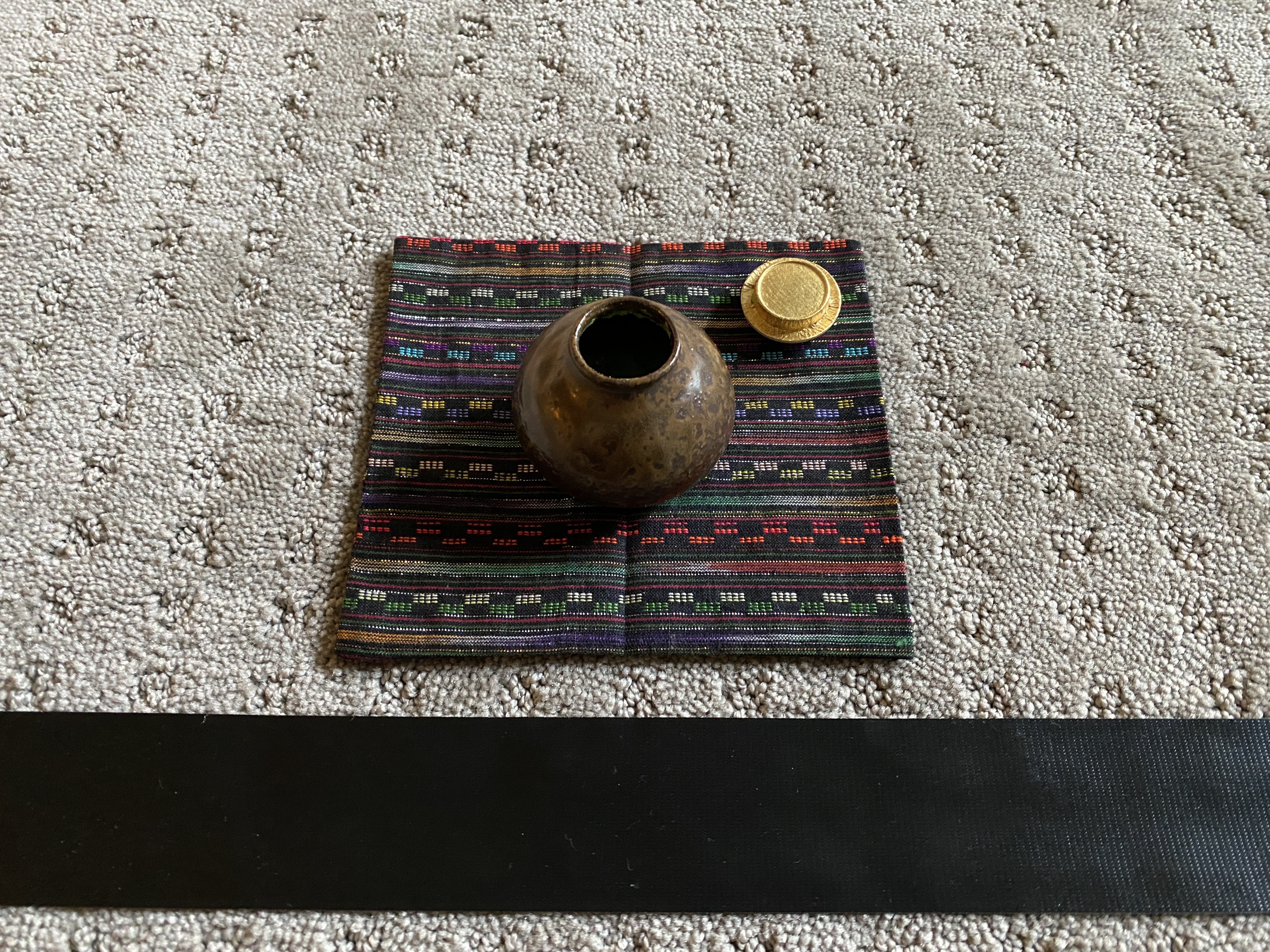
- Then view the chashaku and shifuku as usual.
Scratch Notes
- Honjimae
- The definition of honjimae here is a little odd. Your honjimae is what the setup looks like when you come in with the kensui, ie bowl in karioki and chaire in front of mizusashi. So at the end, your honjimae would also be with the bowl back in karioki, ie centered between the shikiita and your knee line.
- However! Normally when you’re doing haiken, you have the bowl low enough such that the chashaku is tangent to the kinindatami heri. There’s no point in karamono where you pull it though… so what do you do? Very weird!
- The debate ends up being between: do you be consistent with other temae [and put it tangent to the heri] or do be self-consistent with your honjimae [and put it karioki]. No good answer.
- Asking for haiken
- ONLY KARAMONO + GYO NO GYO are split haiken. Everything else (ie bondate), you ask for everything all at once.