POINTO
- If you put the kensui at 9mei away from the wall instead of 5, you have more room to put the chawan at the end and have it be in the correct spot (tangent to the knee line) suzuki
- Wipe chashaku after scooping tea
- Ending sequence:
- Chashaku onto chawan (without wiping)
- Chawan to karioki
- THEN kensui down
- Haiken sequence:
- Turn with chaire to kyakutsuki. Gyo sabaki, place out (hidari-mawari).
- KEEPING gyo sabaki, turn back to imai. Refold gyo sabaki here.
- With newly-folded fukusa, take bon → turn to kyakutsuki → place out (migi-mawari).
- Place everything else out as usual for shikaden, te wo suite.
From Suzuki-sensei, 2023-04-24-CU-Tankokai-20th
(These need to be incorporated once I clean up the rest of this temae).
- In ro, you sit mizusashi shomen, pull the tray forward, turn to imai, then take the chaire.
- This is in contrast to Karamono, where you sit mizusashi shomen, then take the chaire and turn to imai simultaneously.
- Hold the bon deeply when purifying.
- When reaching for the chaire lid and chashaku, you should keep the chaire in-place.
- This is different from what Glenn Sorei Pereira teaches, which is that you may move as needed to keep your arms from crossing uncomfortably.
- When tapping zouge chashaku on a raku bowl, tap at 9’ inside the bowl while supporting with L.
- What is placed kantsuki for haiken stays herisoto during haiken.
- [?] TODO Dario note: this isn’t true! shin no gyo, everything goes kantsuki, but chashaku + shifuku go heriuchi (unless Glenn haiken method is wrong) ➕ 2023-04-25
- For square trays, shifuku goes on the upper-left corner.
- (At least, this is what was done during the seminar, and he didn’t correct it).
On magemono mizusashi:
- When placing the lid down, you should rehold deeply and hold the lip, not just pinch the edge.
On why haiken kiyome is weird:
- You turn from kyakutsuki to imai to purify the bon, because you don’t want to do the same thing in the same position as you did for the (high-ranking) karamono chaire.
- There are no other temae where you need to do two identical fukusa sabaki back-to-back.
- (Mental exercise: think through this. Validated for gyo-sabaki, but what about others? Sou-sabaki in hira-demae?)
- There are no other temae where you need to do two identical fukusa sabaki back-to-back.
- Gyo-sabaki is originally done at kyakutsuki, so you need to do your other one in a different place (imai).
History
Q: History??
Q: How do you ask for haiken? Split ask?
Q: Do you keep the relative kantsuki positioning as you move on the kayoi-datami as kyaku?
Dougu
Note: This is only done in a yojohan or smaller.
Okashi are 3x:
- One high-ranking omogashi (kinton, manju, rakugan)
- One saumono (something cut, ie yokan)
- One mizumono (a fruit, cut on the bottom to avoid rolling about)
For furo:
- Karamono chaire
- This is often a shorter chaire, like a bunrin or a marutsubo, so that everything fits on the bon when walking out at the end.
- From Suzuki-sensei, 2023-04-24-CU-Tankokai-20th
- Chaire should be higher-ranking than karamono, but still usually not meibutsu.
- Bon
- This often comes as a set with the chaire (ie soeta-mono) and is usually either a nice Sotetsu, or a low-ranking karamono.
- No matter the origin, the bon is always treated as wamono (ie migi-mawari).
- However! If the chaire is sitting on the bon, the two pieces are treated as a set, and karamono takes precedence (ie hidari-mawari).
- Unlike daitenmoku, there is no “make contact with L first” rule here. Both hands can touch at the same time.
- There are three main bon used in upper temae:
- Haneda-bon - A square, shin-nuri bon with a cross foot (ie a Jesus cross).
- Matsu-no-ki - A large, wood-stained square bon.
- Wakasa-bon - A bon just like matsu-no-ki, except smaller with a black bottom, green under-bevel, and red top.
- Raku chawan
- From Suzuki-sensei, 2023-04-24-CU-Tankokai-20th
- This is literally the highest-ranking temae in which you’re allowed to use raku, so you should pick something pretty hey sailor.
- Chojiro, etc are good.
- From Suzuki-sensei, 2023-04-24-CU-Tankokai-20th
- Fushi-nashi chashaku
- Because we do modoshibuki, we need a chashaku with no fushi.
- There are two main zouge chashaku types: Rikyu-gata and Imogashira.
- Q: What is the name of the second chashaku type again?
- Note that we do not ask about the maker of the chashaku. Because we do not know the maker, we also do not know the gomei. So, the only thing we ask about is the shape.
- Q: Is this true? Are zouge chashaku “found objects”?
- Shin chasen (ie the usual Urasenke chasen)
- Doburo
- No particular requirement on what kind of doburo.
- Any kind of furo
- Shin-nari kama is ideal, but there’s not hard requirement (ie Rikyu-konomi kama preferred).
- Magemono mizusashi, or seto hitoeguchi with nuributa
- Efugo kensui
- Aodake futaoki
For ro, same as above. Remember that this is only done in yojohan or smaller, so a robuchi with makie would not be used.
Special Characteristics
This temae is about learning how to handle a chaire placed on a bon. It could be considered Karamono+, with modoshibuki borrowed from daitenmoku.
Purifying the bon
- In bondate, we purify the tray twice: once during opening kiyome, and once for haiken, both following the patterns below.
- The opening kiyome is done with shin-sabaki.
- The haiken kiyome is done with gyo-sabaki.
- Just like in daitenmoku, after the last wipe, you come back under the bon and rehold in nigiriconde.
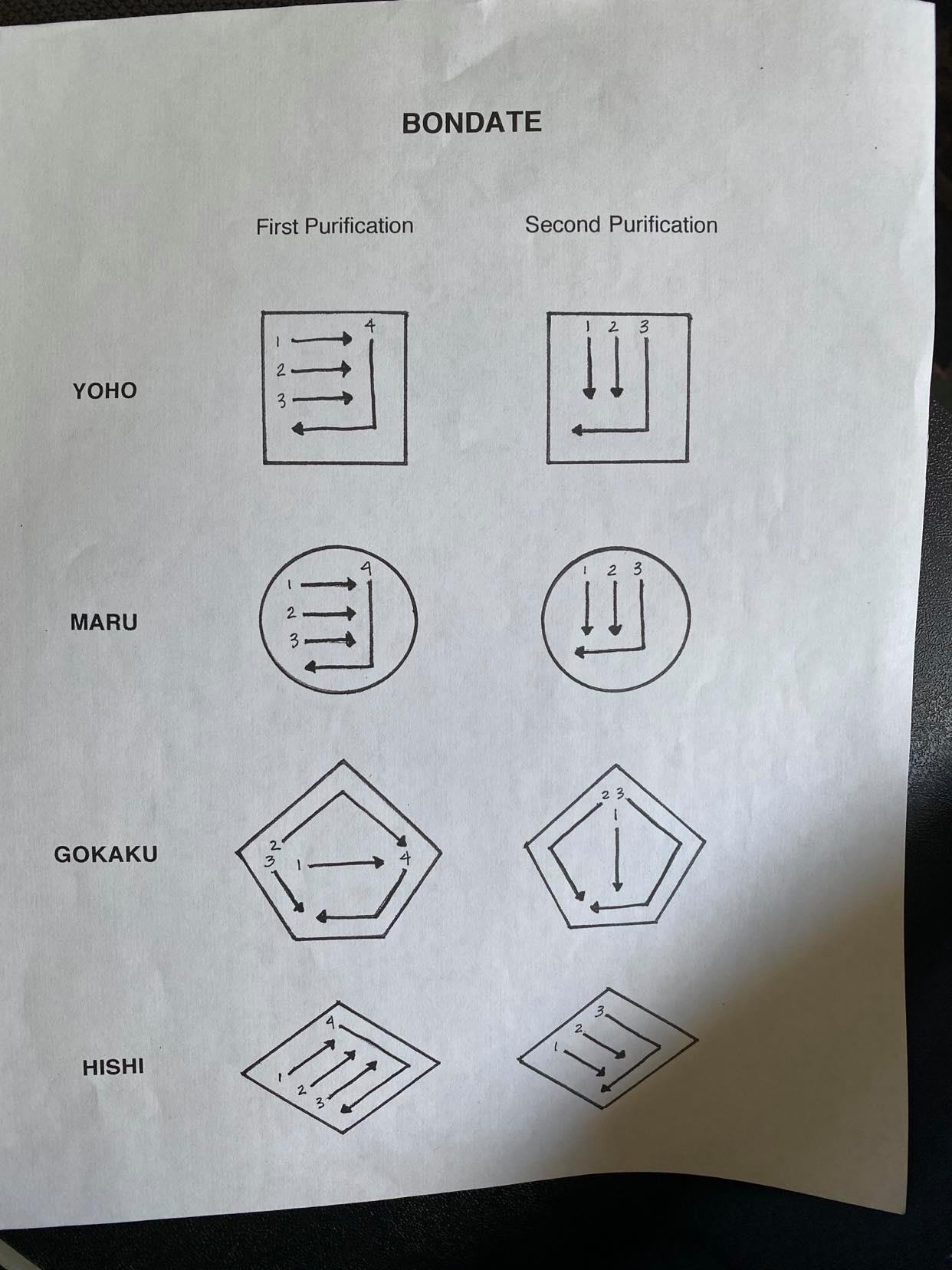
Momite
- Any time you handle the unsheathed chaire, you must momide 「揉み手」 (literally “rubbing one’s hand’s together). If you touch anything else between touching the chaire, ie viewing the bon or touching your kimono before moving the chaire again, you must momide again.
- Momide is done by rubbing your palms together 3x.
- Gunji-sensei described this as “collecting dew from the heavens to purify your hands.”
- Cup your hands together, left hand in the right, and gently rub your hands together.
- (It looks nice to start moving toward the chaire on the third momide, so your hands open as you take the chaire.)
Other notes
- For ro, imai is at sotozumi. Additionally, during haiken kiyome, you are at karamono-no-ichi, ie three mei to the right of center.
Temae (Furo)
Setup
- Kama, furo, and mizusashi are set up as usual.
- Place the chaire and bon kami-ichimai from the front of the mizusashi.
Entrance
- Enter with the chawan as usual, opening and closing with te wo suite, and walk to temaeza, placing the bowl karioki with L.
- Pull the bon forward 3-mei, then bring the chaire to temae with 2H (predominantly R, with L supporting).
- Open the shifuku partially, then place the chaire as-is to himado-mae.
- Pull the knot, then open temae-mukou.
- Instead of lifting into your palm, take the chaire from the top and place tenari to himado-mae.
- While the chaire sits partially-opened, purify the bon.
- First, shin-sabaki, leaving the bon in-place in front of the mizusashi (furo and ro).
- Hold the fukusa nigiriconde, then pick up the bon from the sides. Rehold deeply with L to enable you to wipe with R.
- Wipe according to the diagram earlier.
- Rehold the fukusa nigiriconde, and holding the sides of the bon, return it to kami-ichimai from the mizusashi.
- Take the chaire from the top (2H supporting) and place in your palm. Finish opening as usual, placing the chaire centered at temae.
- Shin-sabaki, and purify the chaire as with karamono, returning the chaire to the bon on completion.
- Bring the chawan to center from karioki, L → R.
- Shittai, and leave the room.
- Turn, don’t back out. That is reserved for higher temae.
- Return with the kensui, sitting low and placing the kensui above as usual.
- The hishaku go should be such that it aligns with your usual knee-line position.
- Shikko, then open the hishaku/futaoki as usual with a sorei.
Kiyome
- (At this point, the chaire and bon are purified, and the chawan is centered in front of you.)
- Purify the chashaku, and place on the bon.
- Sou-sabaki, and purify as usual.
- Push-pull-pull, then refold and wipe one last time.
- Rehold the fukusa nigiriconde, then rehold the chashaku by pinching the sides.
- Place on the bon to the left of the chaire.
- Place the chasen out kensui-no-migi-kata, then wipe and place the chakin on the lid.
- Take care to avoid the chaire and bon.
- Do chasentoshi and wipe with chakin as usual for wamono, lifting 2x.
Making tea
- Momide 3x and take the chaire with R. Transfer into L palm, then open the lid and place on the center of the bon.
- Take the chashaku and scoop tea sukuidashi.
- Usually, you take the chashaku from the bon from the sides. However! To scoop tea, you take from the top and bottom.
- Leave the chashaku on the chawan as usual, then close the chaire and return to the bon.
- Zig-zag, then re-purify the chashaku.
- A note on the zig-zag: if the raku-chawan is too fragile to tap the rim, instead tap the inside of the bowl at 3 o’clock, with the chashaku pointing straight down.
- Sou-sabaki, then wipe as usual, then push-pull-pull.
- Pom-pom, then wipe one last time without refolding.
- Rehold the fukusa nigiriconde, then rehold the chashaku and place on the bon by pinching the sides.
- Return the fukusa (koshi or tatami), then open the mizusashi lid.
- Make tea as usual, placing out to the usual position (not kantsuki).
Drinking tea
- Guests drink as usual, and questions/adding water/etc all follow the usual hakobi koicha pattern.
Shimai
- Bring the bowl back to temae, then sorei. Pause for questions.
- Add hot water, empty, and ichiyo oshimai-itashimasu.
- Add cold water and chasentoshi 2x, returning to kensui-no-kata on completion.
- No abbreviations!
- Also no re-wiping the bowl though.
- Place the chakin, chasen in the bowl.
- Take the chashaku (pinching by the sides), and place immediately onto the bowl.
- This is a 3H rehold, ie pinch, assist, pinch again from the bottom.
- Move the bowl to karioki with R → L. Then, while L is there, pull the kensui down.
- Add cold water, and close the kensui.
Haiken
- Guest asks, Douzo o-chaire, o-bon, o-chashaku, o-shifuku no haiken wo.
- No warigoe; that is only for Karamono and Gyo no Gyo.
- Close the hishaku and futaoki as usual.
- Momide 3x, then take the chaire and turn to kyakutsuki, holding with 2H.
- Kiyome as usual for karamono in gyo-sabaki, placing out to kantsuki.
- With your fukusa still folded in your left hand, turn back to imai. Refold your fukusa in gyo-sabaki, then hold nigiriconde and take the bon from both sides. Turn back to kyakutsuki.
- Wipe the bon in the air as described in the diagrams above. Turn the bon migi-mawari and place out (not kantsuki). Return your fukusa to your obi.
- Place everything else back out as usual, remembering to te wo suite on placement.
- Leave as usual, then return and answer questions.
- Leave with the dougu and silently bow at the door (ie usual for hakobi koicha). To take the dougu:
- Momide 3x, then place the chaire on the bon.
- Bring chaire + bon heriuchi.
- Place the chashaku on the bon, to the left of the chaire.
- Place the shifuku on the bon.
- Shifuku placement can change depending on the size and shape of the bon. For a square bon, the shifuku is placed in the upper left corner. For a maru bon, who knows. We (Glenn) did front!
- With the left hand holding deeply, and the right hand holding the chaire, exit the room.
- The whole set may remain as-is at the sadoguchi, without splitting the dougu apart.
Temae (Ro)
Kyaku Notes
Drinking
- Nothing special here, just usual koicha.
Haiken
- Kyaku must wait until the host stands with the chawan to take the dougu.
- To scoot with the dougu:
- First, momide 3x and place the chaire on the bon.
- Then, move everything as usual.
- Q: Do you keep the relative kantsuki positioning as you move?
- Once back to your spot, leave the bon + chaire herisoto (still together), and the chashaku + shifuku heriuchi.
- To view the dougu:
- Bring the chaire + bon to the center (herisoto), and do the initial viewing.
- Open your kobukusa to the right of the bon.
- Momide 3x, then view the chaire. Use the center of the kobukusa to temporarily place the lid. Some things to note:
- You mustn’t touch anything other than the chaire and lid after doing momide. This includes the floor as well as your kimono, your kobukusa, the bon, etc.
- In the words of Iwama-sensei, always enter and exit through the front door of both the kobukusa and the bon. Don’t be a thief!
- There is no need to view the chaire over the bon. You may leave your elbows on your knees and view as usual for any chaire, ie wherever your body is comfortable.
- Place the chaire (lid closed) on the kobukusa, and view the bon, following usual rules to not show the bottom to the other guests.
- When flipping over to view the bottom, try to keep one hand underneath the bon at all times. Specifically, keep your supporting hand underneath the bon, rather than on top. This is a tad bit safer.
- Momide 3x again (you’ve touched something!), then return the chaire to the bon.
- Close your kobukusa, view the whole thing, then pass it along.
- To return with the dougu:
- Tsume deai’s with the shokyaku as usual, placing the dougu in front of the shokyaku.
- However! When turning the bon + chaire (they’re still together), you turn it hidari-mawari. They’re still a set, and the chaire status takes precendence.
- The shokyaku returns the [bon + chaire], chashaku, and shifuku to their spots, still turning the bon hidari-mawari.
- Then finally, the shokyaku momide’s 3x and takes the chaire off the bon, up to its place at kantsuki.
- Tsume deai’s with the shokyaku as usual, placing the dougu in front of the shokyaku.
Scratch Notes
Okeiko Records
TABLE WITHOUT ID
	link(file.link, dateformat(date, "MMMM dd, yyyy")) as Date, TemaeD as Dario, TemaeK as Kristina, Paid as Paid
FROM "Tea/Glenn Okeiko Log"
WHERE type = "okeiko_log" AND (contains(TemaeD, "Bondate") OR contains(TemaeK, "Bondate"))
SORT date desc