Common Points
Applicable for Chasen Kazari, Chawan Kazari, Chashaku Kazari, Chaire Kazari.
- Chasen-sento
- Sotozumi
- Chawan handled with 2h equally.
- Note: CQ says 1h with 1h support, white books say 2h equal. I prefer 2h equal.
Mizusashi kazari (is there a name for this?)
- Setup
- Chasen on chakin on mizusashi nuributa
- Chashaku on R of lid
- Chaire in shifuku in bowl
- Items comes down from mizusashi exactly when you would otherwise take it for hirademae.
See Shoiri Setup for tokonoma details.
Link to original
From glenn
- When taking out the chaki at the very beginning, treat it like chabako. L is supporting the bowl when you take out the chaki, and L+R come away at the same time.
- We held it up and inside the knee line when turning, rather than down on the floor when going out to kyakutsuki for haiken.
- When moving bowl at very beginning, “I have a tendency to just support” ie 1h with support instead of full equal 2h
CQ Notes
Background
The chaire is displayed on an open fukusa in the tokonoma. It is wrapped in its shifuku, not in a gomotsubukuro, and the fukusa is purple (although it’s acceptable to be a different color, per CQ). This arrangement is usually one-third off-center (not actually centered).
Note: It’s better to use a rakujawan for this than chawan which require kobukusa, as your kobukusa will be occupied. If you choose something else, you must bring two kobukusa.
Another fun CQ note! This temae may be done as well with an exceptionally distinguished natsume, using for koicha. Natsume handling is done the same way as Otsubukuro.
Temae pointo
Temae overall:
- Chaire is handled with 1h! Not 2h!
- Only exceptions are at shimai and haiken.
- As with other kazarimono,
Moving the chawan:
- Pick up L, place down R, with other hand supporting (not 2h completely).
- This is the same as Chawan Kazari.
Kobukusa usage:
- Comes out after removing shifuku, but before starting yoho sabaki.
- Kobukusa goes to where chaire would usually go, along the diagonal from ro corner to mizusashi.
- Chasen goes R of kobukusa as if the kobukusa wasn’t there. (Position is relative to the chaire).
Chashaku is as usual for hirademae. It goes on the lid, not on the kobukusa. (This is distinct from Wakin, Bondate, etc.)
Shimai, haiken
Moving the chaire back to honjimai, it stays on the kobukusa and moves with 2h. Thumbs on the shoulder of the chaire.
Then, for haiken, it is moved to kyakutsuki in the same manner.
- Originally, I was taught to keep the chaire very low to the ground while turning.
- However, Glenn teaches that it should be secure, which would be inside your knee line.
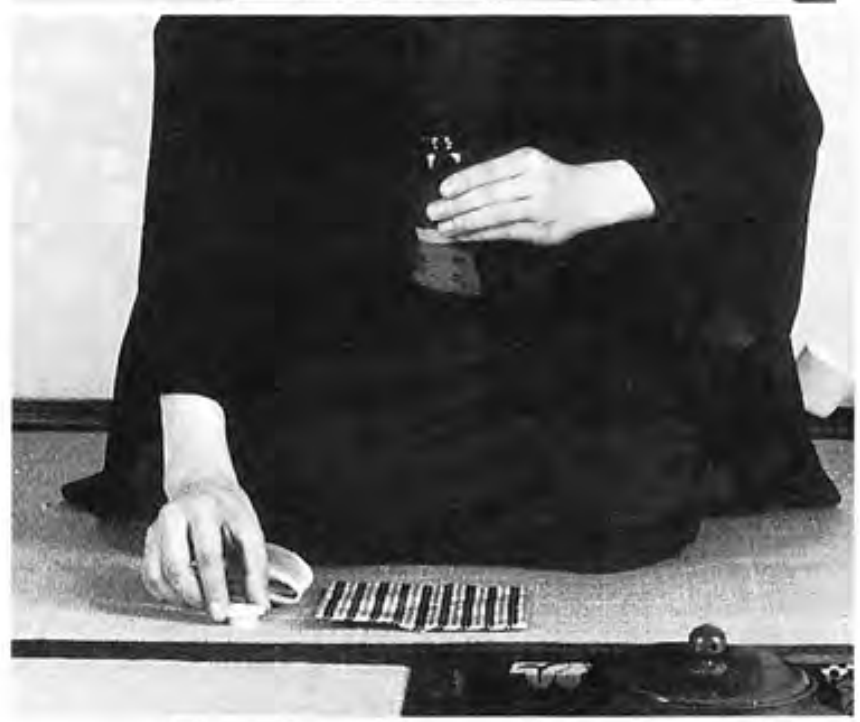
Chaire kiyome on the kobukusa:
- No yoho-sabaki. It’s Konarai after all.
- Fukusa and lid both go to R of kobukusa, with lid above fukusa. See photo.
- After kiyome:
- Fukusa goes down.
- Chaire is turned migi-mawari, placed out. (Book says to spin, Glenn says to pick up and turn).
- Equal 2h on shoulders, place chaire and kobukusa out. Not kantsuki.
- Fukusa to obi. (This is opposite from Wakin, where you koshi fukusa first before turning the wakin).
- Chashaku, shifuku go out as usual for hira-demae.
Guest manner
Haiken
Chaire comes heriuchi (while still on the kobukusa), same as in hira-demae.
To view the chaire:
- Chaire stays on kobukusa. Lid goes onto tatami, R of kobukusa.
- Kobukusa is not viewed.
Asking questions:
Link to original
- Chaire is go-yuissho wa.
- Kobukusa is not asked about.
To leave the room:
- Take chashaku + shifuku as usual for hira-demae.
- Chaire to heriuchi. Close fukusa, kaichuu.
- Take chaire in R, then exit as usual for hira-demae.
History
Dougu
Special Characteristics
Temae (Furo)
Temae (Ro)
Kyaku Notes
Okeiko Records
TABLE WITHOUT ID
	link(file.link, dateformat(date, "MMMM dd, yyyy")) as Date, TemaeD as Dario, TemaeK as Kristina, Paid as Paid
FROM "Tea/Personal Okeiko Log"
WHERE type = "okeiko_log" AND (contains(TemaeD, this.file.name) OR contains(TemaeK, this.file.name))
SORT date desc