Glenn-sensei arai-jakin notes
- Picking up hishaku at beginning, same way as at end for haiken when you palm the hishaku and flip, do the reverse to get it into kamae. Pick up, turn to you, rest on R middle finger, turn L, kamae.
- Futaoki should be parallel to hishaku in kamae
- Karioki chawan position is centered at 8 mei.
- Haiken karioki, chashaku is tangent to the top of the heri, ie one go between the top of the hishaku and the bottom of the chashaku
- Always sit with TOES together (not necessarily heels)
- Araijakin, top of chakin should be straight. Your thumb needs to go at 3pm, so you need to make room.
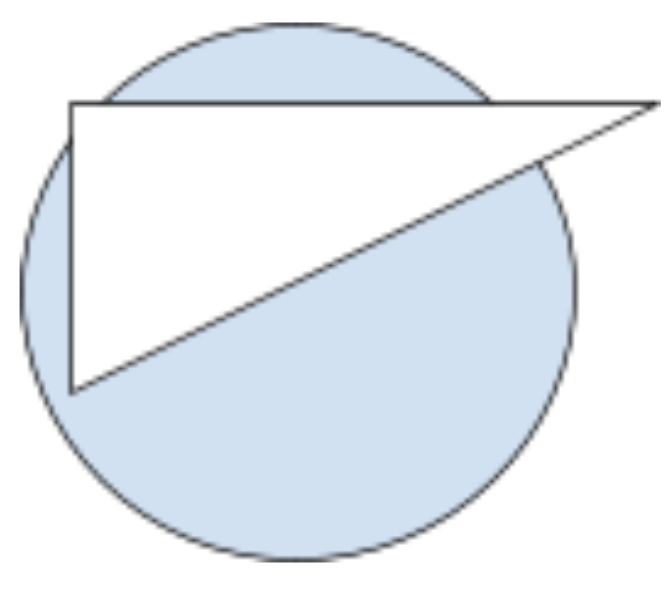
- Handling usuchaki, THUMB should be on the shomen. Forces you to keep your kamae circle. Same as with lid.
- 16 mei from heri, but you sit at 18 mei, ie at the tatami junction.
- Don’t pull L elbow back in fukusa sabaki. Just go straight down.
- Hirajawan, hold deep and pull up a bit before chakin mawashi. Better control + don’t have tail flopping around.
- Why do we do のの字? To correct the thumb position (ie to be able to kamaeru, not necessarily to get the thumb to knot).
- L on top of hirajawan, not side (tateru toki)
- Scooping water, go in with your hand palm facing donw, ie opening of go is pointing straight down. Hishaku should never enter the water horizontally.
- Ukibishishaku (arrow thing), R thumb should be parallel to floor.
- Cold water pickup, keep the bottom of the hishaku horizontal! Don’t let the handle wiggle!
- Note, hishaku length from tip to end of go is distance from kama center to mizusashi center
- At end of whisking, go back to 12pm←>6pm instead of parentheses. Parentheses is for koicha.
- Looking at the lid of natsume for haiken, turn to R instead of up. Don’t break your wrist.
- UNRELATED: If you have kaejawan, you may need to leave futaoki and hishaku in the room somehow (because you’re only allowed to enter/leave three times). Futaoki+hishaku goes to left of shikiita. Pick up hishaku, kamaeru, give to R (like daisu shakutate). Move futaoki with L. Palm bottom of hishaku with L, place (kinda like LH place for ryurei)
Chaji notes
- Ask about everything. Just not during sumi handling
- Chidori conversation
- T) Shall we share sake?
- S) Yes! Do you have another sakazuke?
- T) No :(
- S) Let’s use mine!
- Rice and soup, always pick up hashi first
Mukogiri
Reviewed
- Chasen straight on from mizusashi
- Everything massugu (kama lid especially)
- Try not to put things on the heri when putting out for kyaku
Oiemoto lecture - 1-24-2019
*** Don’t fall asleep ***
- If you are sick, you should request an individual bowl of koicha. Normally that’s dame, but it’s okay! No one wants to catch the flu!
- Moreover, don’t sit shokyaku if you have a cold. Be brave. Don’t try to tough it out - it’s not just your body. “Don’t be self-centered.”
- Scolding somebody for coming to a tea and sitting first is not good though. Scolding won’t fix their cold. Be kind.
- Music: 和, there are lots of different kinds of music. Everyone has their favorites, not just the hits. Also, lots of notes, not just monotone.
- [He also wrote the zengo 一枝梅花和雪香]
- He likes green peppers and tomatoes. Well, he doesn’t dislike them.
- “I like things that are rather smelly. […] I used to drink a lot of sake, but now I don’t for my health.”
- Just as well as liking something, disliking something is itself a connection.
- There are lots of jigsaw puzzles. What kind of piece are you? You don’t have to be every piece.
- 赤心, 「せきしん」= newborn’s heart, pure heart
- Kotoba の gasshou = putting your hands together in prayer before your heart
- In the tea room, don’t treat people in a way you wouldn’t want to be treated. Don’t judge other people for their skills or appearances.
- Take care of your own waste at restaurants.
Temae notes (Suzuki)
- Shin nari gama is the “standard” kama shape with the hane (wings).
- If kama is arare (hailstone), during gozumi, dab instead of wipe with chakin
- Oimatsu chaki → hiranatsume style, kiyome is vertical (top to bottom), R then L. Don’t use thumb to open.
- Honjimae in furo = sotozumi in ro. Does not depend on room size → depends on the formality of temae.
- My additional note: the only times you’re allowed to do nakajimae are for the seven “basic” temae that have the basic junban. That is, usu/koi hakobi, usu/koi tana, nagao, ootsubukuro, tsutsumibukusa
- Another note while I remember, ootsubukuro and tsutsumibukusa are extremely wabi and should never be used with a tana (come directly from rikyu, also using not a chaire/using not a shifuku makes it wabi). Nagao, on the other hand, is originally how all karamono chaire used to be. Definitely not wabi.
- It’s okay to clear the sumi first in gozumi, then stack (ie push everything to the side).
- Haiken, don’t need to avoid natsume with chashaku. For example, you often see people make a wide arc with the chashaku around the natsume when placing the dougu heriuchi. Don’t do that. Just lift with your heart — the arc is a byproduct of moving with your whole body.
- Tsutsumibukusa, don’t let the fukusa dangle. Lift it and put in palm.
- Tsutsumi, after setting down chaki, middle finger should be on the mountain. Rest should be valley.
- Ootsubukuro for ro, pull off bag, leave on left hand, fold top down, rehold in R with thumb and index finger, pick up with left hand like normal and place.
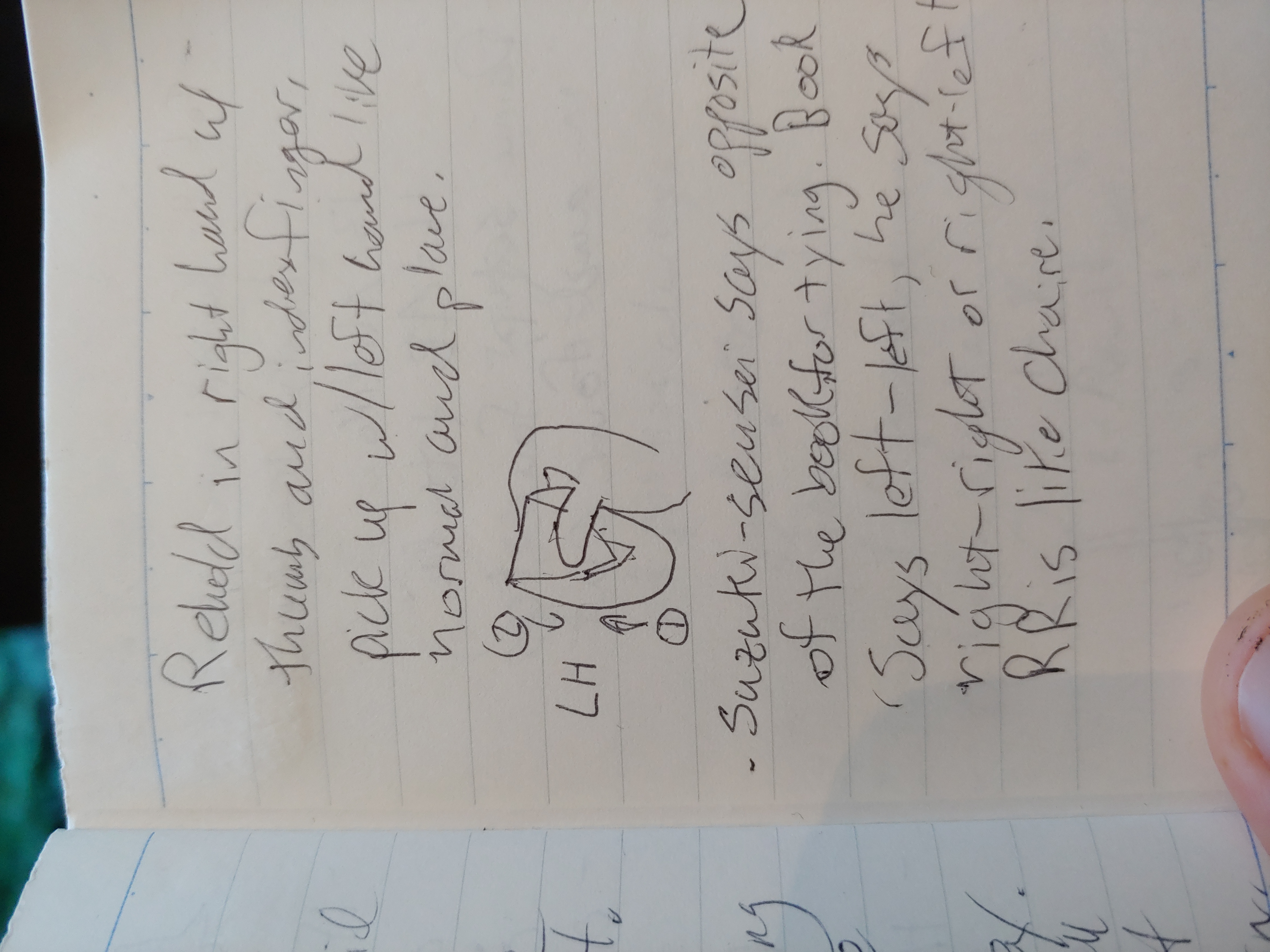
- Suzuki-sensei says opposite of the book for tying. Book says left-left, he says right-right or right-left. RR is like chaire.
- My note: do it like chaire. First one, R goes over L. This means after your first tie, you have ears upper-left and lower-right. Then fold L ear to R, and tie around L with R. This should result in a straight knot.
Gyakugatte (Suzuki)
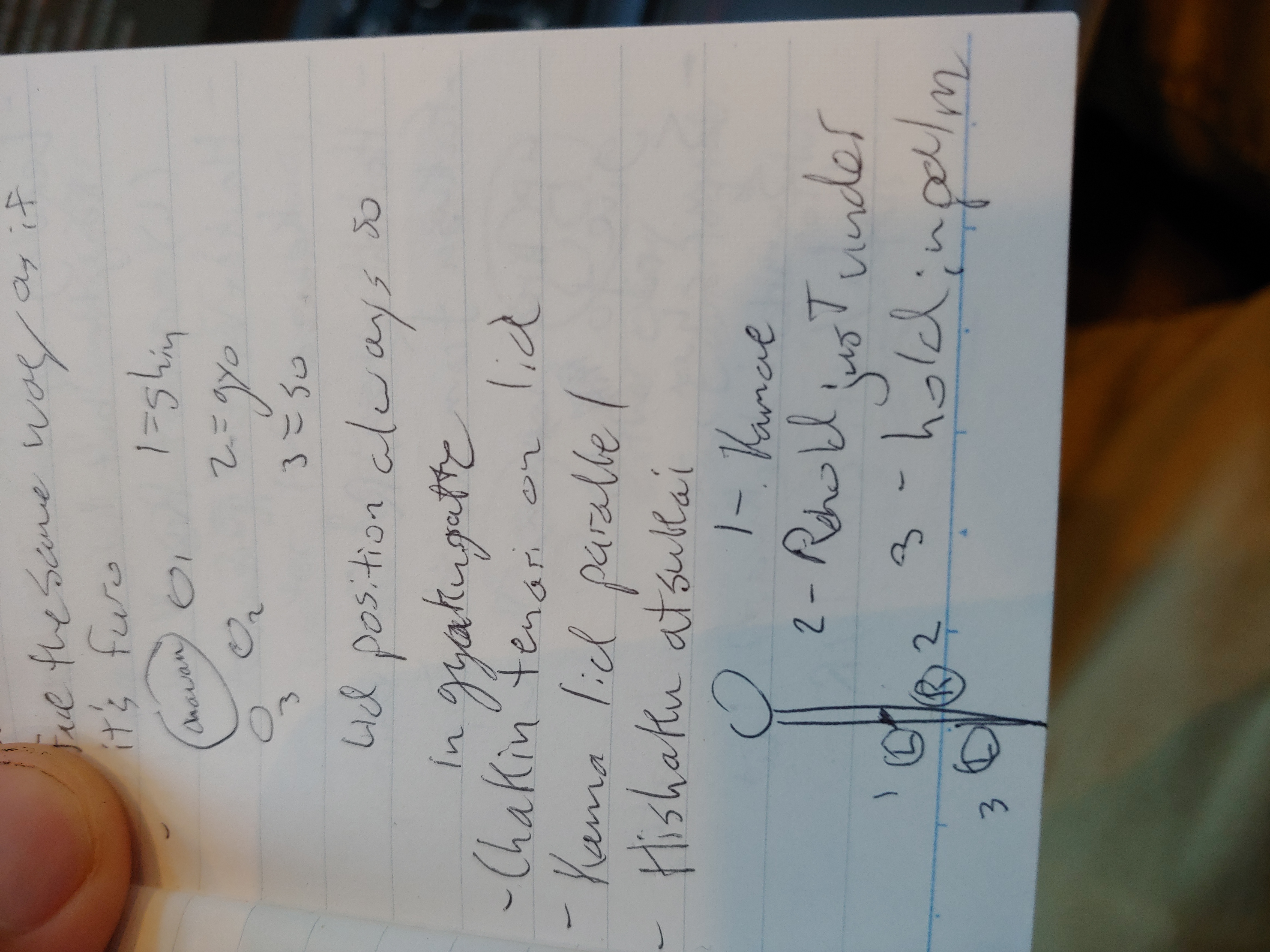
- Kama kao should always face the same way as if it’s furo.
- Relative to chawan position, 3pm is shin, 4:30pm is gyo, 6pm is so. Lid position in gyakugatte is always so.
- Chakin tenari on lid.
- Kama lid should be parallel to your body.
- Hishaku atsukai
- Fukusa sabaki is over R knee
- Leaving with kensui, hold like hongatte (in L), but hide kensui against the R wall. Slowly straighten your arm as you turn to keep kensui hidden as you turn.
- Haiken initial placement is kamiza-order, not R→L order.
- Haiken return placement is R→ order, not kamiza-order.
- Fukusa from waist, flip up like women’s way, then give to L.
- Sumi when placed into the rochuu is same as hongatte. The sumitori is backwards, but kuda/wari are still L/R.
- Always pick up hishaku with R from kama.
- Always handle futaoki with R (unless you’re by the door at the end of temae)
- Nakadachi, 3 hand futaoki.
- Always alternate R and L emptying kensui with gyakugatte. ie If you have one guest, you do chasentoshi water (L), pre-oshimai (R), oshimai chasentoshi water (L). Two guests, L R L R. Etc. Don’t know why we do this other than to make it different from hongatte.
- Sotozumi always.
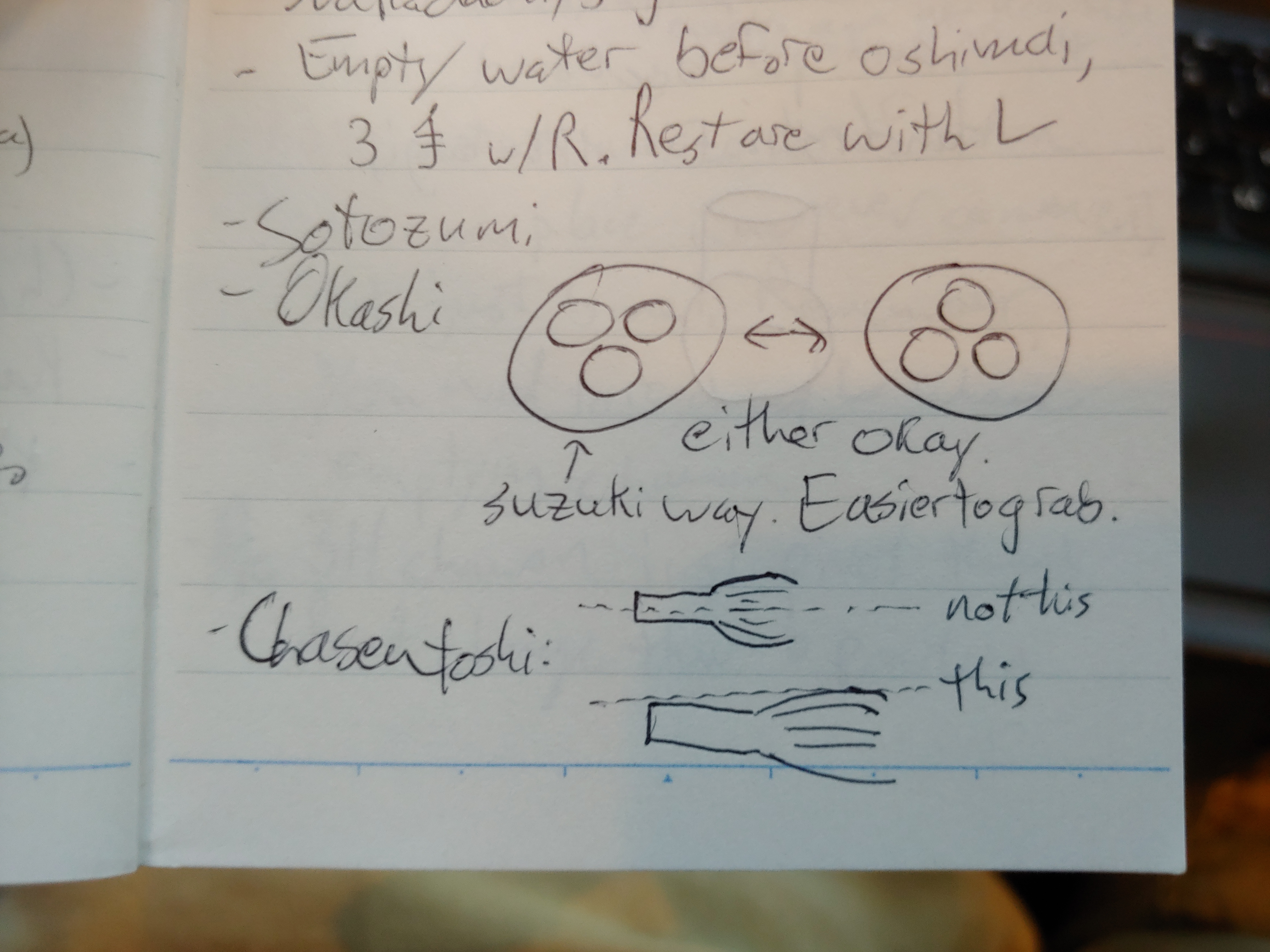
- Okashi placement, if you have 3 pieces, the suzuki sensei way is to put one forward and two back. But two forward and one back is also okay.
- Chasentoshi, when the chasen is in the air, it shouldn’t be perfectly level (ie center of the handle to center of the tines). The tangent line of the top of the handle to the top of the tines should be parallel to the ground.
- Sugitana:
- RH only immediately as needed, 1H push and pull.
- If you have a natsume, hold it in LH palm while moving board.
- Mizutsugi, mizusashi is handashi.
Dairo koicha, Suzuki
- For dairo, set up sumi in the ro when doing koicha (ie how you would have it in a chaji setting)
- Chaire, tie very tight, then make the top knot loose.
- Dairo, aim at the inner corner of the rodan. You can also aim at kantsuki if it’s really difficult.
- Kensui can be wherever, doesn’t have to just be 5 mei from the tatami border like normal. Remember, you need to be able to reach with L when emptying the chawan.
- When doing 3h chawan atsukai, just pivot the thumb. Don’t change the thumb position.
- Lifting the chaire into L from R, pick up from the side underneath the cord.
- NOTE: Chaire knot should be fluffy. Rear knot should be perky (but not vertical)
- Yoho sabaki, arm position should be kamae (maru) with your whole trunk rotated, not just your arms rotated.
- Putting fukusa on belt doesn’t need to be pretty. Don’t fuss. Just worry about the final time (ie when you’re standing, bc guests will see).
- Remember, start elbow at side then pour with elbow (hishaku)
- Dairo is nezumi-iro because it’s wabi
- Metal versus ceramic for dairo sumi, literally zero preference. Dochi demo ii. However, ceramic is much harder to scoop soooo… [suzuki sensei’s preference is metal]
- Fill the corner a bit with shimeshibai to assist wari/marukuda to stand properly.
- Kuromoji on fuchidaka, if you have 3+ guests, bottom ones should be staggered so the ones closer to the guest are to the right. All in one line indicates that they’re chopsticks, and that you should use them to take the sweet [but not keep them for your own use].
Random
- Suisen - in february, leaves stop growing, but the flower keeps growing. So the flower should be taller than the leaves.
- 日の出や is the oft-recommended kimonoyasan. Go here some day.
Glenn-sensei notes
- During okeiko, have koicha guests eat their sweet during the junbi so they get a chaji feeling and the actual proper timing to bring the fuchidaka to the door.
- Kensui initial placement, hishaku cup just below the kneeline, against the thigh (ish).
- Kirishaku (arrow), thumb should be parallel to ground
- Always kama first in seki-iri
- Don’t cross the corner of fumikomi when walking in a yojohan. Cross the center of the fumikomi.
- 3.75g/person for koicha, 1.75-2g for usucha (but ofc preference によって違う)
- Chakin on lid should not touch the tsumami (摘み) if at all possible.
- Chashaku gomei should always be zengo for koicha and seasonal for usucha (I think)
Hakobi-usucha (Sugitani)
- Hishaku pouring from elbow, be more natural. Don’t snap elbow to side. Straight from kama to pouring.
Suzuki-sensei
Sumidemae
- Shitabi should be straight up, not tented (for RO). There should be some space between shitabi, not touching.
- Sumi is placed from largest to smallest.
- Main sumi should be tented. Tops should all touch each other, but bottoms should be wider to allow airflow.
- Note: Every sumi should touch the next.
Warigeiko
- My elbows for kamae tend to be a bit too wide.
- Left hand fukusa sabaki, keep straight!
- Tips of fukusa when finished should be in line with fukusa, not diagonal.
- Length of fukusa tips should change depending on how you are folding (natsume vs chashaku)
- Cleaning natsume, you don’t even have to touch it. So don’t worry about the angle etc. Just do it spiritually
- RH straight forward when putting palm on natsume. Then turn to have straight wrist.
- Don’t bend wrist in chakin wiping.
- Good phrase for koicha nakadachi aisatsu: “taihen kekkona nerikagen”, ie “it was well-kneaded” instead of “you bought expensive tea.”
- With ceramic futaoki, don’t make a sound at the beginning with hishaku.
Suzuki-sensei, kinin
Kiyotsugu Koicha
- Relative to the kinin, tomo always stands and sits on left tatami. All dougu atsukai is done on right tatami. This is in contrast to kinindate, where hanto does everything on the right tatami.
- Tomo swaps chawan when getting the tomo chawan (ie they’ve already haikened the bowl. So they can bring the first bowl when they go to get theirs.)
- TODO doublecheck this meaning - “(Both) Drink koicha, set to left, aisatsu, THEN wipe”
Suzuki-sensei, yuki chabako
- Marudatami, walk in naturally (ie first step diagonal). Leaving is 5 steps walking backwards (1, 2, turn, line, cross) straight from imai, not breaking the plane
- Note from me, this is only the case if it’s koma or komazue.
- Daime shikiita is 4 sun, koma is 6 sun.
- Picking up chawan + shifuku after initial untying, don’t put the loop on top of the chawan. That is nagao specific. Just keep holding the loop nigiriconde.
- When you’re retying katatombo, pull the knot so the left side doesn’t have any excess! Leaving it because it gets caught is a bad excuse! You need to do this in higher temae too. Just do it.
- Holding shifuku, left hand supports chawan whole way down.
- Natsume, untie and place in left hand. Open first knot. Then, RH index + thumb, pull the knot back while the middle and ring finger hold the fabric down.
- Chashaku shifuku, natural. Don’t fold top down then do bottom. Both at the same time.
- Lid placement should be center (horizontally) between heri and shikiita.
- Natsume placement on the lid, first it is center, then after you kiyome you bias it to the left to make room.
- Chakin in tsutsu should be shibori’d, ie have a spiral look to it. It should also be rather tight.
- Ears LEFT. Take out of tsutsu naturally. Hana is the exception (ears right), and that’s because of the rim.
- Haiken, turning kyakutsuki with kakego, fukusa nigiriconde should be as if you just wiped chashaku. This is more natural → if you place on your palm and close your hand, this is the shape it takes.
- If there is a heri in the way for dougu positioning, you must obey it. So it ends up awkwardly kamiza (if you’re in koma/komazue). Same for your seating at the end — you must sit in front of the dougu to have the haiken conversation, but that will have you ending up sitting very high in the temaeza. Daijoubu.
- Tying chawan shifuku, always left folds over and right ties. This is a general shifuku rule.
- Don’t ponpon the fukusa after wiping chashaku. This is done in the mizuya (it’s in your kimono, remember)
- Ivory, always tap inner left of the bowl (not the rim).
- CHASEN, CHAKIN, KARA NO FUKURO
- Guests only need to open a small square (fukusa) for natsume and chashaku haiken.
Shikishidate (Suzuki)
- Knot, start with L side down. Then double up L, fold up, tie around L with R.
- Additionally, bunkou musubi dekiru. Look up later.
- Chakinbako, place bottom half turned 90 degrees.
- Chakin, fold like normal, turn right, fold right under, then smash into box.
- Chakin refold, start by holding nigiriconde. It should be correct-side facing up, just turned to the right (ie fukudame is at East instead of at North). Turn from top to bottom so the fukudame is still on the right, but now it is facing up. Grab the two easiest corners to take. This should become a big rectangle, not the two triangles. That’s only for shibori — this is tatami.
- Chakin kobukusa is normally kinran. Chawan two are the same donsu. Middle is purple fukusa fabric.
- Chashaku, can atsukai 3h when moving usuki kobukusa if needed.
- Ootsubukuro, fold ears into bag, not down like with natsume.
- Kobukusa are open when doing furidashi at beginning because it mimics the end when you do need it.
- Haiken, guests put chakinbako on the lid to move. Then during haiken:
- View all
- Open fukusa
- View chakinbako
- View box lid
- View everything else
- Taterutoki, LH is on chawan as if it is on a hard surface. Kobukusa counts.
- OYU CHAKIN. SIMPLE. OYU CHAKIN. OYU CHAKIN.
- Chakinbako lid, open close like a japanese book. 1H flip in-air atsukai.
Hamana sensei
- Chashaku kazari, in tokonoma it is on fukusa folded in half (with wasa originally on right)
- Chaire, never tie the knot in yasumi musubi. That’s only done in mizuya.
Suzuki sensei - Tsuki chabako
- Kakego needs to be open to take the kogo because in old times, kinuta kogo (tall) used to live IN the box.
- Kobun moku 「好文木」 → in kodo, uguisu is used but it’s a straight needle instead of bent like a paperclip. Paper is poked on like orders at a restaurant. This looks like a tree, and uguisu is attracted to plum, hence why the pokey thing is called uguisu.
- Lid of the box should line up with the last board of kizue.
- Kizue to start, knot should be on the underside and right.
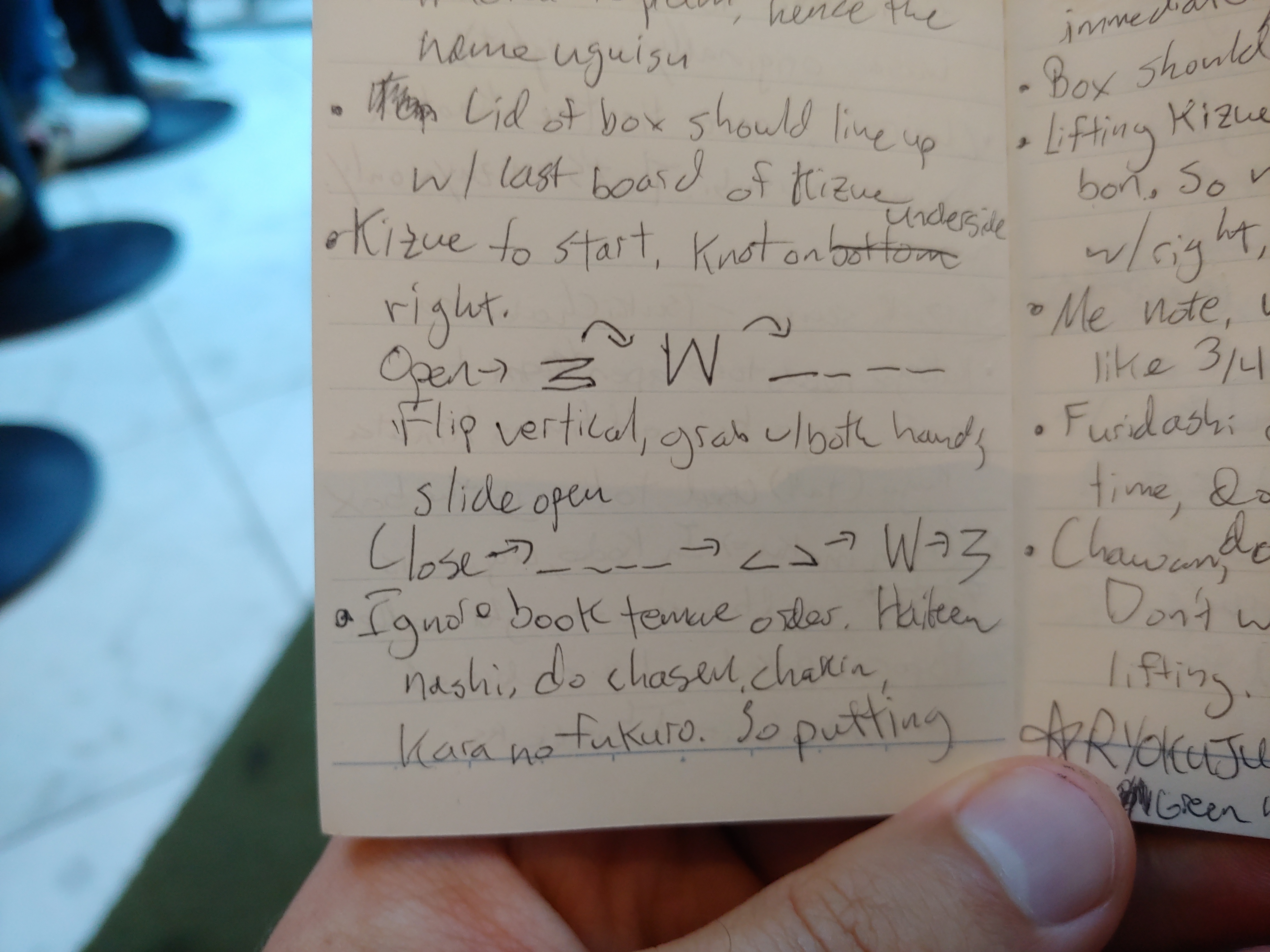
- Ignore book temae order. Haiken nashi, do chasen, chakin, kara no fukuro. So putting things away, pull box, then immediately put tsutsu away.
- Box should line up with kizue.
- Lifting kizue to wipe, treat like bon. So nigiriconde hane, support with R, lift with L.
- Personal note, uguisu looks to 1/4 down from top of kizue
- Furidashi can come back any time, don’t sit and wait for it
- Chawan, don’t treat like nagao. Don’t wrap cord on bowl when lifting. Just nigiriconde.
- Ryokujuuan 「緑寿庵」, best compeito shop. Suzuki sensei likes watermelon, soda, ichigo.
Iwama-sensei, Daisu
- Daisu should be higher things (like sometsuke, seiji). Seto is only for gyou no gyou, and that only works because the rest of the dougu is so high.
- Hibashi in shakutate should face teishu, then on the ground they should face kyaku (if they have a face)
- Starting from the lower R corner and working clockwise, the bottom-most fushi should go from lowest to tallest. That is if you don’t have the proper 3322 legs. If you do, 3 goes UL and LR. If you only have one 3-fushi pole, that goes to back left.
- Kama no futa should be such that it lines up with the edge of the daisu (so futaoki comes forward from the original kensui position)
- If you have shin nuri daisu, use rikyu chuu natsume.
- There are no real kama classifications. Shin nari is shin, yoho and onigiri are so. Rest are gyo.
- Rikyu take daisu is smaller than joo daisu. Not a ro/furo thing.
- Should always be odd # of mei on kyaku side if daisu doesn’t go from edge to edge.
Chakai notes, Iwama
- She prefers not to turn the bowl until you sit. Don’t be hurry.
- I disagree but w/e
- Walk fast but not noisily.
- Don’t do 3 out, 3 back for hakobi. More nagare. Constant flow of people instead of a big wave in and out.
- Taking sweets, shokyaku should take the lower-most sweet because they’re already in the highest position. Better to balance low with high than do high-high. People after should do 円流「えんりゅう」, ie make it beautiful and balanced.
- Order of higashi to take, start with higher-ranking one.
Toyama san
- みえかくり, to see and be hidden, the way you walk through a japanese garden. 見え隠り?
- Urasenke, the washi on shoji are centered in the middle of the blocks. Omote, the seam is random depending on the length of the washi.