- [n] TODO This should be split out into different notes, one per “section”. Multiple teachers opining on a single section. ➕ 2023-05-03
From iwama
Chashaku kiyome
Unlike Suzuki-sensei’s way, Iwama-sensei prefers the tips in the middle of the fukusa. Tips then get trapped in your palm, and when doing chashaku kiyome, you make a “tube” with your fukusa which the chashaku slides through. This is unlike Suzuki-sensei’s, which is flatter (like a piece of paper being folded in half around the chashaku).
From suzuki
Kamae
In his words:
Often, I hear people say to pretend to hold something like taiko drum. But doing that would pull your shoulders forward! This is not the way!
His recommendation:
- Start from your shoulder blades (literally exactly what I do for lifting).
- Arm position will follow.
Kensui and hishaku
When placing down kensui at beginning:
- Kensui should be right up against your body. Literally almost touching.
- This is the easiest position to take the futaoki from.
When taking hishaku from kensui at beginning:
- Pinch from the sides (at fushi?), then lift until the handle hits your palm.
- Do not take earlier than that. Otherwise, your hishaku will not be stable.
- Bring to kamae position while still pinching sides. Rehold bottom with R, turn L to hold top/bottom on the fushi, kagamibishaku.
On kagamibishaku:
- With an ideal hishaku, bottom of the go should be exactly vertical.
- However, hishaku have slight variations, so this rule doesn’t always work exactly.
- Hishaku go should be inside the knee line.
On placing hishaku onto futaoki (konarai):
- Hishaku should not be placed directly onto the futaoki.
- Instead, it should be “pulled” (hiku) onto the futaoki. Overshoot slightly with the cup, then pull the cup toward you to place down.
Fukusa yoho sabaki
Arm position should be in kamae (maru) with your whole trunk rotated, not just your arms rotated.
Fukusa sou sabaki
Left hand, when making the ichimonji, should be straight!
NOTE
I always tend to pinch my fingers together, rather than my hand being completely straight.
When taking fukusa to refold (ie after purifying natsume),
- R should take the fukusa corner exactly as it will be when holding with both hands in kamae.
- Some people come from the top, or the side, then move their hands to get into kamae position. He doesn’t like this!
- “This is kata.”
When folding fukusa in sou sabaki:
- Tips should line up along the top of the fukusa.
- He explicitly does not like when the tips are hidden in your palm, or moved to the center of the fukusa.
- “This is kata.”
- Fukusa has thickness, which means that when you fold it over, the outermost fabric will move. You want to end with tips exactly in line with the end of the fukusa though. Therefore, you should fold it differently depending on what you’re doing.
- Natsume: Tips end up inside, so initially they should be shallower.
- Chashaku: Tips end up outside, so initially they should be deeper.
It is difficult, but you must not avoid it because it is difficult. It is kata. Sometimes, things just are that way. You must just learn it.
Natsume kiyome
You don’t even have to touch the natsume. So don’t worry about the angle, etc. Just do it spiritually.
Standard way of teaching this (not specific to Suzuki-sensei):
- Wipe top half, bottom half.
- Flatten with hand pointing straight forward.
- Turn hand to point along the direction of your arm.
- Open hand, pull off as if there is a second natsume.
As always for Suzuki-sensei, this should be done inside the knee line.
An observation from watching him do his:
- His first wipes (top half → bottom half) are not completely flat.
- He gently angles the fukusa as he wipes to follow the curve of the lid. Maybe 10º at most.
Chaire kiyome
For normal to tall chaire (ie not Bunrin, etc), take the chaire from the side and underneath the cord when lifting it into your L palm.
Chashaku kiyome
When taking chashaku from chawan for first kiyome:
- Pinch the sides of the chashaku.
- Then, using your entire arm (wrist?), turn the chashaku to face up. You should still be pinching from the sides. Place like this onto the fukusa.
- Then, rehold from top and bottom to wipe.
- Note: I didn’t catch exactly how to do this rehold :(
If you follow his rule to align tips of the fukusa:
- When doing chashaku kiyome, your thumb must be on the tips, which means your thumb is on the corner of the fukusa.
- This means that when you are doing the actual wiping, your fukusa will not be exactly even.
- Photos below are my best recreation of how he held his.
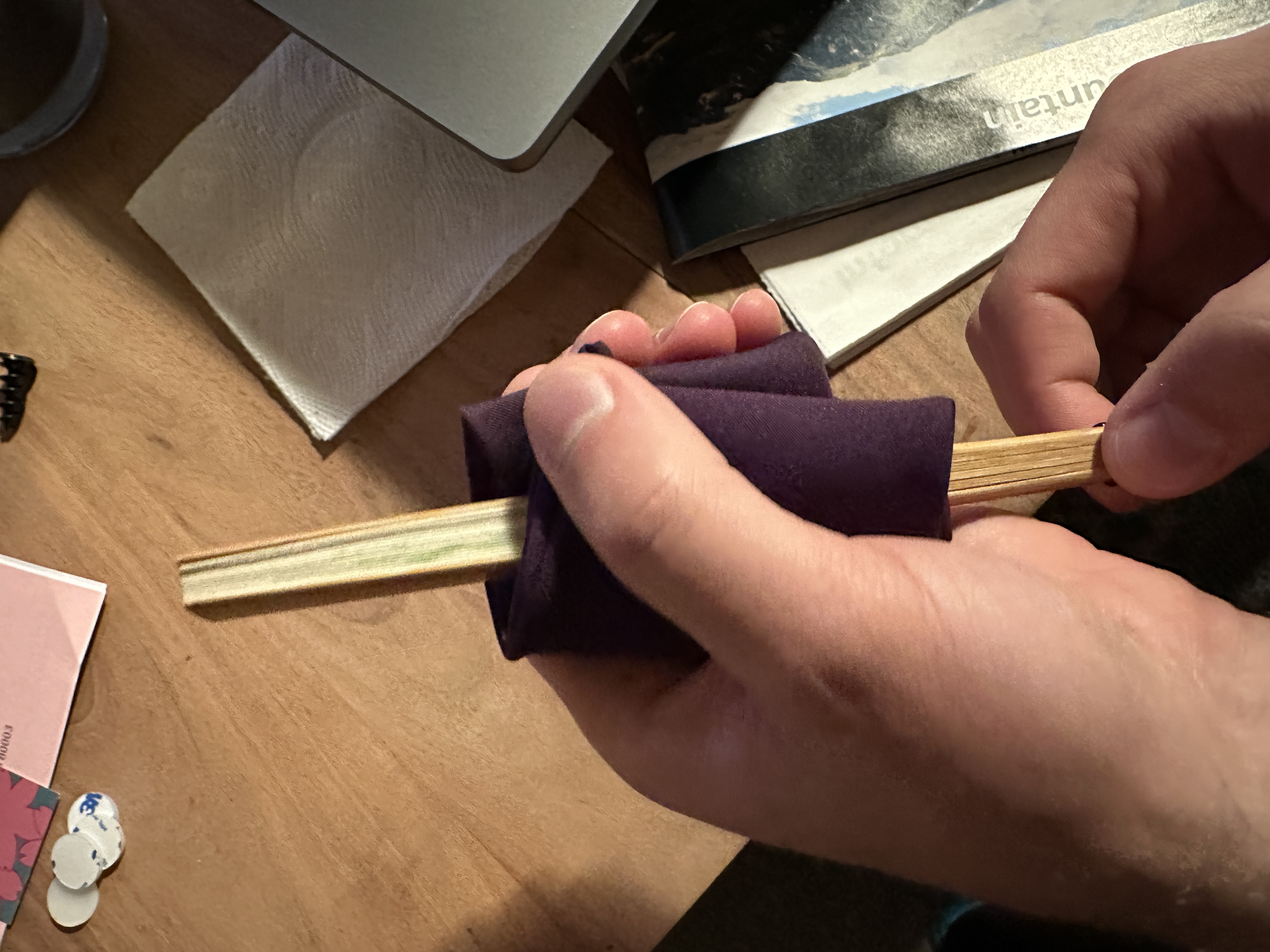
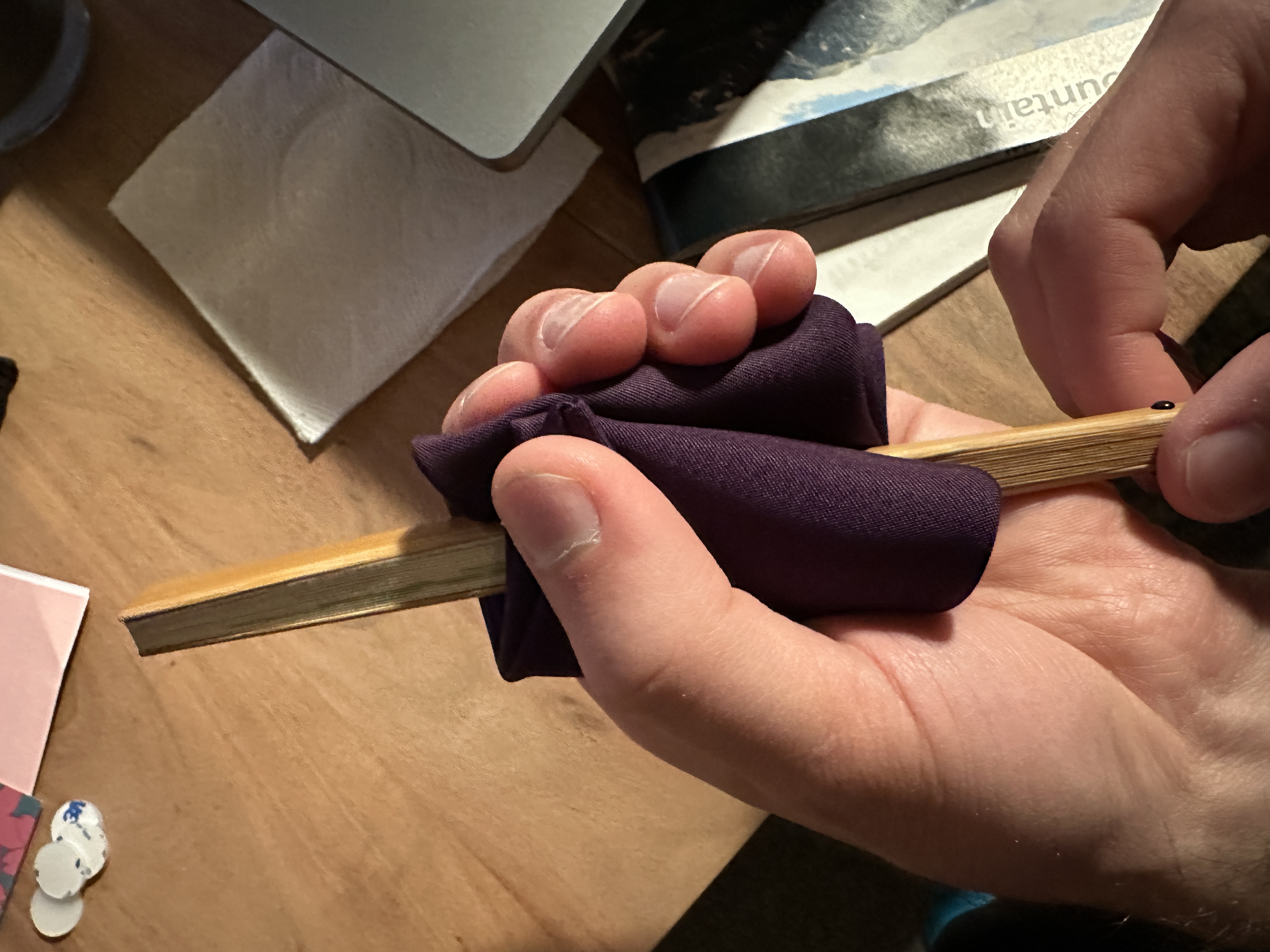
As with other things, this should be done inside the knee line.
Returning your fukusa to your obi
This does not need to be pretty. Don’t fuss. Just worry about the final time. Before that, guests won’t see if it goes in a little messy.
Chawan handling
From Midorikai little book transcription: When moving the chawan 3h from mizusashi shomen to temae in furo, just pivot your thumb. Don’t change your actual thumb position.
Chasentoshi
When lifting the chasen, it shouldn’t be perfectly parallel. The tangent line from the widest part of the tines to the tip of the handle should be parallel, not the chasen itself.
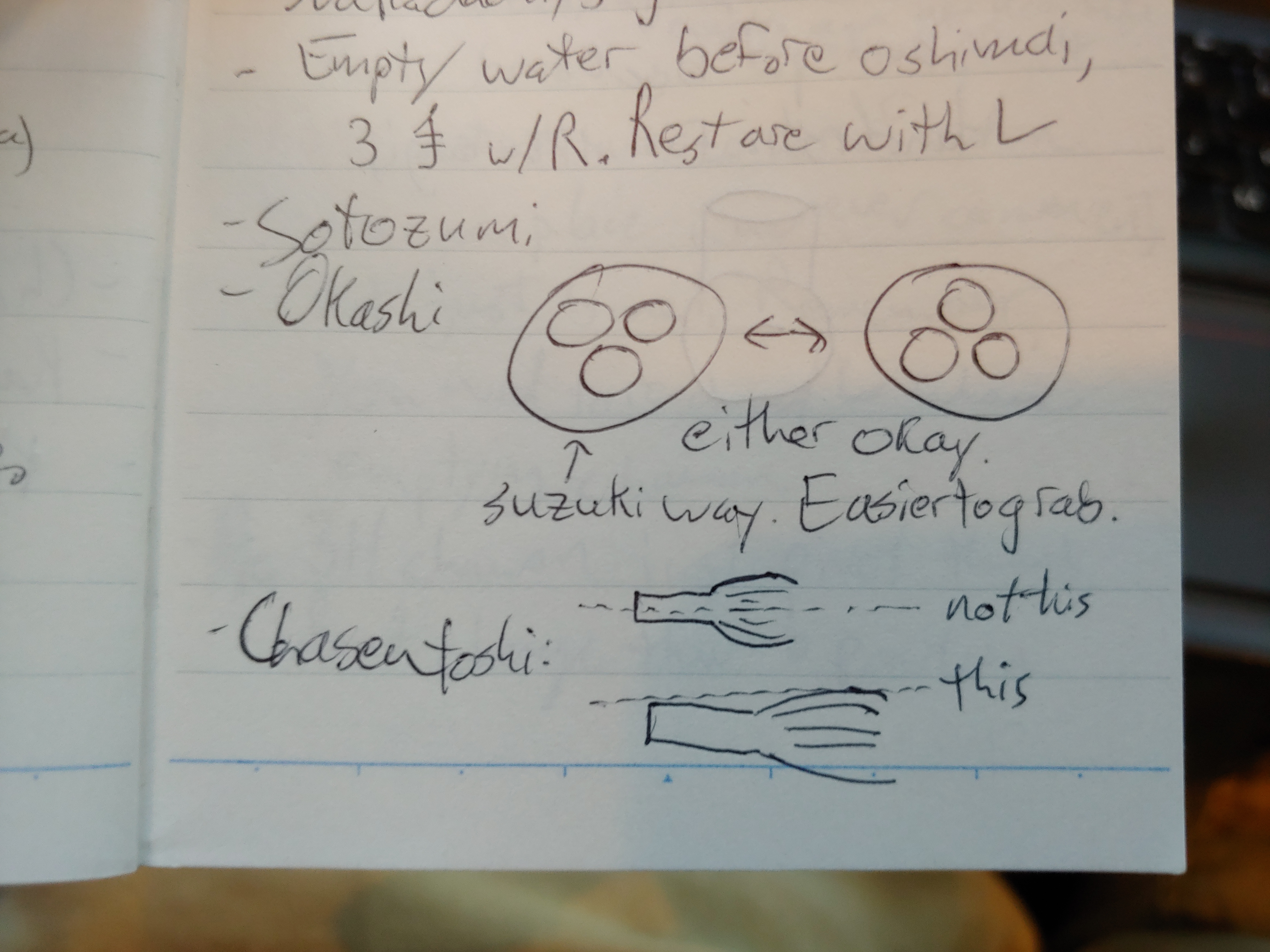
During nonoji, don’t move your body until you finish the whole movement! Wait until you finish, then lift the chasen out using your whole body.
- People have a tendency to move while in the middle of the nonoji.
Chakin wiping
Don’t bend your wrist.
Kama no futa
We often hear that you should open the lid with a “U” shape, and this translates to people using their arms to move the lid. No! Use your whole body. Lean into the kama, take the lid, sit up, then lean back down to place the lid down. This will cause a “U” shape naturally without waving your arms around.
Exiting with hishaku
When taking hishaku from kensui:
- Pinch sides with L, lift until it touches the heel of your hand, then turn your wrist such that the cup faces up. Hishaku handle is still mostly parallel to your body at this point.
- Then, with R, turn the handle and slide your hand in to the fushi.
- (This is a little less catapult-y than Glenn Sorei Pereira’s way).
From Glenn
Kama no futa
Hold the lid with your middle finger, rather than your index finger. This is slightly more natural w.r.t. the shape of your hand.
Pouring into the kama
Don’t come into the kama from the front. This is reserved for higher temae.
Doubuki
How do you deal with chaire that eat fukusa?
Nothing really.
The original chaire were Seto-yaki, Zeze-yaki, Takatori-yaki, maybe Tamba-yaki. Those were all smooth. The newer styles tend to be the ones that eat fukusa, so do what you can.