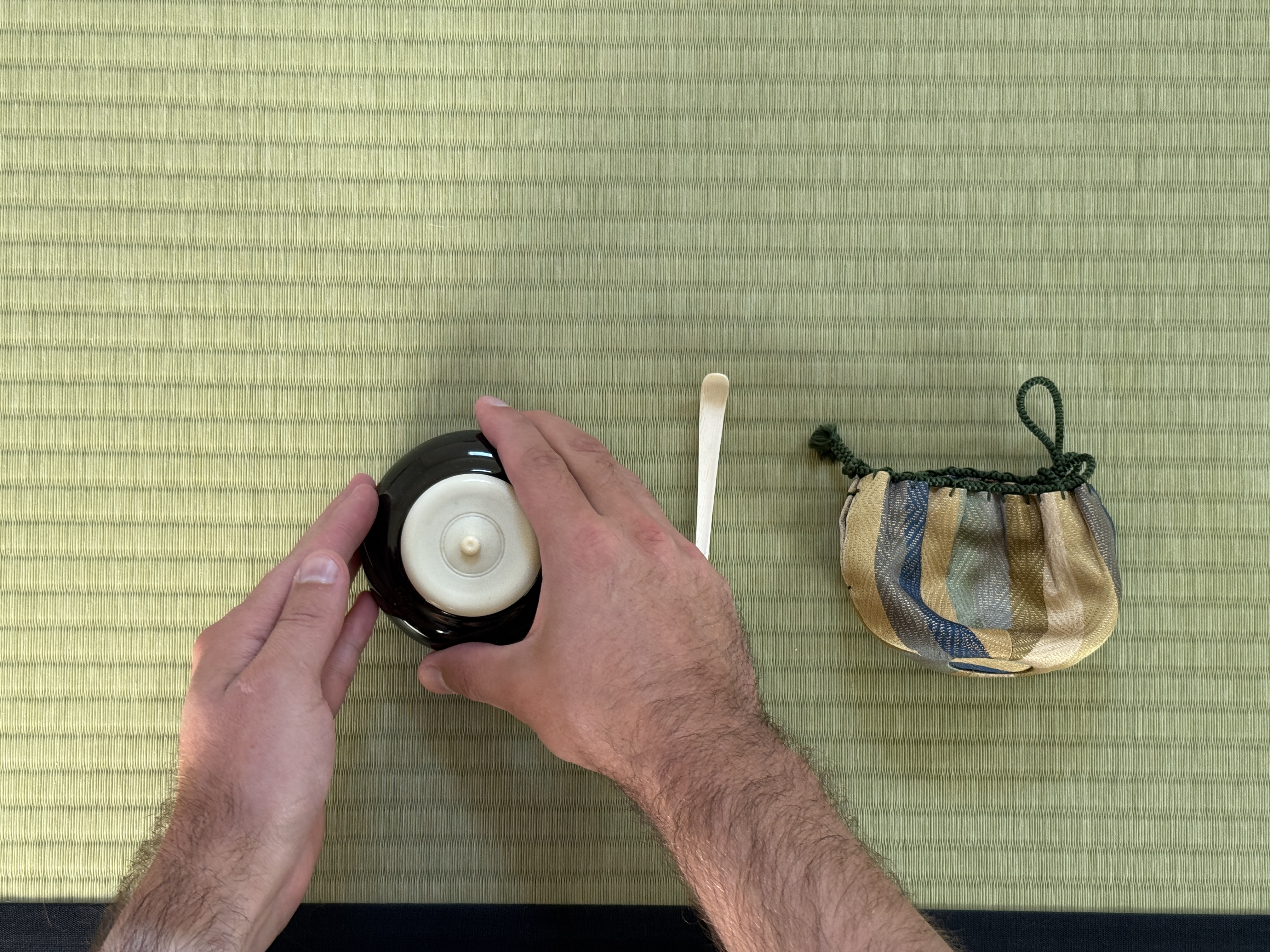
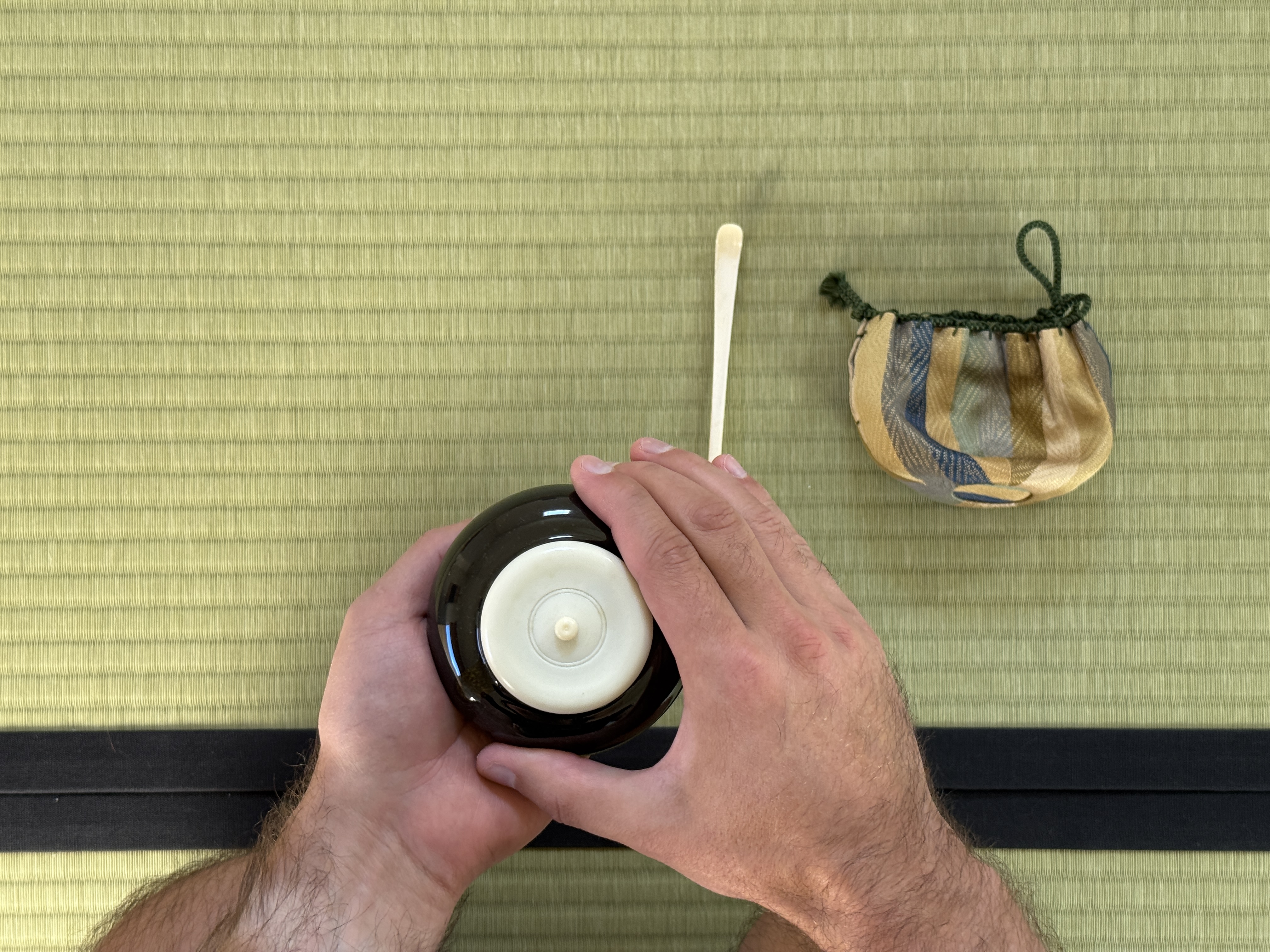
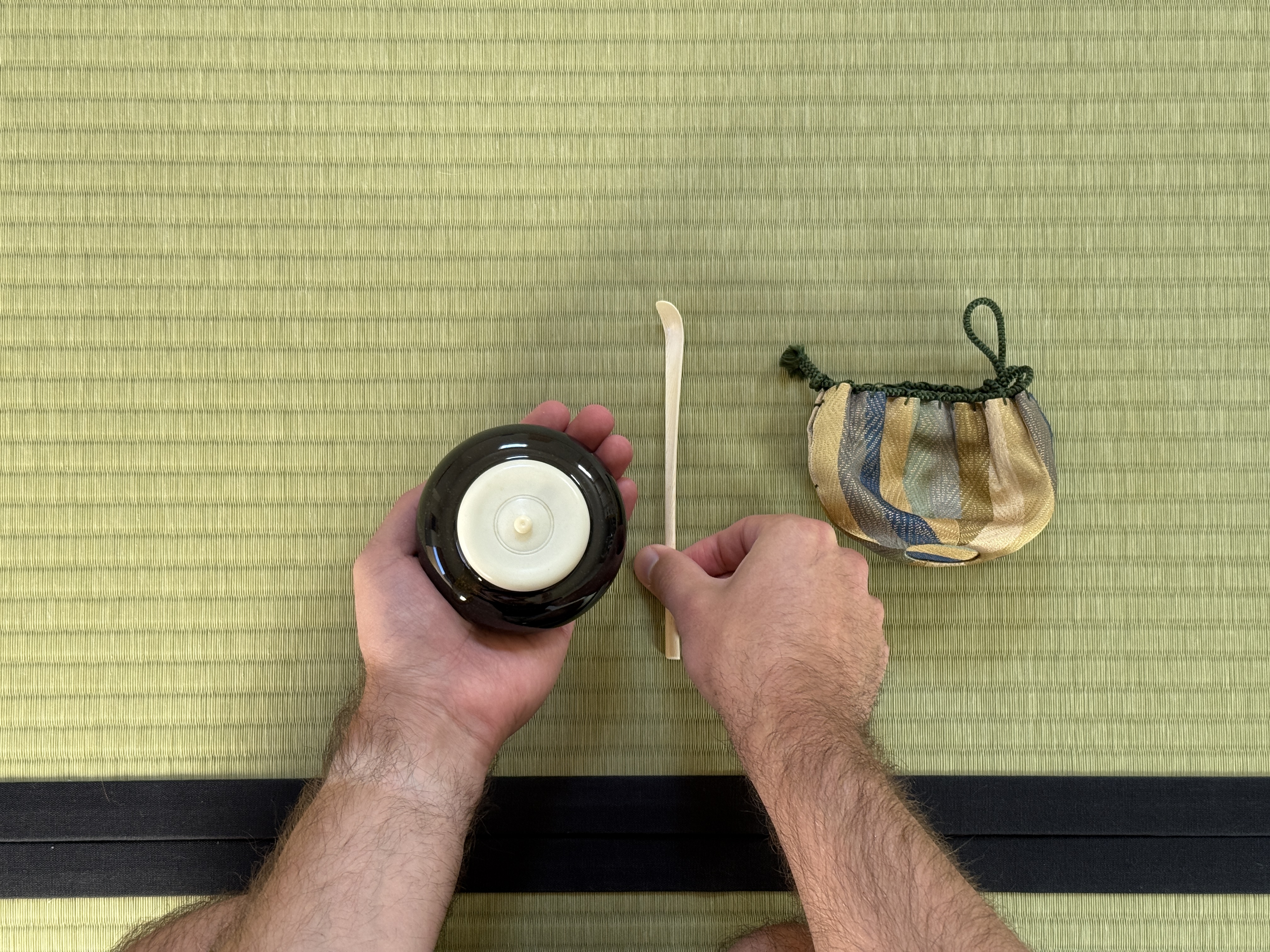
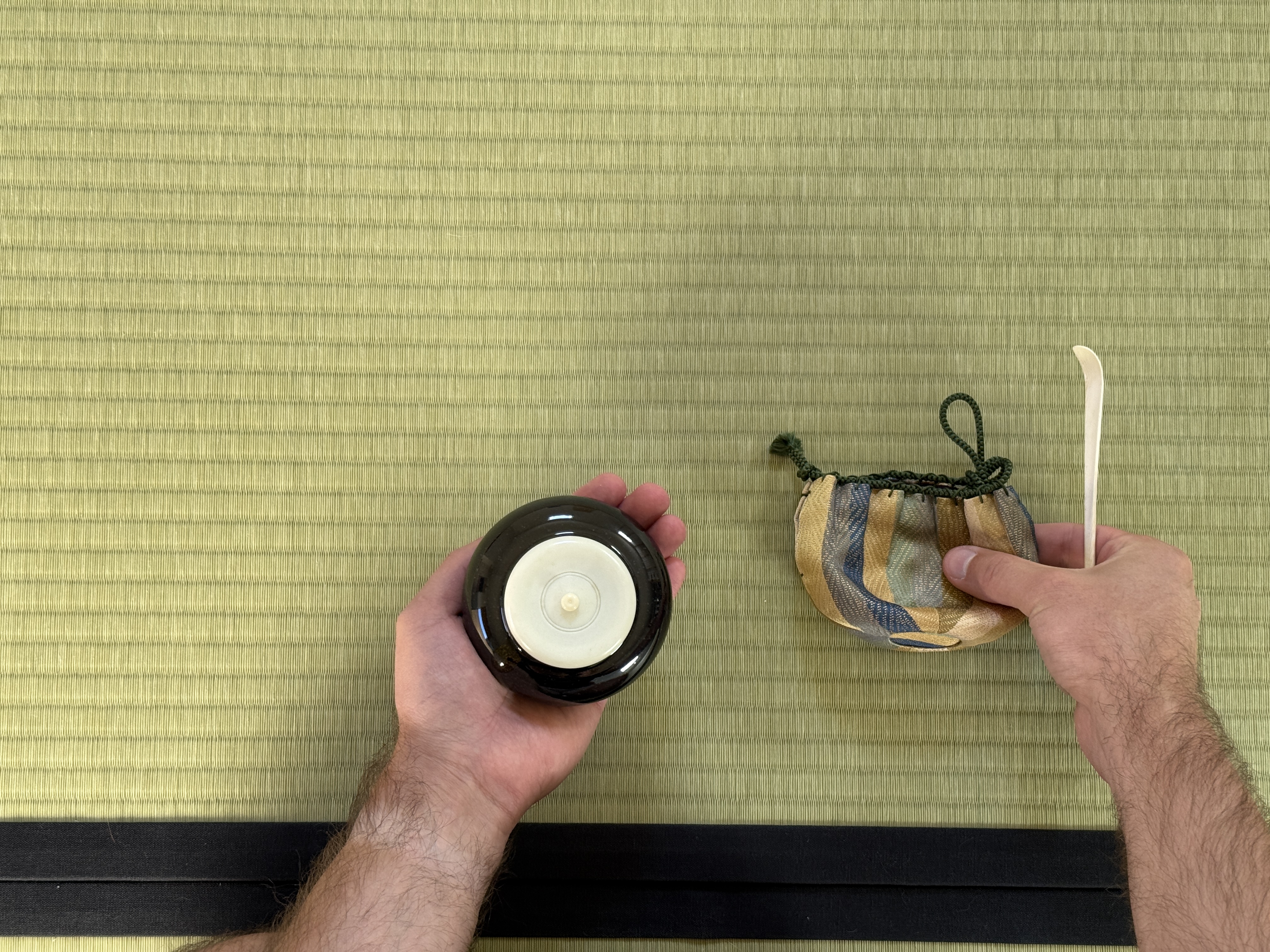
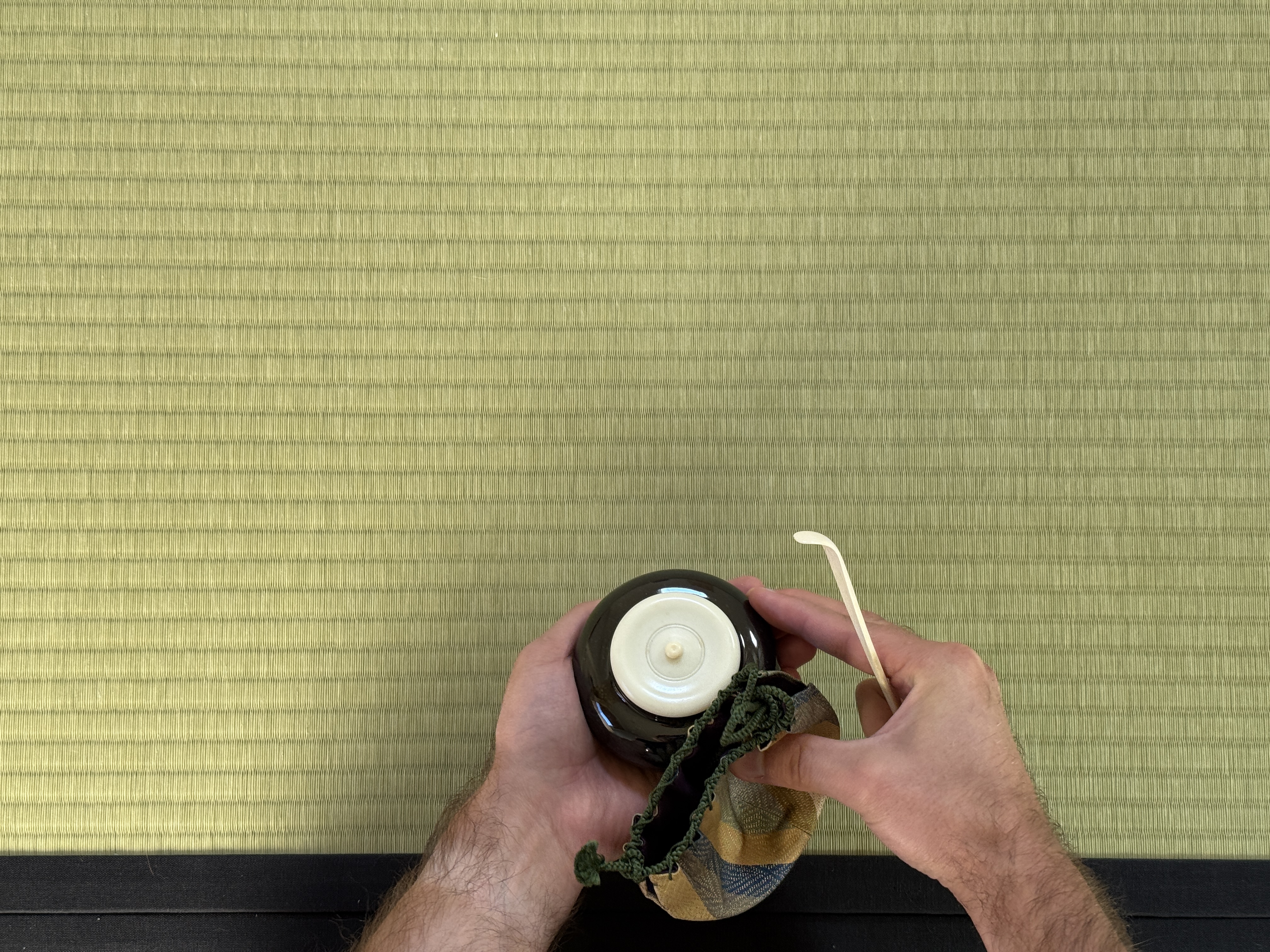
Tenita starts with daikai chaire tied in takara-musubi in the center. Not placed on anything!
During nakadachi, bring in tenmokujawan with chakin, chasen in bowl, and chashaku vertical on right side of hane.
Move daikai chaire to right half of tenita.
Place tenmokujawan to left half of tenita.
Daisu is “active”, shittai out.
Entrance and kiyome
Enter with nothing, sitting low and scooting up.
Hands in shin to open / close the door.
(No bow yet, that happens much later).
Remove hibashi.
Same way as Gyo no Gyo. Both at the same time, not betsu betsu.
Bring down chaire and take out of shifuku.
From kaichu, take kobukusa and open temae, centered in the space between you and the daisu.
Bring down chaire 2h onto kobukusa.
Open takara-musubi as you do with Shin no Gyo chawan.
Just turn the chaire though after draping the cord, not the chaire + kobukusa.
Remember, this is wamono. So open mukou → temae.
Place in hand, open right → left, remove shifuku and place down 2h.
Tie shifuku in Katatombo. Flip hi-no-hou, then place with L onto left corner of tenita.
(Don’t know if it does the Gyo no Gyo thing of placing in a yo slot. Probably?)
Kiyome chaire.
Fold fukusa in shin-sabaki, then nigiriconde.
Place daikai in flat of L palm, then wipe lid mukou → temae.
You still need to handle like daikai, meaning you do the 2h overhand rehold to place on palm / doubuki / etc. So, hold fukusa nigiriconde, then use remaining R fingers to help do the reholding.
Open fukusa like in Shin no Gyo, then doubuki (wamono, so push with thumb).
Note: Apparently opening the fukusa like that is done for meibutsu?
Bring fukusa under like zabuton, then spider hands and place down onto kobukusa.
Koshi fukusa.
Move chaire + kobukusa to mizusashi shomen.
This is done exactly like Wakin with the kobukusa handling etc.
Kobukusa moves giri-giri to the front of the daisu.
Note: you do not momite here. You do end up touching the chaire with your bare hands though, and it feels really weird.
Bring down dai combo. Kiyome chashaku.
Chawan-dai comes down to temae.
Take fukusa from obi and sou-sabaki.
(Not yoho-sabaki. Just plain, usucha hirademae sou-sabaki).
Wipe 3x, then push-pull-pull.
Refold, taking the bottom (“under”) corner, and wipe 1x more.
3h rehold chashaku, then place to the RIGHT of the chaire (not the left!).
(Keep holding your fukusa folded in L).
Take things out of the bowl.
Wipe the front-right corner of tenita. (YES, this happens BEFORE taking out the chasen. It’s weird.)
Holding your fukusa perfectly horizontal, wipe the kanji 三 on the right front of the tenita.
Give your fukusa back to L.
Chasen goes to tenita, to the right of the shifuku.
Take fukusa in R, then push against L to fold back into “natsume wiping” sou-sabaki mode (no full refold).
Place chakin onto tenita where you just wiped.
Give fukusa to R, then place karioki by R knee.
Bring down kensui to the floor.
2h taking kensui, then place down directly to its spot tangent to knee line (no moving), exactly like Gyo no Gyo.
Place the futaoki back in its “normal spot” on the jiita (like Gyo no Gyo), then sorei.
Chawan kiyome
Open futaoki, then open kama.
(It feels silly, yes. You place the futaoki down, then sorei, then take it again).
Open the futaoki as usual for Hoyasan, placing to its “active” position on jiita.
Open the kama lid.
No kobiki! Just use the fukusa like in Gyo no Gyo.
Place the fukusa below the kensui when done.
Take hishaku and add first oyu to chawan → kosusugi.
(Important: Apparently in none of the juuden, including Gyo no Gyo and Shin no Gyo, do you kagami-bishaku? You just take it and go straight into water, no Kagamibishaku.)
Add half scoop of water to bowl while on dai.
(Remember, oki-kiri)
Kosusugi → empty → catch drip with ring finger → return to dai.
Add second oyu to chawan. Place chasen in bowl, then place bowl onto the tenita to R of shifuku.
(It goes to the same place as the chasen lives).
While the bowl is warming, kiyome dai.
Take fukusa from below the kensui, then yoho-sou-sabaki.
At the end, do reverse Fukumi-bukusa as described above.
Chasen goes back up to tenita when done (this is its home when clean).
Catch the drip with chakin (taking from tenita), then wipe like usual for Daitenmoku.
Place bowl back down on dai with chakin still inside, then Tatami-kae and return chakin to its spot on the tenita.
Making tea
Scoop tea.
Momite, then take chaire with 2h primarily with R (L supporting), placing into L palm.
Note: This is the only time during temae that we momite!
Open lid, placing back onto center of kobukusa, then take chashaku.
Sukuidashi.
BEFORE PLACING ON THE HANE, tap once at 7’. Then place chashaku on hane (vertical on right) when done.
Close chaire, then return to kobukusa 2h primarily with R.
Zig-zag, then tap 2x at 7’.
(Yes, you tap 3x total, and the first tap is without L supporting the bowl. glenn ‘s theory is that it helps avoid getting tea on the kobukusa.)
Without wiping, rehold chashaku 3h and return back to R of chaire on kobukusa.
Open mizusashi lid into gyo (diagonal) position.
Add cold water to kama, then take hot water and start making tea like in Gyo no Gyo (aka “like usual”).
Escalator up for cold water.
Knead on dai.
When done, place chasen down kensui-no-migikata.
(We hide it now because it’s green!)
Turn to kantsuki with chawan dai. Turn hidari-mawari in the air, place kantsuki.
Shittai, hikae.
The rest of drinking, teishu manner, replenishing kama, etc is exactly the same as Drinking tea.
Shimai
Turn to kyakutsuki, take the dai, then return to imai. Sorei, and questions.
O-chawan no go-denrai wa?
O-dai wa?
Add hot water → kosusugi, empty, catch drip with finger, return to dai. Ichiyo oshimai itashimasu.
Add cold water → chasentoshi (as usual for tenmoku) on dai.
Return chasen to tenita.
(Because it’s clean!)
Empty chawan → catch drip with chakin (currently on tenita) → wipe → place bowl down onto dai.
Tatami-kae, then leave chakin in bowl. Chasen into bowl.
Clean chashaku, then return to same position on hane.
(This part is really weird)
Take chashaku in R, (no kensui movement here), then take fukusa from obi.
Snap over L knee, then fold “like normal” in sou-sabaki and wipe 3x.
Push-pull-pull, then refold, taking from the BOTTOM.
(You’re getting all the tea on the front… then for the last wipe, you’re using the opposite side… why?)
Do one last wipe, then place chashaku back to the same place vertical on the hane.
(No pom-pom!)
Fukusa-koshi, with the tea on the outside.
Chawan dai to himado mae.
Add cold water, then close up shop.
Toribishaku, then add cold water, going up the escalator like Gyo no Gyo.
Yugaeshi.
Shin ni sou ari, close lid then return hishaku to shakutate.
Close futaoki, then close mizusashi lid.
Haiken
Douzo o-chaire, o-chashaku, o-shifuku no haiken wo.
Conflicting opinions on if you can ask for kobukusa.
Opinion 1: Don’t ask for kobukusa! It’s “just the host’s kobukusa,” and not going to be viewed during haiken, despite being the origin of Wakin.
Opinion 2: Feel free to ask. And if you ask, you should haiken it.
Opinion 2 is more recent.
Move futaoki back on jiita to kensui position.
Turn with chaire to kyakutsuki. Kiyome and place out kantsuki.
(Any time you’re moving, always do it like Wakin).
Turn out to kyakutsuki with the chaire + kobukusa.
Take fukusa from obi and fold again into shin sabaki, wiping exactly the same way as in the beginning. This includes opening the fukusa for doubuki.
Place down onto kobukusa, then fukusa-koshi.
Wakin-style turn chaire (migi-mawari! wamono!), then place out kantsuki.
Again, you will probably touch the body of the chaire. No momite though.
Repeat for the remaining haiken dougu (chashaku, shifuku) to kantsuki.
Te wo suite as usual
Nothing special for placement etc. No seatbelt hook, nothing strange due to being nagao, etc.
Return to imai, then return hibashi.
It is crowded! But it’s okay to deal with hibashi when there’s something at himadomae, eg Shin no Gyo when senzara is at himadomae
Take things out.
Shittai, then take kensui and back out. Open door in shin to exit.
Come back, sit low, shikko. Take chawan dai, shittai, back out.
Come back with mizutsugi, handle exactly like Gyo no Gyo, opening mizusashi with 2h.
Return with kensui, placing back to its home on jiita. From here, turn and exit (not backing out).
Guests do haiken, see below.
Kyaku return dougu in kamiza-geza order, with chaire on the host’s left.
Return with rikyugata chuu natsume (not on hoshogami). Place on tenita, then turn to answer questions.
(This should actually have tea in it! You can continue from here to do usucha)
To exit, follow photos.
(Note: photos are missing the kobukusa)
Momite, then take chaire 2h. Place on L palm, then while there, kaichu kobukusa.
Take chashaku, then nigiriconde and take shifuku.
Press shifuku against front right body of daikai with R thumb, while R forefingers are holding the daikai. Scoop of chashaku should be above the daikai (like in Gyo no Gyo with the Buddha snake thing).
On the ten-ita is a meibutsu daikai chaire, wamono specifically, with a long cord, nagao cord.
The cord is tied in takara-musubi, the same as shin no gyo chawan no shifuku.
In the nakadachi, it’s set up that way, with that chaire just in the center, no tray.
Everything else as is on the ji-ita, as I said.
During nakadachi, you come in, you bring in a tenmokujawan (no notes on the kind of tenmokujawan) sitting on a shin-nuri dai with a zouge chashaku (different from Gyo no Gyo), zouge chashaku, vertical on the right side of the hane, sitting on the hane.
Chawan does not have a shifuku inside, it has a regular chakin with a regular shin chasen sitting inside it on the top.
I think that’s it for dogu.
Otherwise later, there’s going to be a katakuchi mizutsugi (ceramic).
Okay, so you walk on in, hands in shin.
When you enter, you enter with nothing, right, as you’d expect.
Door opens, enter, close the door, hands in shin, go back in, that’s the same as Gyo no Gyo, sit low.
Shikko, up, one, two, three, same as Gyo no Gyo.
Very first thing you do, take the hibashi.
Hibashi should be symmetric, rotationally symmetric, not torigashira specifically.
Take the hibashi out, two hands, like usual.
Take them out, both at the same time, like in Gyo no Gyo, place to the left, like usual.
Open up your kobukusa now.
Your kobukusa coming out from your kaichu.
Place it kami ichimai from the front center of the daisu on the ground.
So it’s directly centered in front of you, but it’s as far away from you as possible.
So the edge of the kobukusa is basically touching the daisu.
Two hands, bringing the wamono daikai chaire down, bring it down to sit on the kobukusa.
Open the takara-musubi the same way that you do with the shin no gyo chawan.
You know, drape the cord over on a diagonal, turn it, open it, turn it back, so on and so on.
You do not turn the entire kobukusa to do that though.
In shin no gyo, right, you turn the bowl and the dai.
Here you do not do that.
You are just turning the chaire.
So you pull the cord, drape it over, turn it hidari mawari (like normal for all chaire irrespective of type), take the cord in your hand, nigirikonde, open-open mukou-temae, because it is wamono.
Turn it back, put it in your palm, open right-left, because it’s wamono.
And then set it down with two hands.
It is still meibutsu, so it is still two hands setting down with the shifuku.
Tie the cord, katatombo, that’s the reversible one that you can pull it out.
Sidebar, we checked and the nagao tie, or the one where you hang it on a hook that’s not reversible, there’s no name for that.
So katatombo is this reversible type.
So reversible katatombo tie, flip it hi no hou, flip toward the fire because it’s wamono, and place it to the front left of the daisu, to the same place as it goes in gyo no gyo.
Side note, we didn’t talk about if it goes into that in like inyo, that second yo slot or not.
I just put it front left.
Chaire now is still sitting centered, laterally centered, all the way giri giri up against the front of the daisu on the kobukusa.
You do shin-sabaki with your fukusa, and then open the fukusa to wipe the daikai.
So the way you do this, you’re going to treat it like you treat kind of regular daikai with the flat handling and stuff.
So you do shin-sabaki all the way.
Shin sabaki when you’re done, hold it in your right hand, nigirikonde, and then two hands, left hand, overhand, takes the chaire, right hand with the fukusa nigirikonde is kind of assisting (pinching index finger + thumb on the shoulder as feels natural).
Place like daikai onto the flat of your left palm.
Then you wipe far then near (wamono) on the lid.
Then nigiriconde fukusa, re-hold to the side for doubuki, just like you do for daikai regular.
And then open the fukusa.
So just like shin no gyo, you’re wiping with shin sabaki open.
(I think it’s because it’s meibutsu? or maybe this is a shin element/)
So pushing with your thumb like wamono, hidari-mawari.
Push three times.
Do the zabuton thing.
Spider hands to change to holding with R, zabuton, place back down to kobukusa.
Fukusa koshi.
Next, move kobukusa + chaire like wakin.
So lift the lower left corner.
Both hands go under, go under, boop boop.
Move that to girigiri on floor (same vertical position) in front of mizusashi shomen.
You are holding the body of the chaire, just the same way that in wakin you’re holding the body of the nakatsugi.
Later we will momite only when we are scooping tea.
All other times when we’re moving it around like this, you do not momite, even though you’re touching the body.
So holding like wakin, move it over to mizusashi shomen, girigiri to the front, and then that’s it for the chaire for the moment.
Now take down the tenmokudai and chawan that goes to temae, just to the position in front of you.
Take your fukusa and fold sou-sabaki, not yoho-sabaki, just regular sou-sabaki.
Fold sou-sabaki, take the zouge chashaku and wipe one, two, three, push, push, flip it over, re-fold, or take the top, kind of like normal, and then refold back into sou-sabaki again, wipe one more time.
And then now it’s going to go to the right of the daikai, not to the left.
So this is what gengensai did originally, he put it to the right, and then tantansai moved it to the left.
So the chashaku goes down to the right.
Chasen comes out.
Chasen goes onto the ten-ita, onto the ten-ita to the right of the shifuku.
As long as it’s clean, it goes up there.
Once it has tea on it, it goes to kensui no migikata space.
Now, your fukusa is still kind of in your hand the same way that it was when we took out the chashaku, or when we wiped the chashaku.
So we’re going to take that, take the fukusa that’s in your left hand, let it open it up and fold it right back on itself so you’re back into a natsume folding position.
So without actually refolding, we’re just flipping it back so we can wipe with it again.
Holding completely horizontal now, like completely parallel to the front of the daisu.
And the ten-ita on the top, not girigiri to the right, I don’t know, maybe like two inches, three inches from the far right side.
You make the kanji “san”.
So ichi ni san.
This is with, again, the fukusa perfectly parallel, horizontal, like a credit card swipe.
One, two, three.
Give it just like that back to your left hand and then chakin goes onto that spot on the ten-ita that you just wiped.
And then from there, fukusa goes down, karioki, to beyond your right, beyond to the right of your right knee.
From there, two hands take the kensui out, place it down with your left hand exactly like in gyo no gyo, take out the hoya san, place it to where it’s going to go on the ji-ita, and then sorei.
And yeah, that is your first sorei.
It’s insane.
So sorei there.
Then after the sorei, this is weird, you just touched it, but yes.
After the sorei, then you take the hoya san again, pick it right back up, open it, and then place it down.
Next, hoya san is open, take the fukusa and open the lid of the kama.
When you’re done, place it below the kensui.
This part is like gyo no gyo, so there’s no kobiki.
Just open it up straight away.
Also, hishaku handling is going to be oki-kiri, like gyo no gyo.
Hands down, take hishaku just like in gyo no gyo.
So it comes out at three o’clock.
Again, this is a raku shakutate, so there’s no pull-pull.
Take it out.
Now here he also said do not kagami bishaku.
He said that for all juden, you do not kagami bishaku.
And then we had a debate, if you kagami bishaku for shin no gyo or gyo no gyo.
Kathy and Glenn both said it seems like it depends on who is your teacher about what you do.
Whether you kagami bishaku or not, but they both lean toward you not.
So you take the hishaku, no kagami bishaku, you just take it and then right away rotate it and then plunge into the water.
Half scoop like normal.
Pour half scoop, kosusugi, dump it, catch it with your ring finger, place it back on the dai.
One more time, take half scoop, place it down.
Again, oki-kiri.
Take that half scoop.
Chasen goes into the bowl and then now bowl goes onto the ten-ita, just where the chasen was.
Insane.
Alright, now take the fukusa, this time yoho-sabaki, sou-sabaki.
So you’re going to do sou-yoho-sabaki, one, two, three, four, fold it into sou-sabaki.
And then from sou-sabaki you’re going to do a reverse fukumi-bukusa.
So you fold it into sou-sabaki.
I need to work on the handling for this, I don’t know how to describe this.
Fold it into sou-sabaki, re-hold it over the top, like in fukumi-bukusa, give it to your right hand, like in fukumi-bukusa. (I think you use both hands to fold it to the back. Like both hands are equal partners in folding it in half after you do the ichimonji and give to R).
Now it should feel exactly like fukumi-bukusa, except the tips are on the inside.
You don’t have a smooth wiping surface like you do in fukumi-bukusa.
You just have sou-sabaki that you fold it in half.
From there, do hasami kiyome, I don’t remember the name, hasami kiyome with this weird fukumi-bukusa.
So temae muko on the hozuki, and then temae muko on the hane coming all the way around, like usual, make the question mark, place it down.
Now from your sou-sabaki fukumi-bukusa,
Give it back to your left hand.
With your right hand, grab the fold so it turns back into a normal sou-sabaki position (folded in a rectangle).
And then as is, no refold, just place it directly down below the kensui.
Now take down the chawan.
First chasentoshi is in your hands.
So take it, put it in your left palm, do chasentoshi just like you do in gyo no gyo.
When you’re done, after the nonoji, put the chasen back onto the ten-ita.
The same place that it has been going to the right of the shifuku.
Empty the water.
Take the chakin, which is still on the ten-ita.
Take the chakin, wipe it like in gyo no gyo.
Wipe the tenmoku, place it down, then tatami kae, and then return the chakin exactly back to the ten-ita on that spot.
Now here, momite.
It’s weird.
Why do you momite here and not anywhere else?
Here, momite, and then take the daikai chaire, primarily with right, left doing atsukai.
Place it into your left palm, kind of like you would expect.
Chaire lid, take it off, place it onto the kobukusa.
Onto the center of the kobukusa.
From there, take the chashaku and sukuidashi.
When you’re done with sukuidashi, place the chashaku onto the hane.
Onto the right side of the hane, vertical.
This is the same as gyo no gyo (I think?).
Place the lid back on, no wiping, because this was sukuidashi.
And then place the chaire back onto the kobukusa.
Chashaku, take, re-hold, zigzag across the tea, and then tap at 7 o’clock, like in gyo no gyo.
I think it’s gyo no gyo that does this.
Certainly, tenmoku does.
Tap at 7 o’clock.
Not yubi uchi.
Tap at 7 o’clock.
Without wiping, re-hold three hands and place it right just back to the right of the chaire again (chashaku still dirty).
Now from here, you add water.
First, open the mizusashi lid.
Mizusashi lid opens in the gyo position, diagonal gyo position, three hands, just like in gyo no gyo.
On that note, there is no midare in this temae.
There is no rearrangement on the jiita or anything.
Take your cold water escalator from the mizusashi out to the front of the kama, just like in gyo no gyo.
Go in, take the water, pour, and oki-kiri.
This is still the same, so take your chasen, knead on the dai directly.
Knead, knead, knead, add more water, knead, knead, knead.
Chasen goes out to kensui no migikata now, hide it because it’s green.
Take the chawan, turn out, place it kantsuki, as you would expect.
And then scoot back, hikai, ofukukagen, taihen keiko, blah blah blah, scoot up, wait, suikiri, turn back to temae, add cold water.
Adding cold water here is the same, escalator coming up.
Add cold water with oki-kiri, and then fukusa koshi.
Turn back when the guests are done, take the dai, turn back into temae, place the chawan-dai down, sorei, talk about denrai, whatever, whatever.
Hot water, kosusugi, dump, catch with your ring finger, place down, ichiyo shimai itashimasu.
Toribishaku, take your cold water, pour in, remember place down oki-kiri, so now we’re placing down oki.
Take your chasen, which is currently on the floor, and then sara sara, sara sara happening on the dai.
So sara sara, do chasentoshi like normal, so sankai age, sankai sage, and nono ji, and then now because it’s clean it goes back up to the ten-ita.
Take the chawan-dai, or take the chawan empty, take chakin, which is still on the ten-ita, wipe the rim like usual, wipe wipe wipe, place it down, tatami kae, and then after tatami kae, you leave it in the bowl, because remember, there’s no shifuku.
It’s going to stay in the bowl.
So chakin stays in the bowl.
Chasen from the ten-ita goes into the bowl.
Now we do chashaku.
So now you take the chashaku first.
There’s no kensui movement.
Take out your fukusa and then snap.
So holding your chashaku nigirikonde, you do your snap of the fukusa over your left knee.
And then from there you wipe.
So you fold sōsabaki, wipe, wipe, wipe like normal.
Push, pull, pull.
And then now you take the bottom side of the fukusa for your last wipe.
And yeah, this is really weird.
So this means the bulk of the tea is actually getting in the front.
And the very final wipe is getting in the back.
You do not pom pom in this temae.
So it’s just weird and I don’t know why.
So you do your last wipe with your fukusa currently folded opposite.
You do that one more and then you place the chashaku back onto the hane vertical on the right side.
From there fukusa koshi, just directly fukusa koshi, tea is on the outside.
Now closing up.
Move your chawan-dai to himadomae.
Shin-ni-sou ari. Take the hishaku, close lid, then return hishaku.
Close the hoyasan.
Close the mizusashi lid.
From there dozo ochaire ochashaku oshifuku no haiken wo.
Not o-kubukusa.
You are not looking at the kobukusa in this case.
It is just the host’s kobukusa.
Nothing special about it. It is not some fancy wakin fabric.
Touch the futaoki as always.
So hoyasan, three hands, rehold and place it back like in gyo no gyo.
Now just like wakin, leaving everything else and leaving the chawan-dai himadomae and leaving the kensui as is.
Take the chaire like in wakin.
So take from the corner, lift, lift, holding the kobukusa and the chaire, holding the body of the chaire with your right hand, just like wakin, turn out to kyakutsuki.
Place down and then you take your fukusa, do shin-sabaki again and then you do exactly the same as the beginning.
Shin sabaki, open for the dobuki, do the nigiriconde thing that I said at the beginning to get it in your palm.
So do that whole daikai handling stuff.
Dobuki three times in wamono direction with the fukusa open, like in shin no gyo.
Turn, turn, turn, then it goes down.
Do zabuton, itsy bitsy spider, hands to rehold and then place it directly down onto the kobukusa.
Fukusa koshi and then turn the chaire just like you do in wakin.
Not really worrying about touching it, it is okay to touch it as you’re turning.
It’s also okay to use the kobukusa to keep you from touching it as you’re turning.
Again, there is no momite at this point.
Then you place it out to kantsuki after you’ve turned it, migi mawari, because again it is wamono.
It goes out to kantsuki and then you turn back, take the chashaku, not placed on anything, it’s like gyo no gyo, you do not put it on a kobukusa or anything.
So take the chashaku, turn back to kyakutsuki, place out te wo suite to kantsuki.
Turn back, take the shifuku, put it in your left palm like normal, turn out, place it to kantsuki.
Again, so all of three of these things just in a line.
Now turn back to imai.
Now you need to deal with hibashi.
So it is a little crowded, the chawan-dai is there, himadomae, the kensui is there as well to the left by your knee line.
Even with all of those things there, take the hibashi.
Hibashi you take just like normal, like in gyo no gyo.
So take them both at the same time, two hands down, take the hibashi, place them in, two hands back down again to be done.
Leaving the chawan-dai on the floor, himadomae.
Scoot back.
Scoot, scoot, scoot.
Then take the kensui and exit, reversing out like in gyo no gyo.
Come back in, take the chawan-dai, reversing out like gyo no gyo.
So shikko-shittai.
Come back out, katakuchi mizutsugi, just like gyo no gyo.
Scoot in, scoot out, exit, come back in with the kensui.
Sit low, scoot, scoot, scoot.
Futaoki goes in and then place it back to its home.
From here you can stand like hira-daemae rather than backing out just like in gyo no gyo.
Stand and exit, closing the door in shin hands.
Kyaku during their haiken portion, nothing super fancy.
The chaire stays on the kobukusa.
You do not haiken the kobukusa.
And the chaire lid goes onto the upper right of the kobukusa.
Do not flip it unless it’s a heishibuta.
This is just daikai chaire.
It comes back kamiza side on return to teishu.
So it comes back with the dougu still kamiza orientation, not left-right orientation.
You walk in with a rikyu gata chu natsume.
Just like in gyo no gyo, you walk in and place it onto the center of the ten-ita.
You can continue with usucha hirademae after this temae.
Turn out, answer the questions, and then from here…
This is weird.
So two hands, no momite again.
With two hands, take the daikai chaire, place it onto the flat of your left palm.
While your hand’s there, close the kobukusa, still at kantsuki.
Close the kobukusa and then place it kaichu.
Next, take the chashaku, hold it nigirikonde, and then take the shifuku from the right side.
Not the bottom, taking it from the right.
Now you’re going to place or push the shifuku against the body of the daikai chaire, kind of the front right.
Put your thumb there to hold it.
With your other two fingers of your right hand, thumb is pushing against it, right hand, or other two fingers are against the body of the daikai chaire.
Chashaku should be nigirikonde in the right hand over the head of the chaire, like the Buddha thing, and walk out like that.