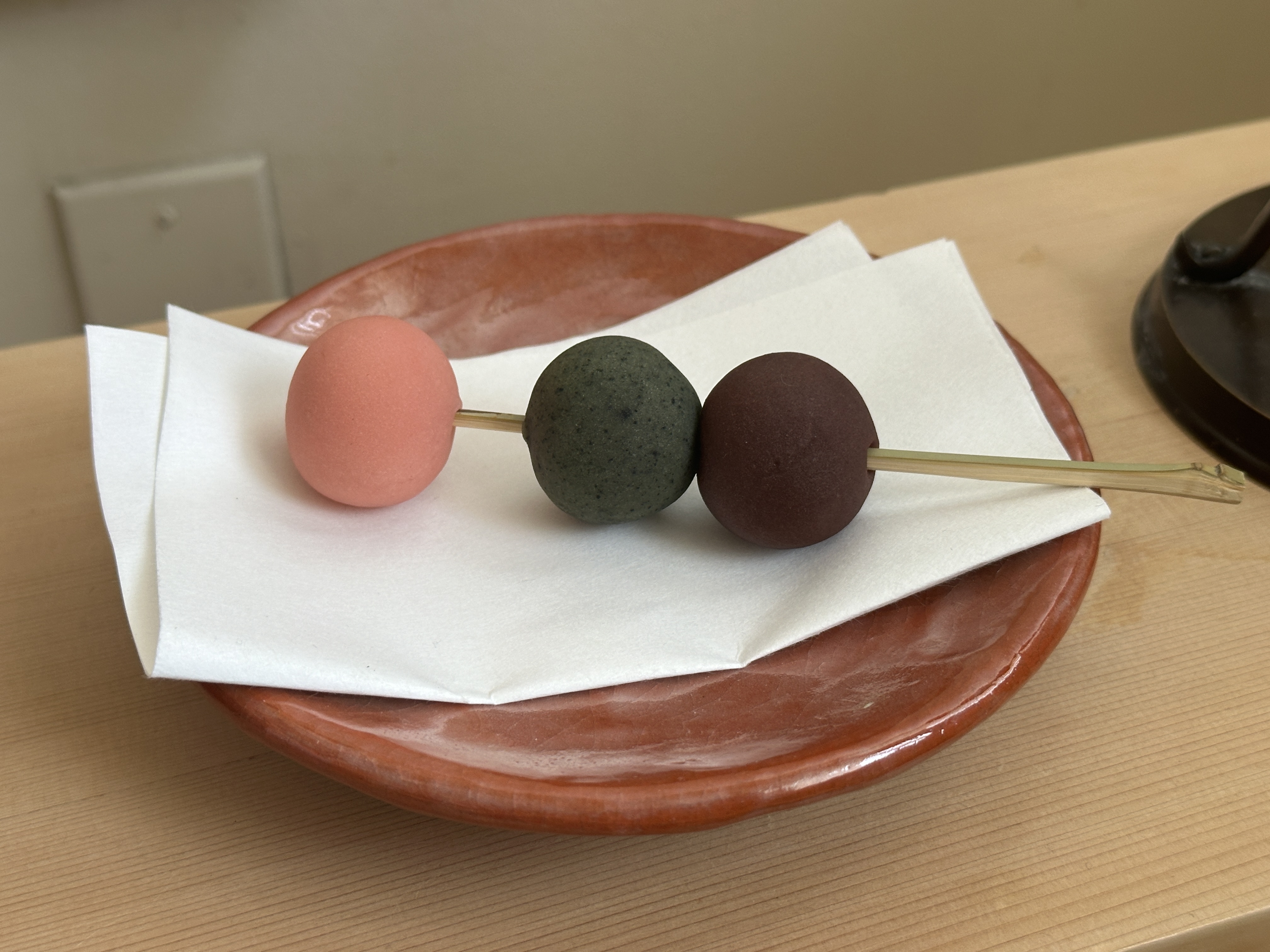
- Hanami Dango
- brown closest to hand, then green, then small space (for dango-bako), then pink. Urasenke does brown, but most of Kyoto does white. He doesn’t know how the brown started
- Hanami Dango is just called hanami dango. No mei.
- Pushing the dango on, then puling it back slightly will keep it from looking “punctured”
- Pink should be just on the tip, just barely not poking through
- When thinking about Yakan vs Katakuchi, he thinks about gozumi. What would you do in gozumi?
- In Nagaita Hitotsuoki, it’s kazari, but you’re using an aodake futaoki, so you have a hakobi “feeling”. So for this, he likes to use a yakan like you would in hakobi gozumi.
- When taking the hishaku in ro from kama, have your thumb already underneath so you don’t need to swivel the thumb around.
- He was originally taught not to rehold the chashaku when doing the zig-zag (like how Lindsey Higo does). It seems that reholding, like we do, is the new style.
- Try to keep the futaoki closer to the kensui when leaving at the very end, and the door. It should stay under the hishaku fushi. If that’s hard to do, maneuver the futaoki in your hand to hold more from the top so you can put it closer.
Nagashidate Usucha Ro
- In both usucha and koicha, he likes to take the bowl at the end from the diagonal as well, not from straight on. “In hakobi, the bowl is to your left when you sit to take it. So why not do the same thing?”
- Dougu Positioning
- Mizusashi should be in the center of the imaginary ro, adjacent to the real ro. This will be kantsuki, with the mizusashi centered at 7 sun from the edge of the ro.
- Chawan and natsume should be precisely where they would be in a hakobi temae, along the diagonal.
- Body Positioning
- Imai is directly facing the ro.
- Kattetsuki is facing the chawan and natsume.
- Kyakutsuki is bisected by the corner of the ro.
- Jifuku
- For both ro and furo:
- Guest brings the higashiki to you when you take the chashaku. (This lets the host know there will be a jifuku)
- When you place out the tea, guest says douzo go-jifuku wo.
- Host adds cold water.
- Move out twice (beyond kyakutsuki), kansha the higashiki, turn, and place slightly away from where it was.
- Move in once (now at kyakutsuki), then take the bowl and drink.
- When finished drinking, keep the bowl in hand and turn back to imai.
- For ro specifically:
- On the “move out twice,” move diagonal to the heri, toward the higashiki. (This is like in Okuden where you place the mizutsugi down, then advance up and right without turning your body).
- It is okay if the higashiki overlaps the heri. “We sit on the heri, don’t we?”
- His way of drinking:
- Take the bowl from 6’ (the shomen is facing away from you at this point)
- Place the bowl on your palm, having rotated it 90deg. Then place it down, fixing the shomen to face you.
- Oshoban itashimasu
- Lift, kansha, turn, drink “like usual” for a guest.
- Then when done, turn it back, and bowl-in-hand, return to imai.
- The way we were taught to drink
- Leave the bowl facing away from you the whole time, including when doing the oshoban.
- Either don’t turn the bowl at all after kansha, or only turn once slightly.
- For both ro and furo:
- Not a new point, but don’t forget that the lid of the mizusashi goes to the right side. But not like gyo; tsumami is facing toward the mizusashi.
- When standing from the diagonal with everything but the kensui, stand directly and cover your foot with L. When standing with the kensui, do the sneaky pivot thing. (This is because you need to turn around the other way, and turning >180deg is hard).
Nagashidate Koicha Ro
- Chaire starts where the dougu chawan and natsume would be, on the diagonal. (Similar feeling to nakaoki, where the chaire is far from the mizusashi).
- Chawan karioki, it goes to the center of that large hanjo space (L → R → L handling).
- Glenn said that the kensui doesn’t move, but the books have it moving. Should collect more info.
- Where to put the shifuku
- Option 1: Exactly where it usually goes, if it was hakobi and there was a mizusashi.
- Option 2: Same vertical position, but on the right part of the mat. Maybe 5 mei from the heri. Still positioned vertically, still rotated the same way, etc.
- His preference is option 2, because if you were to take the entire setup and rotate it 90 degrees, that would be much closer to where it is during hakobi temae.
- The chawan karioki position is “katte”, so anything beyond that would be going through the wall.
- Note: These options work for both ro and furo. His preference is option 2 for both. But either are fine.
- Jifuku:
- Note: This is NOT like Koicha-tsuki Kagetsu. In that temae, you ask about fukukagen, then you leave immediately.
- After the very opening sorei, this is when you tell the guest that you’re going to join them for tea. (We didn’t know the exact phrase).
- When the kyaku gets the bowl, the bowl stays herisoto!!, and both kyaku + teishu sorei.
- (This is very unusual! But this is correct.)
- Kyaku drinks, then after teishu asks about fukukagen:
- Close the kama up like usual for hakobi. Hishaku should face diagonally to the center of that hanjo.
- Stand straight up from imai, then go to the kariza position (e.g. in Kagetsu).
- Drink with the guest all as normal. Guest asks for chawan haiken after you finish drinking. Bring them the bowl, then stand and return to temaeza.
- Open everything up, add cold water. etc.
- NOTE: We did not ask questions! But it probably follows the same principles here as Kasane-jawan. Probably finish opening things up, then take questions from imai.
- In usucha, haiken dougu goes out with natsume far away, then chashaku below it pointing straight. The same thing happens here, but with the shifuku below the chasen.
- All three objects are in a line. (It’s tight).
- The shifuku will be turned the correct direction after just placing it out “like usual.” No need for an extra flip or anything.