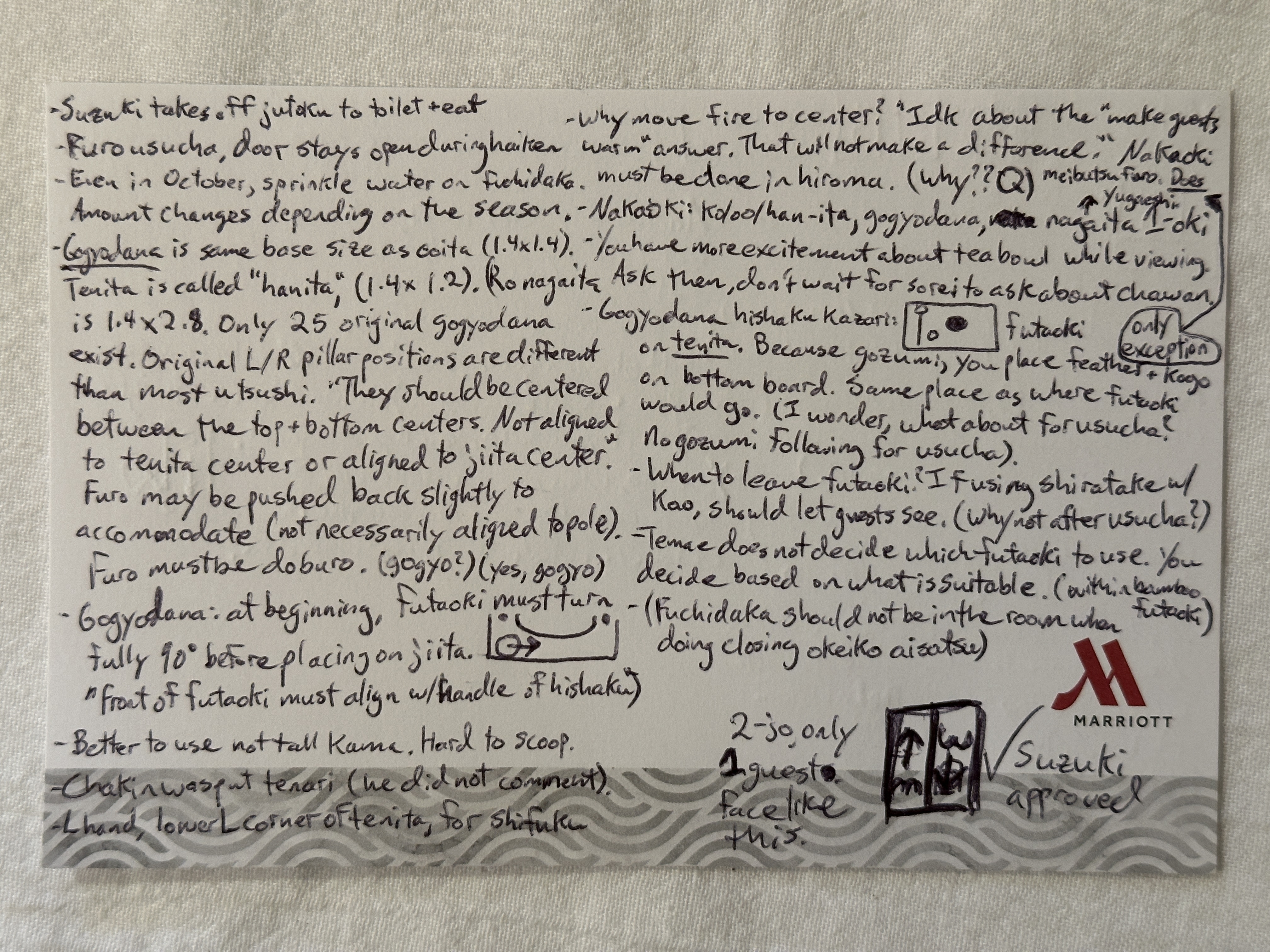
This is a raw transcription of my notes from the New Mexico 20th anniversary seminar with suzuki .
Suzuki-sensei quotes
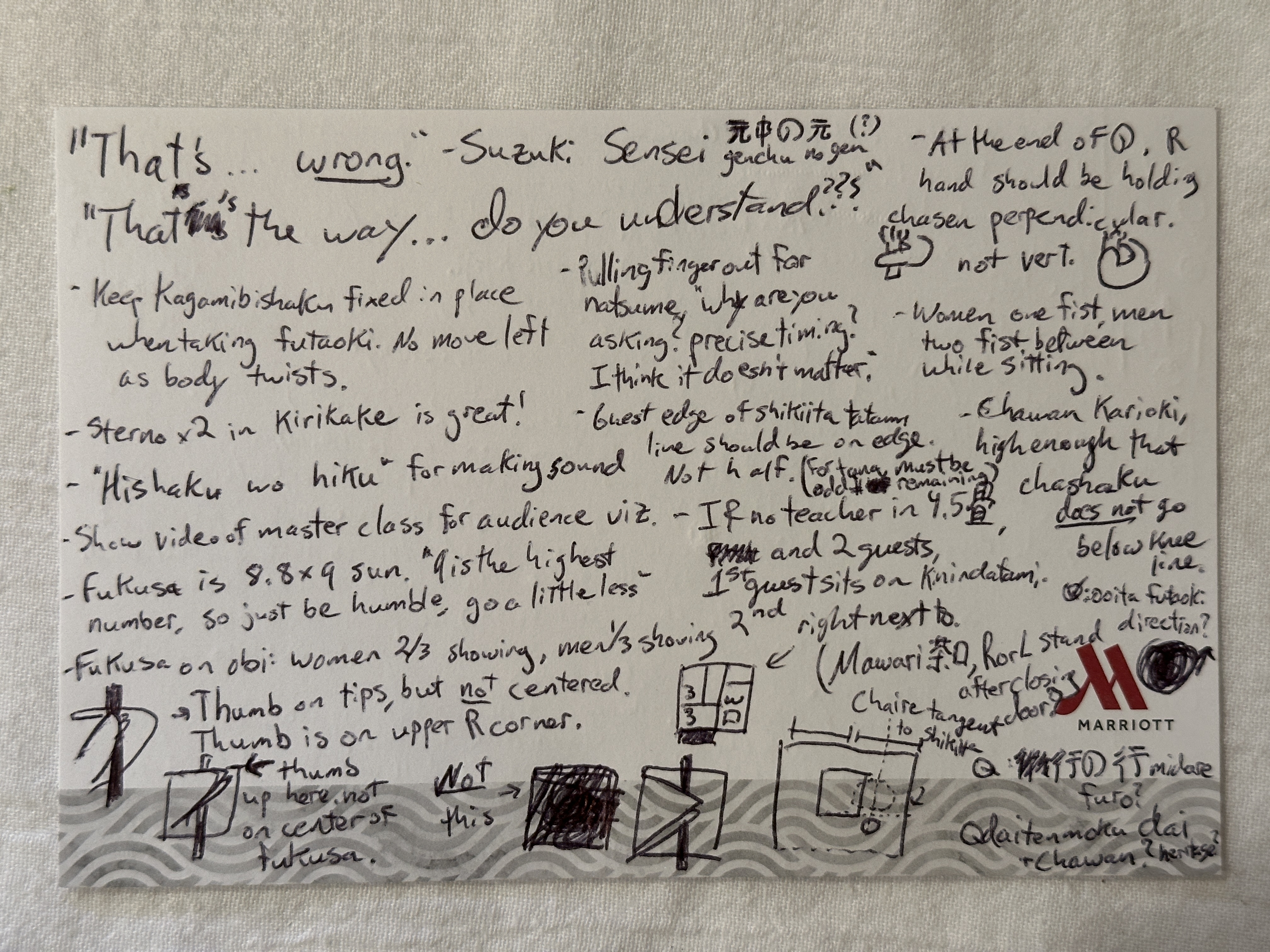
- That’s… wrong.
- That’s the way! Do you understand?
- You can do it any time. Just don’t do it at a stupid time. (regarding when to ask about dougu, ie when to ask questions about the chawan during usucha)
- You choose the shokyaku. Everyone else is just people. They are only there to make shokyaku feel comfortable. The chaji isn’t about them.
Temae notes
- Keep Kagamibishaku fixed in place when taking the futaoki. Don’t let it move left as your body twists.
- The cue for Making sound with the hishaku is hishaku wo hiku. Pull the hishaku back onto the futaoki.
- Fukusa is 8.8 x 9 sun. Why 8.8? “9 is the highest number, so be humble! Do a little less.”
- Fukusa position on obi:
- Women: 2/3 showing
- Men: 1/3 showing
- Fukusa wiping for chashaku, Suzuki-sensei’s way:
- How I wrote in earlier notes is wrong. He does keep his thumb on the tips when wiping, yes, but he keeps his thumb on the upper right corner. Versus putting his thumb in the vertical center of the fukusa.
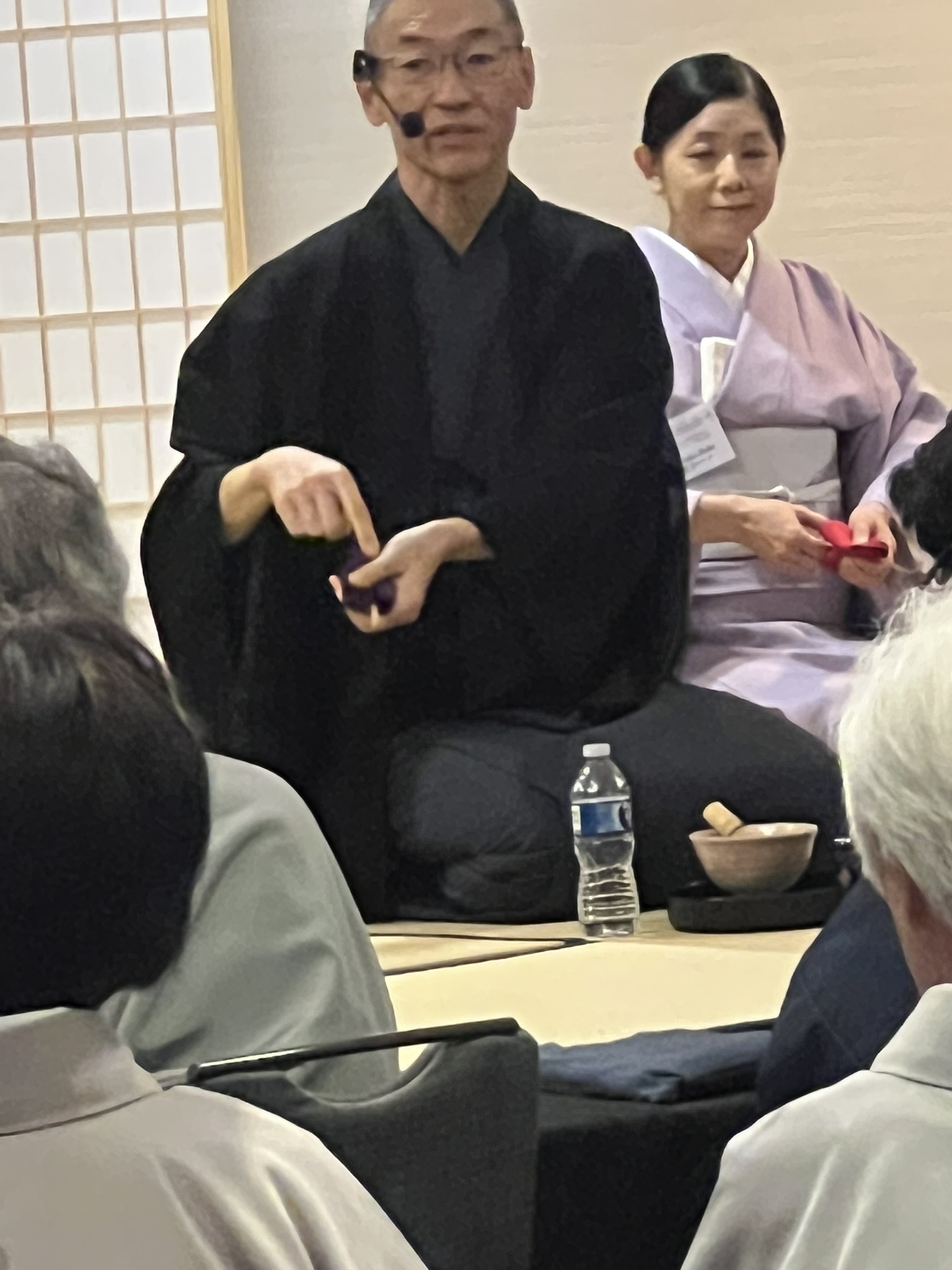
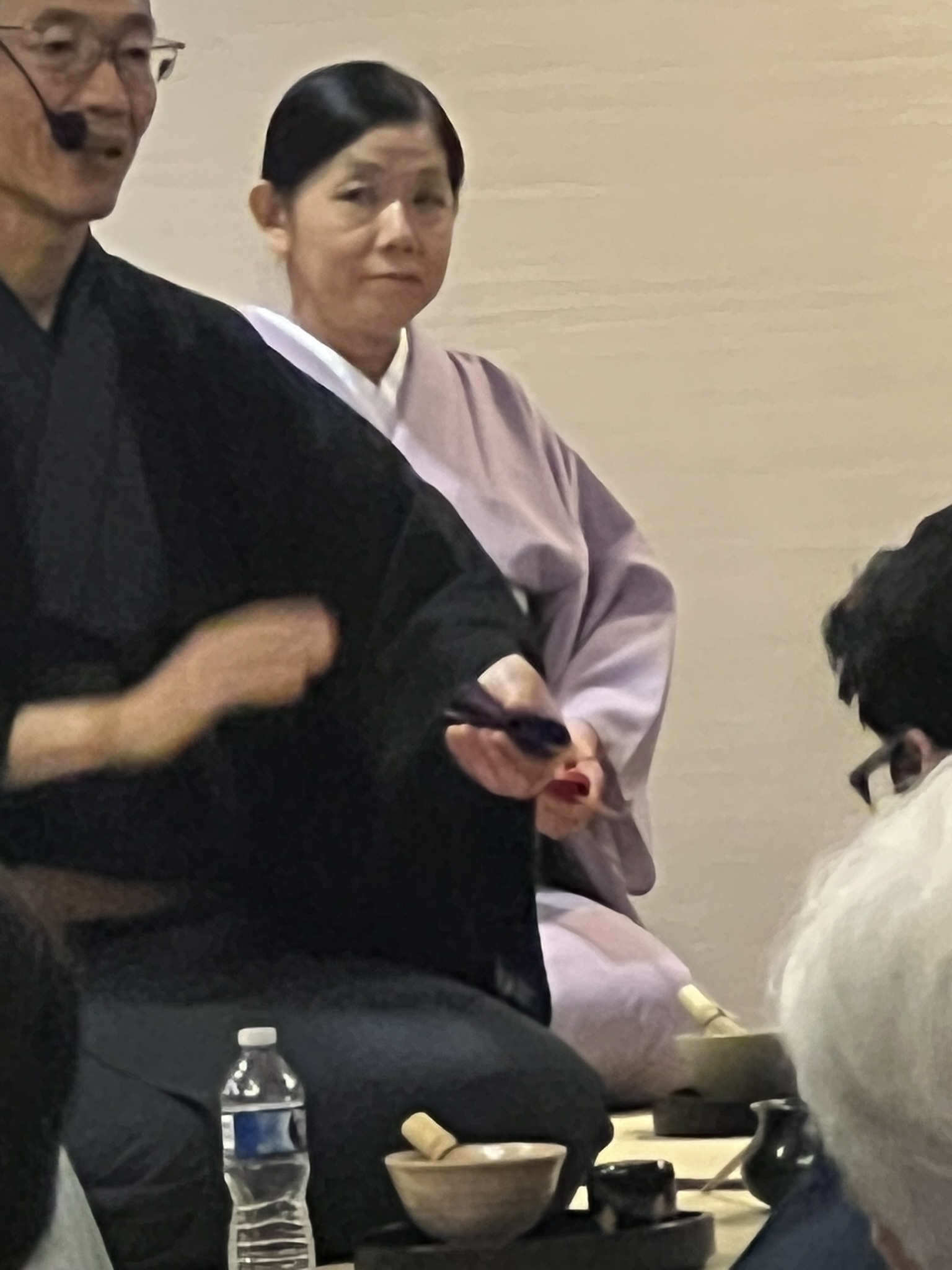
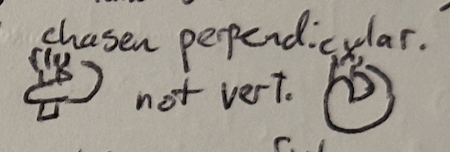
- At the end of No-no-ji, right hand should be holding chasen perpendicular, not vertically.
- When sitting, women should have one fist between their knees. Men, two fists.
- (My recollection: this is mostly a function of kimono, not of femininity. Women’s kimono are much tighter. You must always leave at least one fist though to have room to move your legs and turn.)
- Chawan karioki must be high enough that the chashaku does not cross the knee line. (Same as I teach)
- Regarding when to pull your finger out from the natsume: “What are you asking? You want to know precise timing? It doesn’t matter.”
- When aligning shikiita on the tatami, it will usually not fall perfectly evenly on the tatami ridges on both side. Make sure to align the guest side. (This is what I do)
- [?] TODO The same rule applies for tana, but he said that tana must be an odd number remaining. Why odd, and why did he say this is critical? ask-glenn ➕ 2024-10-26
- If there is no teacher in a yojohan, ie teacher is not sitting in the teacher spot, and there are two guests:
- 1st guest sits far right onto the kinindatami
- 2nd guest sits where we usually have the first guest sit during okeiko
- (ie, don’t leave a gap to the shokyaku’s right)
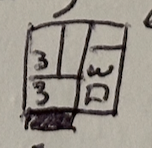
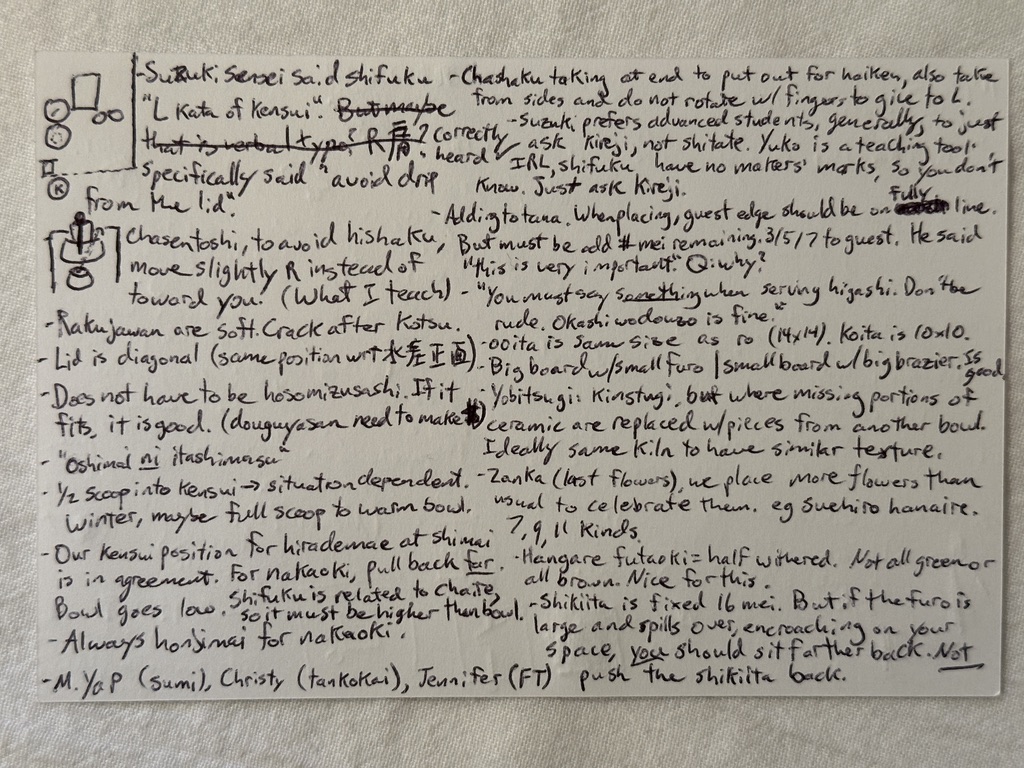
- Raku is soft. If you continue to kotsu in the same spot, they will crack.
- Suzuki-sensei says oshimai ni itashimasu. Noting the ni.
- Suzuki-sensei’s general rule (which I teach) is that if the water is destined for the kensui, it is a half scoop. However, he did say explicitly that this is a guideline, not a rule. In winter, maybe he’ll use a full scoop to warm the bowl. In summer, maybe less than half.
- Same position as we usually teach for hirademae shimai position (hishaku go + chashaku position etc).
- When taking chashaku at the end to put out for haiken, pinch from sides and use whole wrist to rotate upward. Do not twirl with fingers.
- Advanced students should just ask kireji for shifuku, not shitate.
- Learning the senke jusshoku obviously is a teaching tool.
- IRL, if you buy a chaire that comes with a shifuku, you don’t usually know who made it. There are generally no maker’s marks on shifuku, and it’s usually not listed in the box.
- You must say something when serving higashi. Okashi wo douzo or whatever. Don’t be rude.
- Shikiita is a fixed 16 mei from the kinindatami heri. But if the furo is very large and spills over the front of the board (ie big doburo on a koita), and it encroaches on your space, you should sit yourself farther back. Don’t push the shikiita back.
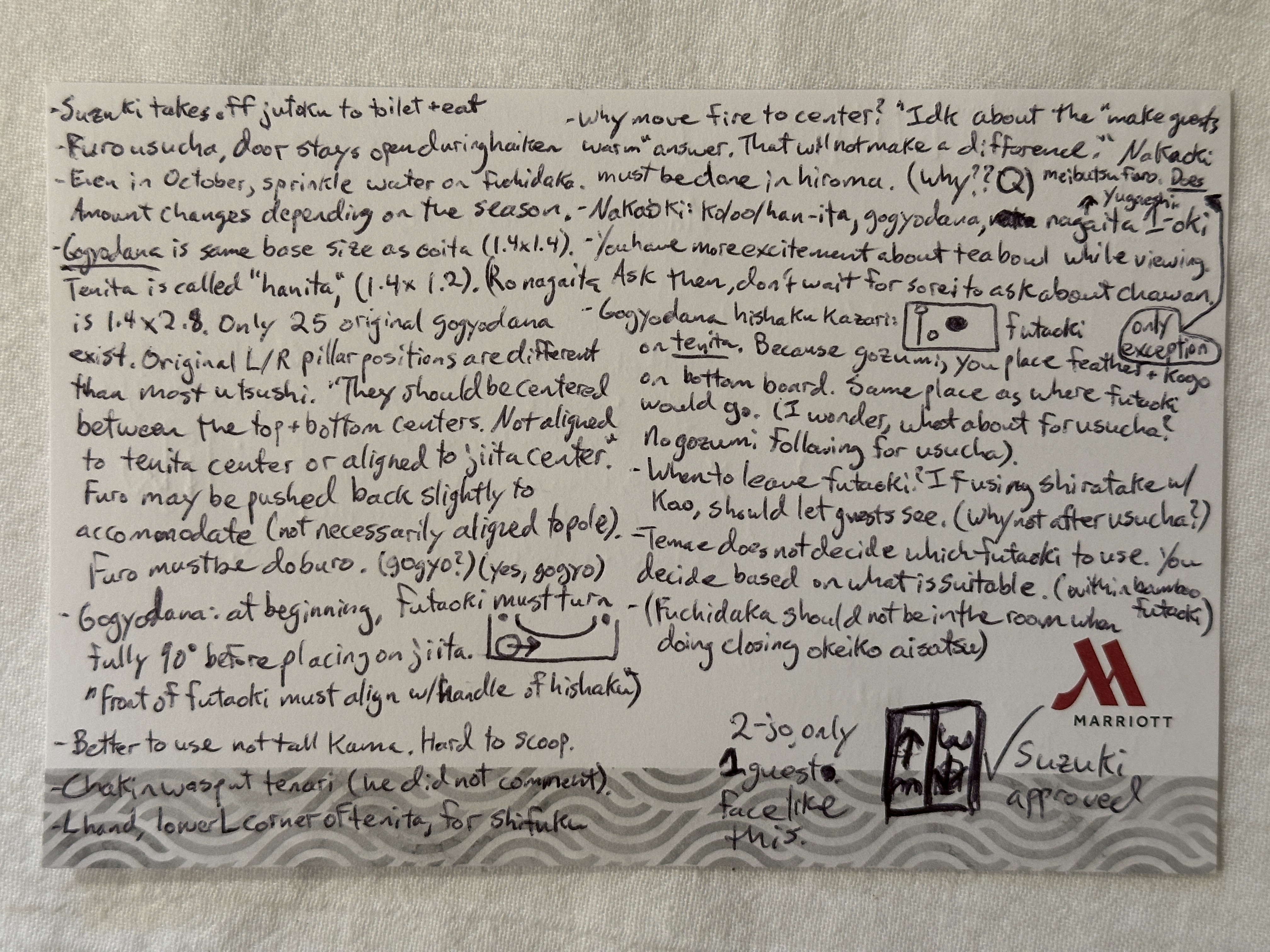
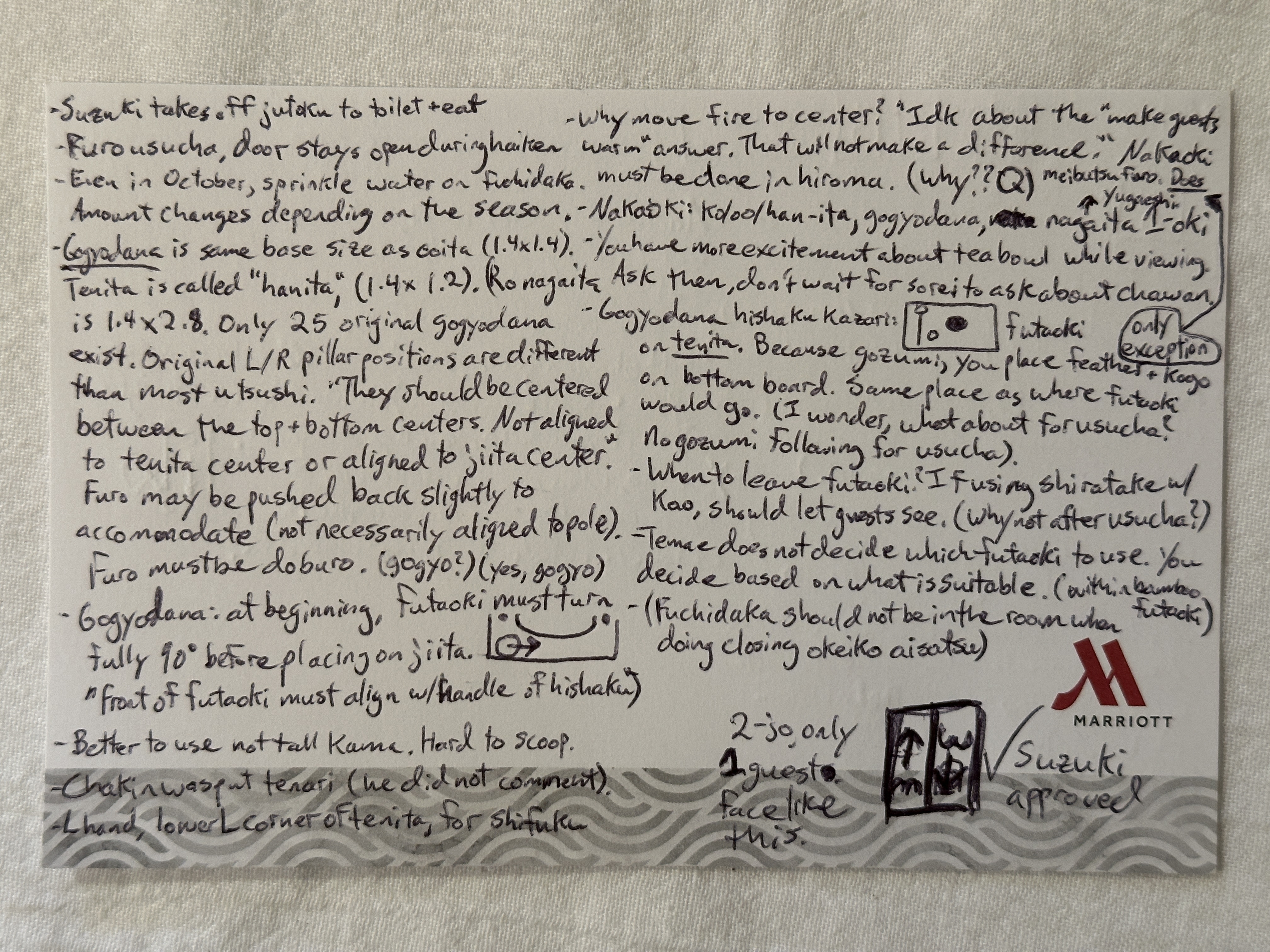
- Furo usucha, door stays open during haiken. (I forgot, not something new)
- Even in October, you sprinkle water on the fuchidaka. However, the amount you sprinkle should indeed change depending on the season.
- For raku (and usucha), better to ask about the bowl as guest while you are holding it.
- You have more excitement about the tea bowl while you are viewing it. Ask then, when you’re passing it around. Don’t wait for sorei after the bowl goes away to ask about the chawan.
- This is only applicable for non-tenmoku. Tenmoku has specific timings.
- Okeiko note: fuchidaka should not be in the room when doing teacher aisatsu after close.
- Futaoki placement: for hirademae, tangent to the front of the shikiita. He used a word that sounded like “tezuirezu”.
- Oval chawan, the narrow portion is the shomen, as it’s easier to drink from.
- “But they always put the wide part of the bowl front in museums. lol.”
- “Oshi itadaku”, 「押しいただく」, where oshi means “to push or press.”
- When doing chawan kansha before drinking, you do indeed lean forward. That’s the way.
- It’s hard to drink the whole bowl of usucha. There is always some foam left at the bottom. Before the last sip, wait a moment and allow the tea to settle in the bottom corner of the bowl. Then, after it’s pooled, you can drink.
- Host does not say okashi wo douzo to second guest. They just need to know.
- Also, personal note: the phrase is o-hayame ni chodai itashimasu for when eating early.
- In usucha, the host does not need to wait until guests return to their seat to take the bowl back. You can take it right away.
- Koicha is different. In koicha, you need to sorei, so everyone should be in their spots before the teishu takes the bowl.
- The teishu is usually the one who serves the sweets (fuchidaka + higashiki). If the hanto is the one serving sweets, they should close the door before the teishu starts.
Nakaoki koita / ooita
Temae done was koita usu/koi.
- Dougu positioning
- Imagine the mizusashi positioned where it is in hakobi hirademae, ie in the center of the right half of the tatami. Chaire, chawan, natsume, etc are all positioned as if they were sitting in front of that imaginary mizusashi.
- They must be tangent to the front of the shikiita.
- For koita specifically, shifuku to “kensui no hidari kata”. Specifically said to “avoid the drip from the lid”.
- Imagine the mizusashi positioned where it is in hakobi hirademae, ie in the center of the right half of the tatami. Chaire, chawan, natsume, etc are all positioned as if they were sitting in front of that imaginary mizusashi.
- (What I teach) During chasentoshi in koita specifically, move the chasen slightly to the right of the handle to avoid it when lifting instead of moving back toward you. Note: This problem doesn’t exist in ooita, Gogyodana, etc, because the kama is further back.
- When opening the mizusashi, the lid should be exactly how it usually is for sou position, ie 90deg left of the shomen. This means for nakaoki that it ends up diagonal.
- Nakaoki does not need to use Hoso-mizusashi. If it fits, it is sufficient.
- Suzuki-sensei’s addition: “Douguyasan need to make money somehow”
- The kensui is indeed pulled back very far in koita at shimai.
- To remember which is higher at shimai, shifuku or bowl: the shifuku has a relationship to the chaire. Even though it’s empty, it’s still a chaire object. So, it must be above.
- Always honjimai for nakaoki.
- Ooita is the same size as the ro (14x14 sun). Koita is 10x10.
- Ooita should be paired with a small furo. Koita paired with a big furo.
- (D: Same energy to using Unryugama with Toyama haigata. A diminutive castle spire sitting alone in a vast landscape.)
- Wabi stuff
- Yobitsugi: Kintsugi, but where missing portions of ceramic are replaced with shards from another bowl. Ideally from the same kiln so they have a similar texture.
- Zanka, or last flowers. We place wayyy more flowers than usual to celebrate them, often in a basket like the Suehiro. 7, 9, 11 kinds of flowers.
- Hangare futaoki == half-withered. Not all green or all brown. Nice for this occasion.
- Yose-ko, when you use all the leftover shavings and sawdust and whatever from the byakudan as your incense. Whole thing is dumped in.
- Why move the fire to the center?
- “I know people say that we move the fire closer to the guests to make them feel warmer. That is the beginner answer. But I don’t know if that actually makes a difference. Will the guests actually feel warmer?”
- Nakaoki must be done in hiroma.
- [?] TODO Can you really do hakobi nakaoki in hachijo? That feels really weird. ➕ 2024-10-27
- Five kinds of nakaoki:
- Koita
- Ooita
- Han-ita
- Gogyodana
- Nagaita hitotsuoki
- This one uses a meibutsu furo. Despite being hakobi, you do yugaeshi here. This is the only exception I have ever seen for this.
- Regarding when to leave the futaoki for kazari (particularly for koicha, where we usually don’t):
- If you are using an exceptional futaoki, like a shiratake futaoki with kao, you should let guests see it! Leave it out if it makes sense.
- On futaoki selection (aodake, hangare, shiratake, etc)
- Temae does not decide which futaoki to use.
- Temae dictates bamboo vs non-bamboo. That’s it.
- You must use your brain and select which kind of bamboo is suitable for your occasion.
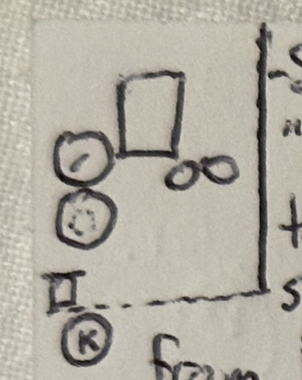
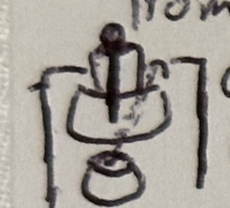
Gogyodana
Temae done was gogyodana koicha.
- Tana notes
- Jiita is the same size as oita (14 x 14 sun).
- Tenita is called a hanita, and it is 14 x 12 sun. Width is same, depth is shallower (and rear of tenita is aligned to back of tana).
- For reference, ro nagaita is 14 x 28 sun.
- Only 25 original gogyodana exist.
- Most utsushi are incorrect.
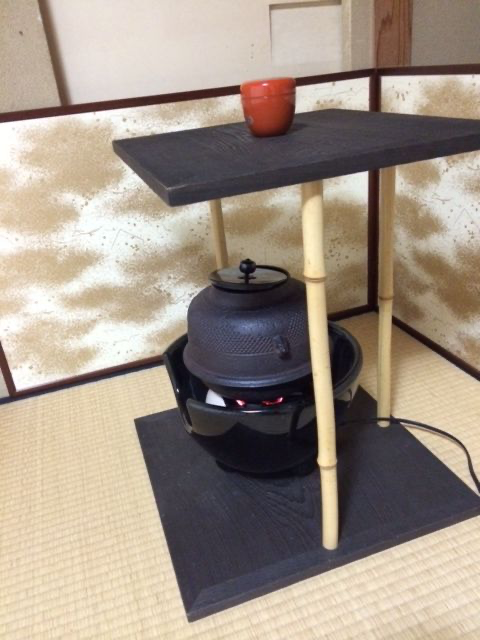
- The rear pillar is not a problem. The two side pillars are problems.
- On most utsushi, either the side pillars are placed to be centered laterally on the jiita, or centered laterally on the tenita.
- The centers are in different positions though! On the original, the side pillars are centered between those two centers. So take the tenita center and the jiita center; split that down the middle. That is where the side pillars go.
- Because most utsushi are incorrect, you cannot just rely on centering the furo on the pillars. (D: I think on the true one, you center on the pillars). The furo may be pushed back slightly to accommodate. There should be enough room to place the hishaku horizontally on the jiita comfortably.
- Furo must be doburo.
- Futaoki must be placed down 90deg before placing on the jiita. The front of the futaoki must align with the handle of the hishaku.
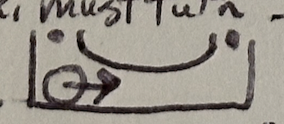
- Chakin then is placed tenari on the futaoki.
- Better not to use tall kama. Hard to scoop.
- Shifuku goes to near L corner of tenita, placed with L hand.
- When displaying hishaku and futaoki after koicha, the futaoki goes on the tenita.
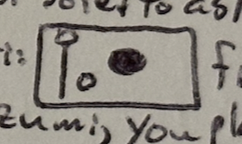
- Gozumi will happen after koicha, and the feather + kogo will need to go on the jiita. That is the same place where the futaoki would usually go in this kind of kazari.
- [?] TODO When displaying after usucha, this is not a concern. Does the futaoki go below for this? ➕ 2024-10-27
Koma
Temae done was sanjo hakobi usucha, temaeza on full marudatami.
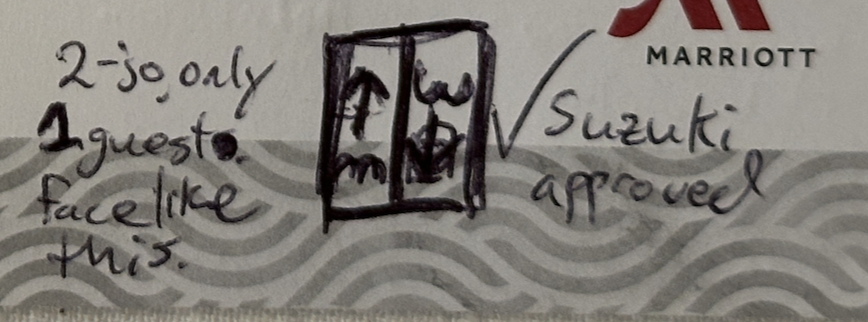
- Types of sanjo
- Hira-sanjo, three mats all lined up in a row
- Fuka-sanjo, two mats lined up with the third placed in a T abutting the back of temaeza (?)
- Furo is 6-sun from the back for full marudatami. 4-sun from the back for daime.
- Stand with L, back up with L, and cross with R.
- Q: Isn’t this too far of a distance to make?
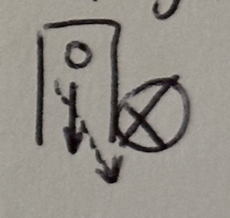
- If the door is a shomenguchi, don’t turn to break the plane when taking the kensui. You will need to back straight out. If you turn, you will end up going diagonal and through the wall.
Other notes
- Sterno 2x in Kirikake-furo is awesome to not use electricity. The kirikake covers up the view so you can’t see the sterno, and 2x keeps it hot enough.
- Whenever doing a master class, have a camera and show temae on big screen for audience.
- People I need to contact
- for sumi, chasen from Nara, and teaching class
- for tankokai
- for facetime
- Suzuki-sensei takes his Jutoku off to eat + go to the restroom
- For the anniversary, they did 10-12 warigeiko, then 1-5 masterclass. That was too much. I was getting fatigued by 3pm, then pooped by 4pm. By 5pm, I was dead.
Notes that I can’t decipher
- Genchu no gen (chashaku name?)
Questions that came up:
- [?] TODO Thinking more about midare. If midare is when the shakutate is not between water and fire, then only gyo no gyo and shin no gyo ro have midare. Neither furo temae are in midare. That would mean that the movement in gyo no gyo furo, where we push the mizusashi back, has nothing to do with midare. Is that right? ask-gyotei ➕ 2024-10-26
- [?] TODO What is the dougu-gumi for daitenmoku? ask-gyotei ➕ 2024-10-26
- [?] TODO Tana question, 3/5/7 edge? ➕ 2024-10-27
- [?] TODO Why does nakaoki move to center? ➕ 2024-10-27