This recipe is used for Ayame, Ichou, and Uiro-Wrapped Balls. Minazuki uses something slightly different.
2026-06-21 Sweets workshop prep
Used a different recipe from youtube that I really liked.
- 45g joshinko
- 15g mochiko
- 10g katakuriko
- 80g granulated sugar
- 90g water
- (Steam for 30m on ripping high in the big steamer)
It turned out great overall. Texture was nice and chewy, easy to work with, etc. Downsides:
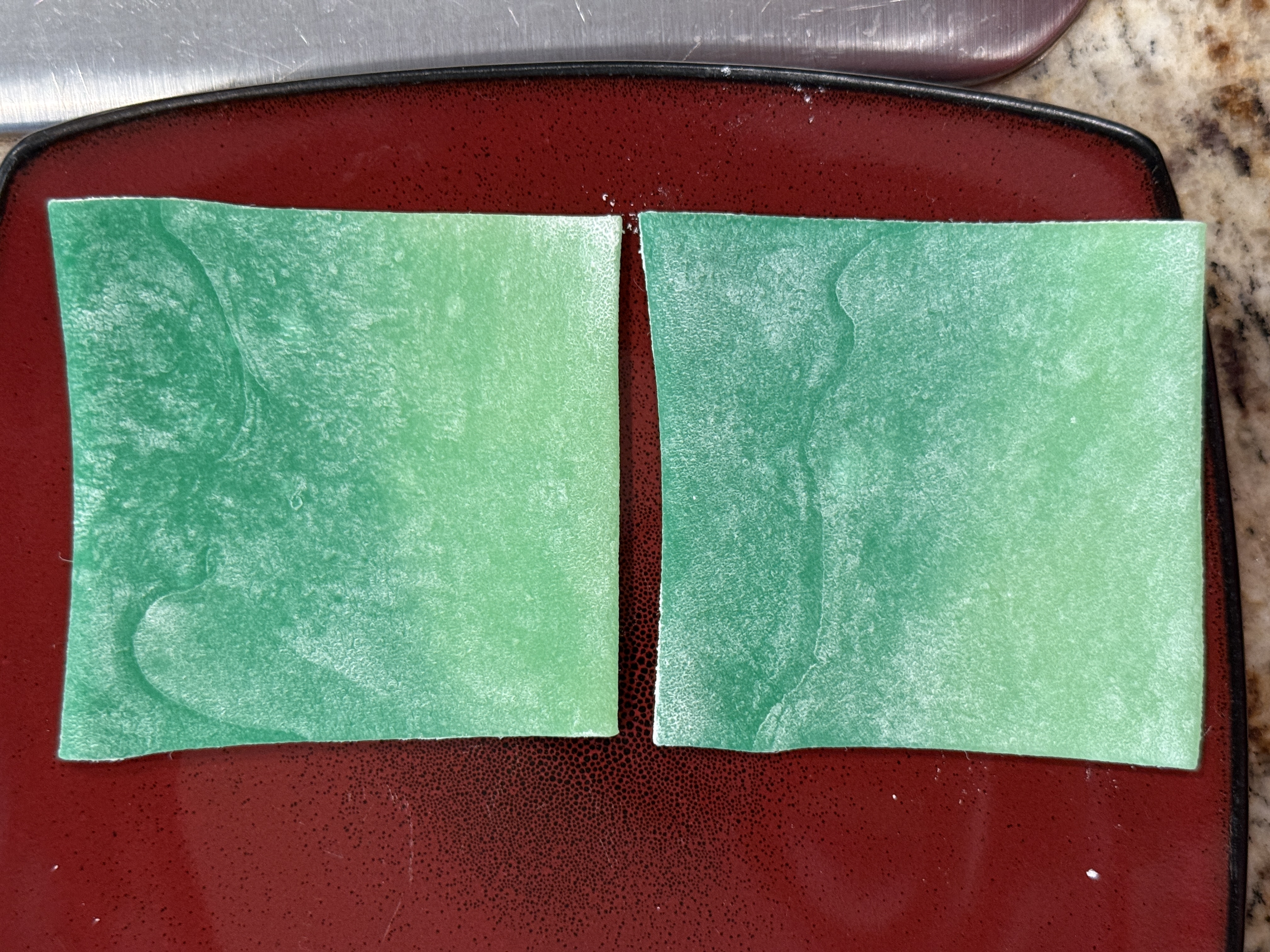
- Blending the hotdogs didn’t really work (below). It was hard to get the colors to actually blend, so they ended up more overlapping each other than blending, causing these waves to appear in the finished product.
- Might be able to address by just being more aggressive with blending, and making sure the dough exterior is dry so it blurs better.
- Also wondering if the other recipe will be better.
- The starch also stuck to the skin a little more. I think this is just a matter of waiting for it to dry out fully before putting the katakuriko on.
Uiro with poor blending
Things to try for next time
- Wait for the skin to dry fully before coating in katakuriko
- Use dry hands to blur the hot dogs
- Try original recipe, but 30m steam on ripping high instead of 25m
Things that worked well or tips to share overall
- From Miyazaki-sensei, steam until it’s slightly translucent. If it’s still opaque in the center, it’s going to be under.
- 30m on high heat on the big steamer (less hot than the small one?) was great. I probably need to try that with the other recipe.
- Try to make it as wide and flat as possible in the steamer so that it cooks more evenly.
- For shiro-an, if it’s crumbly then it’s too dry
- Use mitsu instead of water! Always!
- Even when the mitsu dries on your hand and gets sticky, the sugar still provides a bit of a barrier that lets you keep going. It introduces much less moisture into the sweet.
- Adding color still requires a ton of mitsu, but that seemed fine.
- 50/50 of sugar and water by weight, bring to a boil then stop. Don’t go further otherwise it will be too viscous.
- Use as little mitsu as you can get by with. Too much mitsu and it will get soft.
- Flat
- Shape with hands first to get the overall rectangle before rolling
- 8cm squares was great
- Pretty side should be on top when rolling
- Same thing here, don’t dust until it’s dry
- Gently flatten after first fold when assembling rather than leave as ball
- Plum
- Cover a plate with saran wrap and place on that, keeps it from sticking.
- Let the ball exterior dry completely before coating in katakuriko to keep the exterior from holding onto too much starch.
- To do the starching
- One hand wet, one hand dry. Wet (mitsu) hand should be as dry as possible, just have a little coating of sticky sugar to keep it from getting the sweet wet.
- Put into the bowl, roll, take out with dry hand
- For making the point, don’t reshape any of the naka-an. You don’t actually want to change the shape of the plum, you just want to pull the uiro up a bit to redistribute it into a point.
- For shaping, I found this worked well
- Make the point
- Then gently smoosh with palm so it’s gently oval (looks more “full” that way)
- Then hera, then pinky knuckle
- Then gently reshape, fix back into a circle
- Yellow should be slightly off-center to the left
- When doing the doubleshot color:
- Don’t flatten the base completely, just bring it together and get it to a thick disc
- Then put the yellow on top, giving the yellow a chance to spread as you take the “blank” and flatten it out
- (If you add the yellow after flattening the disc, or you make a heavy indent to put the yellow into, the yellow won’t smooth out and it’ll just be a heavy yellow dot in the middle)
Check this out, watermelon uiro icho style https://youtube.com/shorts/dSN2gR9Tdis?si=w-FbC2Kl0cXPCrqq
—
Okay I did the trial again, and this time it went much better.
- Used the original recipe, ie the one below that I’ve been using for ages, but this time at 30 minutes instead of 25 or 22, and on ripping high heat. I loved it, I think this is what I will use from now on.
- The other recipe is very good too, but the outcome is a little more elastic. For uiro, I prefer more chewy, which you get from this recipe.
- I tried the blending technique where you take the two hot dogs and form the edge where they meet into a little wedge, then overlap the wedges. It worked nicely (you still have to blur the hot dogs), but you need to keep in mind that if the wedges are long, the transition period will be long. For colors where one is intense and the other is pale, the transition can overpower the pale color. So for those, keep the transitions short.
Recipe
This recipe has gone through a lot of changes. This recipe is my current favorite. It is a mix of sweets lady’s ingredient list and Miyazaki-sensei’s technique.
Ingredients
Dough
- 65g granulated sugar
- 35g joyoko (from Miyazaki-sensei, joshinko is a reasonable substitute)
- 20g mochiko
- 15g hakuriki-ko (cake flour)
- 5g kuzuko
- 85g water
Making the dough
- Sift and mix the dry ingredients, sans kuzuko.
- Incorporate the kuzuko into the water, then add to the dry mixture. Pass through a strainer to avoid lumps of kuzu. Mix well.
- Line a steamer with sarashi, and pour the mixture directly into the sarashi. Steam on medium-high for 25 minutes.
- (Note: I did 2/3 of this recipe and did only 20m. That worked well. Maybe I should do that always.) → Did this again, worked great. Yield was 140g after steaming.
- On 2025-11-28, I made the full recipe at 22m. I don’t think I would go lower. It was perfect.
Working the dough
- Remove from steamer and knead using the sarashi used for steaming.
- Just knead until it’s cool enough to start working with your hands.
- Remove the dough from the sarashi and put directly onto a baking sheet.
- Keeping your hands thoroughly wet (plain water is sufficient), add color and knead in your hands.
- Note: Because it is not going into heat after this, you can use plant-based food coloring.
History
Sweets lady recipe
Youtube: https://www.youtube.com/watch?v=LHMgjEWyUPQ
Miyazaki-sensei’s recipe
Trick from Miyazaki-sensei: Before rolling into hot dogs, fold into itself like how we do with mochi to make the surface smooth.
Full reference: https://drive.google.com/drive/folders/1CRhqS7b-80xOqfiez7KFm9967fsAscn9
- 50g joyo-ko (a fine grade of rice flour. Joshin-ko can also be used)
- 20g mochiko
- 90g sugar
- 13g kuzuko
- 100g water
- 15g x 6 balls of koshi-an
2024-05-11 - Ayame
Historically, I have used the recipe from the top, but this time, I tried the Wagashi Issho recipe.
Everything about the technique, I loved. I should do that every time.
- I loved coloring it after. That was so much better, because I could use plant-based food coloring (gentler, no need to worry about heat stability).
- Steaming was also significantly easier coloring it after.
- Kneading in-hand on top of a baking sheet, instead of with sarashi, worked surprisingly well.
- Blending the seams of the hotdog on the baking sheet worked well.
The recipe composition itself, I loved less. It was much softer than the other recipe. Easier to cut with kuromoji, but the texture almost felt the same as the anko once putting it in your mouth.
Next time, I should try Miyazaki-sensei’s technique, but with Machiko-sensei’s recipe.
2024-10-05 - Ichou
- Used a 3in circle cutter, really would like to use one slightly larger (3.25”?)
- Used sweets lady recipe, but steamed all together and split + colored after.
- Just used our hands to knead in the color, wetting frequently and kneading on a sheet pan. Didn’t work great. Would have been much better to use sarashi.
- Split dough half green, half yellow.
- Rolled hotdogs imagining quarters, eg 1/4 yellow on either edge, then 1/4 x2 on the inner part. That results in half/half circles.
- Rolled the hotdogs a little too long imo. They needed to end up being 9”, and we rolled them to 6”. But they were much skinnier than they needed, so we didn’t have room to roll them out evenly.
- Next time, make them shorter (4.5”?) and leave them wider.