Warning
The only success I have had so far is with glenn’s recipe. Everything else has come out watery.
Photo
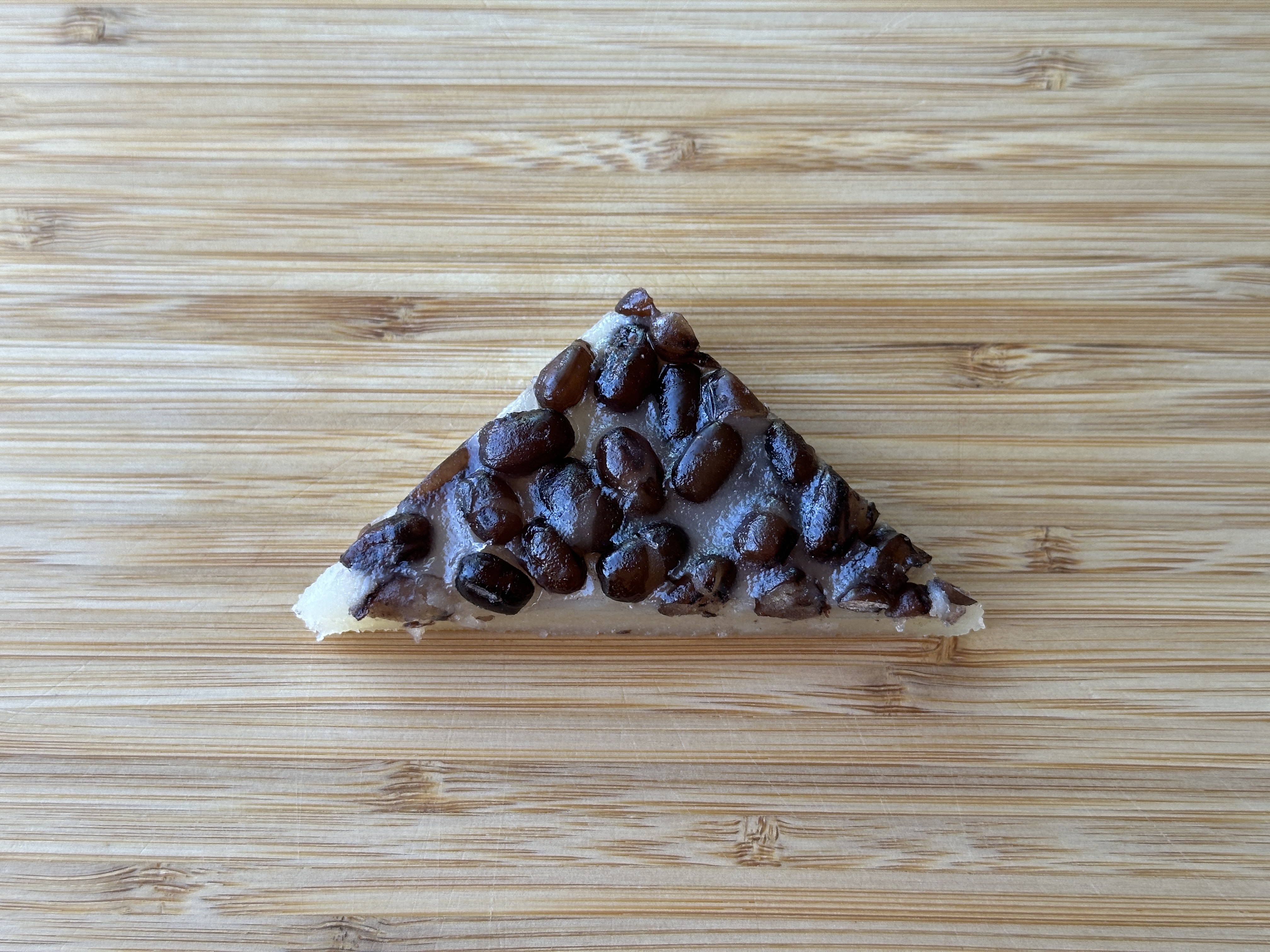
Attempts
2025-05-30
- Making Glenn’s full recipe yields 936g total. I used 527 for our 7” x 6” nagashikan, leaving 409g remaining.
- Make sure to use a strainer on the shiratamako too, not just the kuzuko.
- My big steamer doesn’t quite fit the nagashikan. I had to make a ring of aluminum foil as a “riser” for the pan to fit (as the edges of the nagashikan just hang over the edge of the steamer basket).
- Don’t forget to rotate the nagashikan when doing the bean + second pour addition. Can’t miss the corners :p
To try next time:
- Don’t do a second pour over top of the beans. It makes it look… messy? when it comes out, some of the beans end up partially covered. Instead, try this:
- Drain the liquid on the top of the uiro that collects after the first steam
- Pour batter on top just once. Add all the batter you’re going to want here.
- Then add the beans on top, gently patting them down.
- Then, that’s it. Steam. Don’t add more batter
- UPDATE: did these things the next day. It worked great.
Recipe
From the book, for a 16cm x 13.5cm nagashikan:
- Cake flour 80g
- Joshinko 16g
- Johakutou (sugar) 150g
- Mizu 300g (250g + 50g)
- Kuzuko 5g
- Nure-amanatto 60g
Our nagashikan is ~7in x 6in, or 17.8cm x 15.2cm. Multiplying proportionally by the size above (1.25x), that gives us:
- Cake flour 100g
- Joshinko 20g
- Johakutou 190g
- Mizu 375g (325g + 50g)
- Kuzuko 6.25g
- Nure-amanatto 75g
Steps
- Mix (kuzuko separately a la corn starch), let sit for 10m.
- Sift before dumping into tray. Leave ~50g of liquid to put on top later.
- Steam first for 10m on medium heat.
- Add beans, add excess liquid steam again for 20m on medium heat.
- Cover with a wet cloth and let cool completely.
- Cut into triangles.
Attempt 1
It was awful. Didn’t cook in the center.
Things to try for the future:
- Don’t use wax paper in the steamer, it’s not good and it sticks to the side. Use parchment paper instead.
- Make sure to wrap the lid in sarashi to keep the condensation from falling onto the uiro.
- Raise the nagashikan with hashi to get air underneath and heat the middle more evenly.
- Maybe the johakutou was weird? It was pretty old.
Attempt 2
Glenn’s recipe. Original for 2x nagashikan:
- Kuzuko 25g
- Shiratamako 45g
- Joshinko 90g
- All purpose flour 120g
- Sugar 250g
- Water 420g
- Nure-amanatto 100g
Scaled down by 0.625x:
- Kuzuko 16g
- Shiratamako 28g
- Joshinko 56g
- All purpose flour 75g
- Sugar 156g
- Water 262g
- Nure-amanatto 62g
Sweets lady’s recipe, which is almost identical to the book but with slightly less sugar:
- Hakurikiko (cake flour) 80g
- Joshinko 16g
- Sugar 130g
- Water (250 + 50)g
- Kuzuko 5g
- Nure-amanatto 50g
2024-06-22
Making the Nure-amanatto was weirdly really hard. Recipe detailed in the link.
For the minazuki:
- Make the full amount of batter in Glenn’s recipe above, just to have extra. Better to have extra than to not have enough.
- To make the batter:
- Mix kuzuko, shiratamako, water, and strain.
- Add sugar, mix well.
- Add joshinko and flour, mix well.
- Let it sit for 10m ish, then mix again so the lumps all go away.
- Use a whisk to mix the batter, not a spoon. It works much better.
- When fitting the parchment paper into the nagashikan, cut away the edges.
- If you insert the parchment paper and fold it up, you end up with a lot of paper in the corners. That paper will push back against the liquid, and it will mean you have to cut off a lot of the edges, because the batter won’t go all the way to the edge.
- The solution is to completely cut off the corners. You know how cardboard boxes, if you unfold them, they look like a cross? It should look like that. Zero overlapping paper.
- Make sure you have airflow below the nagashikan.
- This is just my hypothesis, but when I didn’t do this, the middle was undercooked.
- My hypothesis: if you place the nagashikan directly onto the steamer basket, it leaves only a tiny (1mm?) amount of space between the nagashikan and the bottom of the steamer basket. This severely inhibits airflow, which means you end up insulating the bottom of the nagashikan with 1mm of cold air.
- Instead, raise the nagashikan slightly. I put chopsticks on the bottom of the pan to do this.
- There will be a tendency to pour a ton of batter into the nagashikan for omotenashi. Don’t do it!
- Using our Westcott plastic ruler, a good amount to pour is up to the 0.6cm line when you insert the whole ruler. I don’t know what that actual height is, given that the ruler has some extra on the end, but it probably comes out to around 1.5cm.
- That gives a good measurement for any size nagashikan.
- Cook on ripping, as-high-as-possible steam for 15m.
- Make sure to cover the steamer lid with sarashi to keep from dripping.
- After the first steam, the top of the minazuki will look a little like brains, with some folds forming. That’s okay.
- Pour a tiny amount of batter onto the top. Just enough that if you pick up the nagashikan and swirl it around, it will just barely coat the entire top (but maybe not even that).
- Cover with beans.
- Patting a little with your hand to move them around is okay.
- Pour batter over the beans until it’s the desired height.
- Make sure to get uniform coverage. You need to do that while pouring, not by swirling it around (because the beans will move otherwise).
- I think it’s nice to have batter go to ~half way up the beans.
- Steam again on ripping high heat for 15m.
- Remove, take out of nagashikan, and let cool on a drying rack until it’s cooled down enough to handle.
- Cut.
- Use the sharp knife! Dull knife will smash the beans.
- The knife should be dripping wet when cutting. That will keep it from sticking. Clean between cuts.
- Try to push the knife evenly and flat through, rather than rocking it (like you are usually supposed to do). That will make it misshapen.
- Keep in a container with a wet paper towel to keep moist.
- (Glenn brushes with sugar syrup before serving; I’m too lazy).