- How to take fukusa out
- For women:
- Fukusa should be 1/3rd in, 2/3rd out from their obi. (This is the normal amount).
- Fold the fukusa up (rather than folding in) in half. That should result in 1/3, 1/3, 1/3.
- Take out directly from there, flipping over to place on L palm.
- For men:
- Same with 1/3rd in, 2/3rd out.
- Fold the fukusa up (rather than folding in) in half. NO PULL.
- (I think it’s no pull from prior notes… but we didn’t talk about it today)
- Take out directly from there, flipping over to place on L palm.
- For women:
- Position differences
- Fukusa sabaki is over R knee, coming to center at end
- Chakin wiping is over R knee, coming to center at end
- Chawan and chaki positions in front of mizusashi are flipped.
- Chaki on kyakutsuki, chawan on kattetsuki.
- In usucha, this is opposite from how you carry, so you need to place down natsume then rehold chawan and place down.
- Chaki and chasen are still L and R, but they are positioned like mukogiri.
- Chaki on a diagonal, shomen facing you (and chashaku tenari on top)
- Chasen at mizusashi shomen, facing same direction as mizusashi shomen
- Handling differences
- Hishaku down with L
- Futaoki still with R
- Kamae still with L
- Mizusashi 4h, take with R and down with L (inside between mizusashi and kama, tsumami facing mizusashi)
- Chawan L→R from mizusashi shomen, then natsume R.
- When opening the kama lid and using fukusa:
- Fukusa goes to R knee for kariza. (You can’t hasami because you need to pick up with L).
- At the end for chashaku kiyome, all happens with R
- Take chashaku R, then nigiriconde and do the following in nigirikomi:
- Pull kensui with R
- Take fukusa with R
- Chawan movement, just check in book. But I think:
- Chawan L→R from mizusashi shomen, then opposite for back
- For koicha, down with kattetsuki hand (R), then R→L→R to get to mizusashi shomen
- At the very end, L→R→L to put to katte
- Then when you take it to stand, just L
- Kensui L/R alternating
- He doesn’t think keeping track of L/R alternating is a big deal (e.g. when you have more than one guest).
- For him, it is important to make sure you start and finish with L.
- This means that you might repeat two L’s in a row at the end.
- Reason for L on the last one is that you need to take the chakin, and you need R free for that.
- (Note: I don’t know if this jives with earlier notes from Midorikai… need to look)
- Haiken
- Teishu puts dougu out kamiza order, and it always stays that way.
- His preference is that when the guest brings the equipment to their spot, they keep it in that kamiza order. ie chaki on L side. Then when they get to their spot, it goes inside as you would expect (most important object closest to you).
- Then on exit, place the dougu immediately into kamiza order, then travel that way.
- (He has also heard doing the opposite. When he was originally taught, Palmer-sensei had him flip the dougu to R/L immediately.)
Seki-iri - (For context, all of these notes will be for 3 guests in a yojohan)
- He has heard of some people preferring not to have all 3 people stand at the same time. But he doesn’t have a problem with that.
- Valid ways he has heard of:
- Shokyaku sits in jikyaku spot when when the shokyaku finishes temaeza haiken. This is instead of kariza. This means that the tsume will have to walk around them. (iirc this is iwama ‘s style)
- He doesn’t like this because of the tsume having to walk around the shokyaku.
- Shokyaku and jikyaku sit on the same hanjo in kariza. Then when the tsume stands from temaeza haiken, all 3 people stand together and walk to their seats.
- He doesn’t like the cramped seating of two people sitting in kariza, and he doesn’t like the “synchronized swimming” feeling of everyone doing the same thing together.
- Toko haiken and temaeza haiken people synchronize standing.
- He doesn’t like the “synchronized swimming” feeling.
- Personally, I don’t like being limited. You should both feel free to look as long as you want.
- Shokyaku sits in jikyaku spot when when the shokyaku finishes temaeza haiken. This is instead of kariza. This means that the tsume will have to walk around them. (iirc this is iwama ‘s style)
- Both his preference and the shogo no chaji book (and the chaji video) are that temaeza haiken and toko haiken do not need to be synchronized.
- Toko haiken person cannot stand until the temaeza haiken person finishes, because they need somewhere to go.
- Temaeza haiken person does not need to look if toko haiken person is done. They can just go at their own speed.
- His way, which I mostly like:
- Shokyaku sits in kariza, taking up the full hanjo.
- Jikyaku and tsume synchronize their movements when standing from temaeza and toko, respectively. When this happens, shokyaku stands as well.
- Shokyaku goes to their seat.
- Jikyaku also goes directly to their seat, bypassing kariza.
- Tsume goes to temaeza haiken.
- Overall feeling:
- Don’t cram too many people in kariza.
- When your final destination opens up, go there right away.
- What I don’t like about his way is that toko haiken person and temaeza haiken person have to synchronize movements.
- For furo (and maybe for ro, who knows), the kariza position for fukusa after wiping chashaku but before kobiki lid is by right knee. After lid kobiki, it goes to left knee .
Specific things for Dario
- Any time when standing, make sure to fully stand and let both heels touch the ground before taking your first step.
- I have a tendency to be a little pitched forward when I stand, then to start walking forward before I’ve finished standing up.
- Finish every move before starting the next!
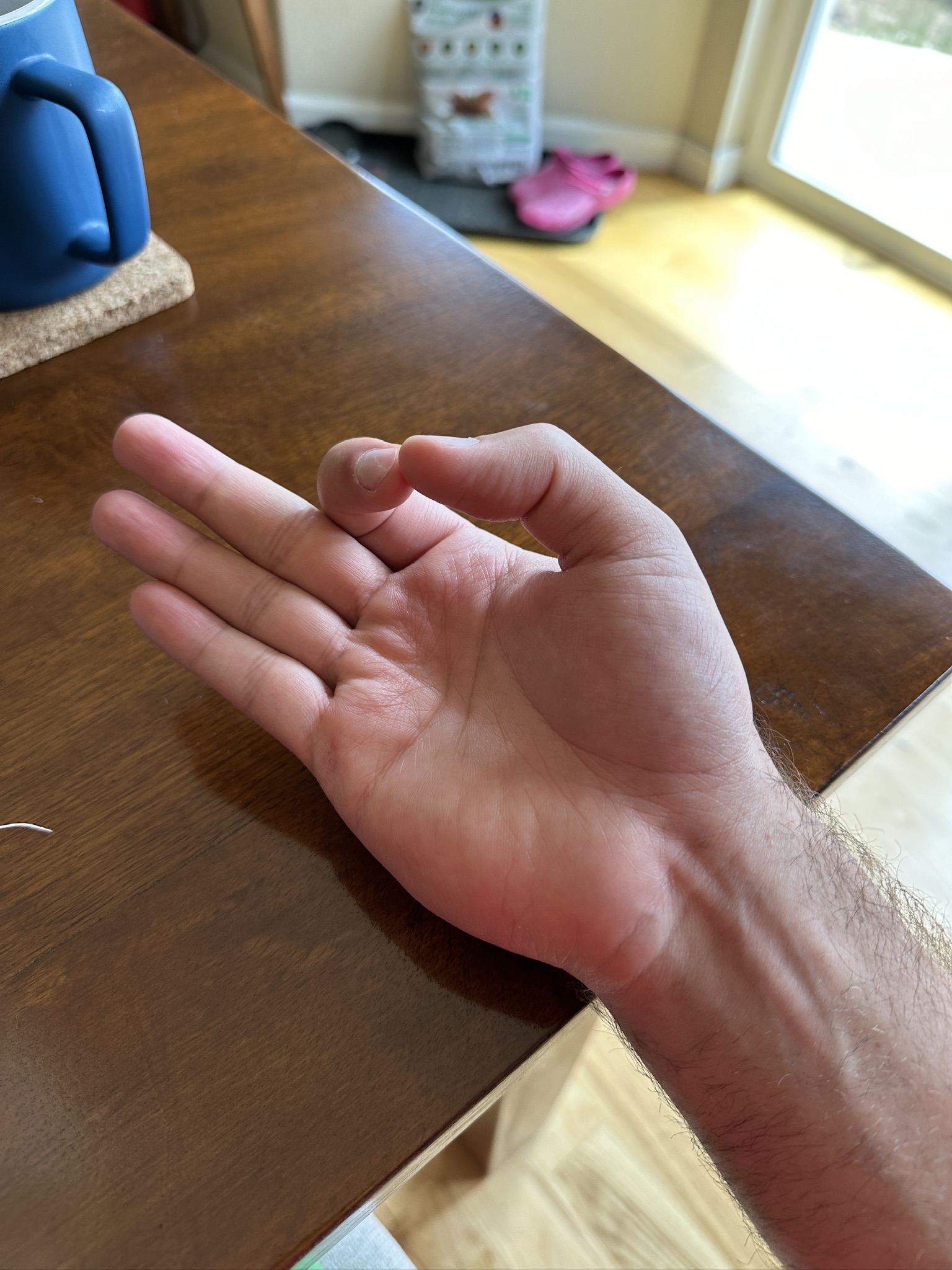
- When holding things, e.g. kensui, try not to bend your thumbs. Keep them neutral.
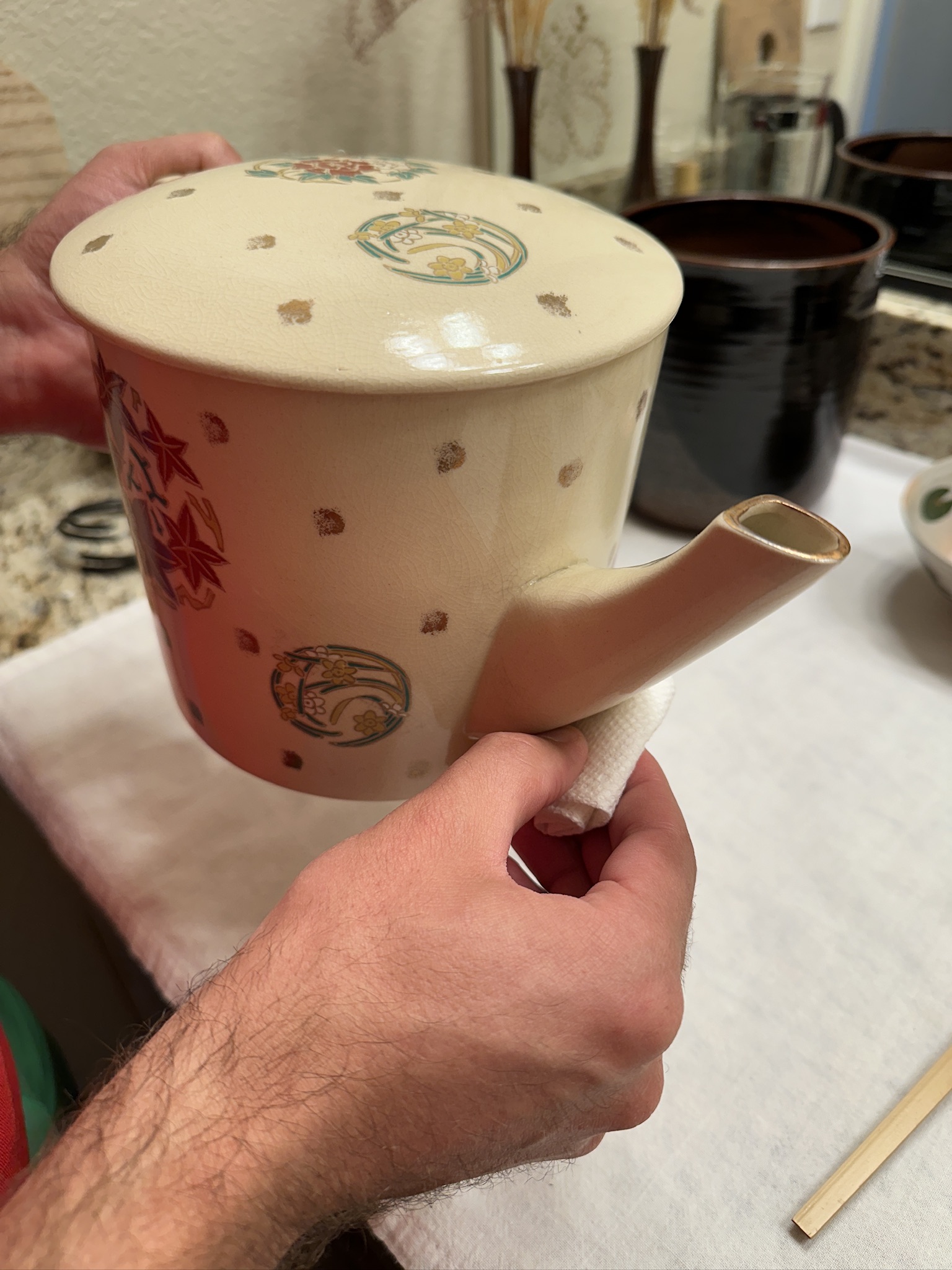
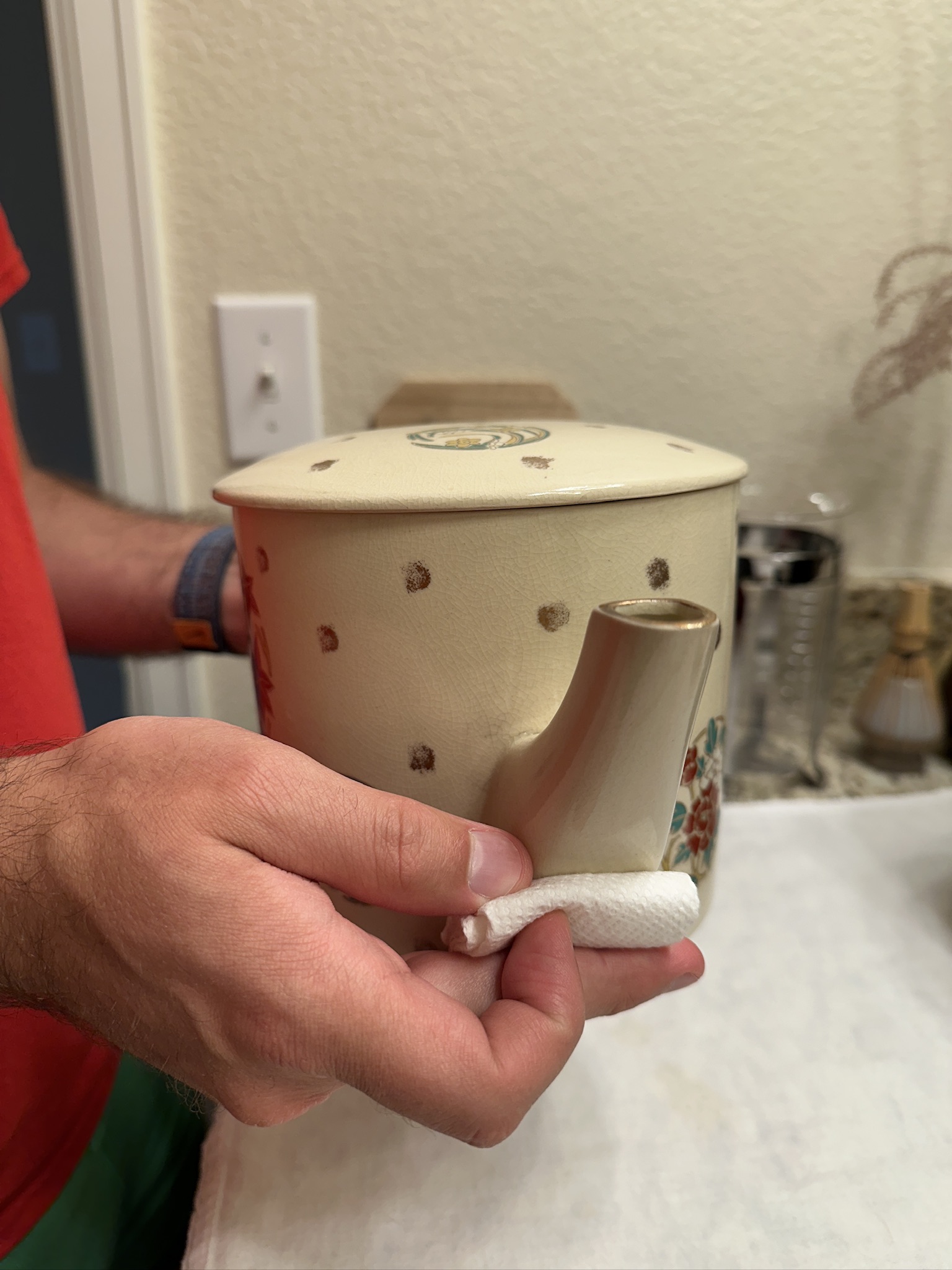
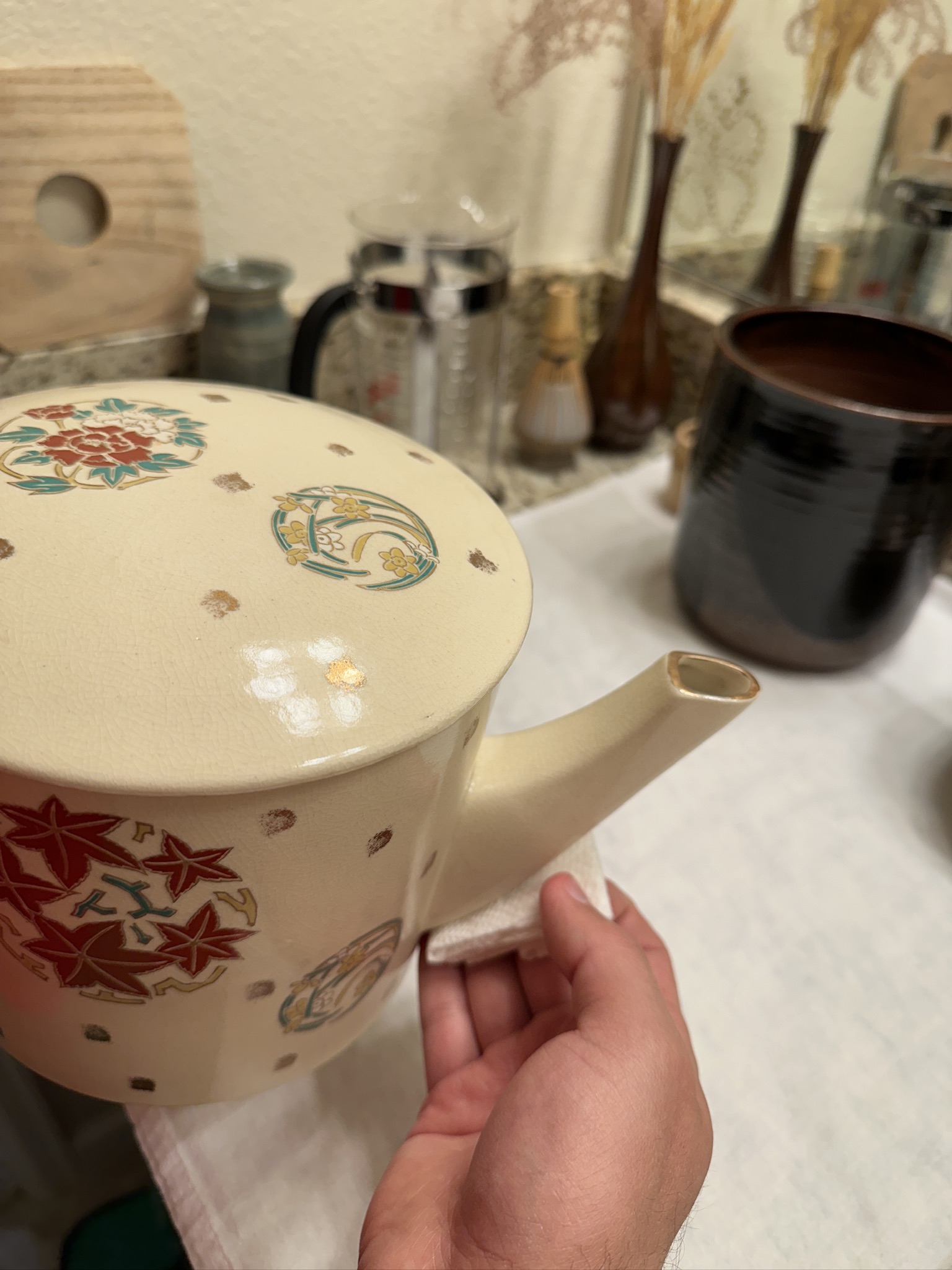
- Glenn’s way of holding Mizutsugi
- I hold it… I dunno, how I’ve always held it.
- But he doesn’t like that, because your thumb is trapped between the chakin and the spout, and water could dribble down onto your thumb.
- His preference is to hold the corner of the chakin with your thumb and index finger, then extend your other three fingers out straight and use them to support the spout.
- I hold it… I dunno, how I’ve always held it.