%%
Records
TemaeD:: Gyo no gyo
TemaeK:: Bondate
Season:: Ro
Paid:: x
Okeiko with Suzuki-sensei.
Also nagashidate ro (usucha)
- Gyo no gyo
- Tenmoku chawan, never let the thumbs go over the rim of the bowl. Hold underneath to take and put down onto dae
- Chasen fushi always inside the chawan, for any chawan
- When moving chawan to daisu jiita, don’t put on palm. Keep holding with thumbs below.
- Seven kinds of tenmoku.
- Dougu
- Chuko meibutsu or meibutsu. Shin is oo-meihutsu, pre rikyu things. So generally good to select things contemporary with rikyu ish
- Motobushi was NOT created by gengensai. There are joo, shuko ones in the museum. They exist. So for trying to choose dougu all within the same era, pick one of those
- ko-seto mizusashi
- Two main chaire used. Can’t remember the names now. But both bunrin.
- fukiage bunrin was one!
- iwaki bunrin i think was the other one?
- Dai should be karamono level. Amagasaki dai is a common one to use for this. It has a metal rim, just like how the keiko tenmoku have a metal rim
- Chawan should be one of the seven kinds of tenmoku (there are seven, look!). Yohen and yuteki are two. The one we used, very thick with big glaze drops on the front with actual volume to them, is kensan. There were also a couple other -san ones (usan?), but his suggested favorite was one with a longer name. The ones that are very Kira Kira (yohen, yuteki) scratch easily. The favorite chosen by Rikyu had a more dull interior and was safe against scratching
- Kama ideally should be more formal too. He mentioned a preferred kamashi of rikyu’s, but I can’t remember. We did sukigigama, and while he said that it’s better to not use something so seasonal, “it’s fine to use even for shin no gyo”
- You can remember how water looks on hakke because if you turn it on its side, it kinda looks like 水 (and it is opposite to the fire character, which is the shomen)
- Hoyasan, it is not used for hishaku in gyo, so you don’t need to position it with respect to where a hishaku should go. Instead, put it where you would want it usually (shomen parallel to body), but make sure the two closest points are parallel to the robuchi. This looks nice. (Same holds for 5 pointed hoya. Two points parallel)
- I asked specifically about in-yo for the shifuku position. He sighed and said don’t worry about it. Just put it lower left corner
- On turning bon and things
- Chaire is a yang object, so you have to turn it a yin direction (left).
- Everything else that we turn, generally, is a yin object (bon primarily). So that turns right (yang).
- Major exception is in shin no gyo. In that temae, the bon and the chaire are considered one object. The bon is on the right of the daisu, so you handle it with rigjt, but it’s part of the chaire, so you turn it left.
- Tenmokujawan is turned left when on the dai, but I didn’t catch why
- Wiping tenmokudai
- Hold deep on the hane when taking. This means you really need to hold R nigiriconde in two fingers, leaving the others free to let them hold deeply
- Daisu positioning
- The mizusashi should be centered in the right half. but how to get the right half is not obvious.
- The ji-ita can be divided in half, straight up from center to edge.
- But it’s not just that. The width of the poles (2cm?) contribute to the balance. So instead of dividing exactly in half, you divide from center to (edge minus 2cm). Practically, this puts the right-most point somewhere close to the poles, instead of to the very edge.
- Shakutate and kensui follow the same rule, but vertically.
- They are centered in their left half.
- But to place them vertically: split the daisu in half front-to-back, following the same rule about omitting the width of the poles.
- Then each object goes in the center of its respective half
- The mizusashi should be centered in the right half. but how to get the right half is not obvious.
- Hibashi
- Took a video on how it goes. Slightly different from Glenn-sensei’s way
- Be sure to keep the hibashi pointing directly forward when giving it to your left hand - don’t let it rotate tenari too early
- There are gyo and shin hibashi. Gyo no gyo should be using gyo hibashi (e.g. torigashira). Shin should use shin (shin = rotationally symmetric). But it’s okay to use shin hibashi in gyo no gyo. If you use torigashira etc, make the bird heads both face the sky when you put them down.
- When pushing the hibashi deeper next to the daisu, never let your fingers cross the front edge of the daisu
- Fuki modoshi
- Reason we do this is because we don’t usually wipe the very bottom of the chashaku. We wipe the top, but where our hands hold at the bottom doesn’t get wiped.
- So we push to wipe the whole thing
- Then we re-wipe to clean where we just touched it
- When pushing, just keep holding the chashaku “as usual” with thumb on top. Don’t push it in with your thumb like you’re pushing a button.
- Reason we do this is because we don’t usually wipe the very bottom of the chashaku. We wipe the top, but where our hands hold at the bottom doesn’t get wiped.
- Putting the chasen to the side
- Reason is because there is no other place to put it. The karamono chaire must stand alone. So the only two choices are by the kensui or on the right side.
- By the kensui works just fine, but that’s dangerous. Too much traffic going back and forth next to the chaire. Your chaire is the most important thing. you must protect it!
- “risk management” he says lol
- Then you hide it briefly while it needs to be cleaned
- Position is in the center of the space created between the corner of the ro and the end of the tatami
- 5 lines below the heri, sitting on the 6th and 7th heri (sit on a valley, not a mountain)
- When over here, chasen shomen should face YOU, not be perpendicular to the heri or anything
- Reason is because there is no other place to put it. The karamono chaire must stand alone. So the only two choices are by the kensui or on the right side.
- When removing hands from tenmokudai, also remove first with L (not stack order)
- Fukusa does go above the knee line when putting next to the kensui
- When removing the fukusa from the chaire (or any time), you should keep contact with the chaire UNTIL IT TOUCHES THE GROUND. So even when you pull away, keep touching it with the fukusa until the chaire is no longer in motion.
- Similar feedback in general for me. When taking the chaire back after scooping out tea (and before), make sure your R hand is fully on the chaire with thumb on shomen before starting to move
- Hishaku should not be inside the chawan when pouring!
- This is true for all tenmoku, aka literally every time you pour irrespective of chawan, the hishaku should be one go above the rim of the bowl
- He has never heard of “keep the hisshaku low”
- Note: hishaku inside chawan comes from shimura.
- Kamae
- His preference is kagamibishaku every time you take it
- Also, because you need to hold slightly lower to put in shakutate (you cannot hold above the node EVER except for in shin no gyo with the pull-pull, so you should hold L a little below the fushi to allow R to go onto the fushi), you should ALWAYS do this. Every single kamae should be L just below fushi, not on.
- Tap inside the bowl is chashaku tip hitting the side wall with L hand on the other side. Same for literally any bowl as long as it is ivory
- Tap with tip of kasaki hitting the chawan wall, not side of kaisaki. (He mentioned to rehold for this, but I don’t quite remember how the rehold works)
- For zig zag, just L soeru like blade
- Fukusa karioki position: it should always be below the half-way point along robuchi. This usually doesn’t matter (because the fukusa ends up lower due to sotozumi imai), but in gyo because of your Imai, you are higher. So your karioki position must end up lower, below your usual right knee corner
- Suikiri with finger on chawan, both times, above knee. Also for chakin, only wipe rim (not body) using fukudame in the direction of the rim
- Momite comes from the movement “shiba chozu”
- L start on top, end with R on top
- Really think about wiping palms together
- When bringing out the kensui from the ji-ita at the beginning, no major need to avoid anything (there’s no room), but it’s nice to bias left to “partially avoid” the chawan and chaire. “At least enough to show me that you care.”
- When taking hishaku out and back into daisu, it should be to R of chaire (don’t come directly over top of the chaire)
- Daisu should be 18 mei away from the heri, putting your body position at 9 mei away.
- This is the gyo and shin position, not just the gyo position
- KANTSUKI POSITION FOR CHAIRE FOR HAIKEN
- Chaire (for gyo, also chaire + bon for bondate) are herisoto. This is not scary.
- But! It’s not far right away from you. It’s as if it was inside, next to all of the rest of the equipment, just pushed out to herisoto. If you were to pull it back inside heriuchi, without changing the lateral position, they would all be in a line.
- (For bondate, it’s about the position of the chaire. the bon is larger, but we don’t give it more space laterally because it’s on the bon. position the bon + chaire laterally as if it was just the chaire).
- Kosusugi, use wrists and keep the chawan in one position as much as possible. “Only daisosho is allowed to go up and down that much!”
- he did have me scoot forward first after hikae after serving the bowl before turning back to close shop, which was nice validation (versus just scoot directly)
- On hakke and midare
- (I didn’t totally get all of this for midare, but I did get this for hakke)
- The correct position for things is fire on one side, water on the other side, with the shakutate in the middle.
- Shin no gyo (both of them) have this. Furo has it by default, ro has it after you move the mizusashi to the middle and the shakutate to the right.
- Gyo no gyo does not have this. Ro doesn’t have it, even after moving for nakadachi. Furo does seem to have it, but I’m definitely missing something here… didn’t get it.
- So shin no gyo does not have midare. Gyo no gyo has midare.
- The hakke is used to fix midare.
- Hakke is the i-ching (geomancy?). This was the style of thinking in heian-kyo.
- e.g. the city was laid out in such a way that the city was a grid, with the palace in the center. Temples were built in each corner of the city, then other temples were built to cover the gaps (N/S/E/W)
- Using the hakke “fixes things”. It is complete and perfect, so its presence fixes the midare.
- Also, mizu (which is the rear of the hakke) is also the trigram for north. In a correct tea room, the teishu should be facing north. But not all tea rooms are correct in that way. So using the hakke fixes the room and makes the orientation north.
- My thought: this implies to me that daisu temae must be done in a perfect room. Gyo no gyo needs a perfect room, but it can be fixed with the hakke. Shin no gyo just gets a perfect room by default. Does that mean that shin no gyo must be done in a room where you are facing north as teishu?
- Hakke is the i-ching (geomancy?). This was the style of thinking in heian-kyo.
- (I need to look more into this)
- If doing gyo no gyo in chaji, you don’t need to put your hands on the ground to open the door through the whole chaji. Or even while serving sweets. Just specifically during the temae.
- Tenmoku chawan, never let the thumbs go over the rim of the bowl. Hold underneath to take and put down onto dae
- Other
- fingers should not be in bon when placing chashaku down
- Shin no gyo, you don’t hold the chaire while walking out (2h on bon). Bondate, you do (1h on bon, 1h on chaire)
- Just like shifuku has a rule, always take the chashaku during haiken from the position you sat when you MOVED THE BOWL
- Daitenmoku, it could be denraimono but it should not be a meibutsu object. Our understanding of karamono is correct (just ask shape). Dai is not particular, could be karamono or could be nice sotetsu
- Any time the water you’re scooping is going to go into the kensui, do a half scoop.
- This includes for daitenmoku during shimai, both hot and cold water, as well as first scoop into a rakujawan.
- To get a full scoop, push the hishaku forward into the kama instead of down
- When making koicha and doing second pour of water, hold the chasen with L completely out of the chawan and horizontal so you can actually see it. “Tea rooms aren’t as bright as this room. you need to see how the consistency is!”
- Nagashidate
- This wouldn’t be done in chaji, better not to do koicha with it
- Adding more water for jifuku isn’t about delayed gratification; it’s about indicating that you are continuing tea (adding more cold water ⇒ more room for tea)
- Furo and ro have different systems
- Furo is “tsukaedori”, where you only take the hishaku when you need it. The hishaku never goes on the futaoki for this temae
- Ro is more “normal”, so you put the hishaku on the futaoki.
- Because furo is tsukaedori, you don’t move the kensui
- This temae is done specifically because the guest has no one else to talk with. The jifuku and the more intimate position are nice, but the real reason to turn toward them is because they need a conversation partner
- For jifuku, he does what we were taught (bring in front of you, just turn away small once so it is beyond 180)
- However, he takes everything from the same kyakutsuki. as in, he doesn’t turn out further to deal with the bon, then come back to kyakutsuki. he does it all from the “normal” kyakutsuki
- Bring the higashiki once teishu empties the water into the kensui from the prior bowl
- When doing jifuku, argue! don’t just accept it! “be like you are in kyoto!” he actually said lol
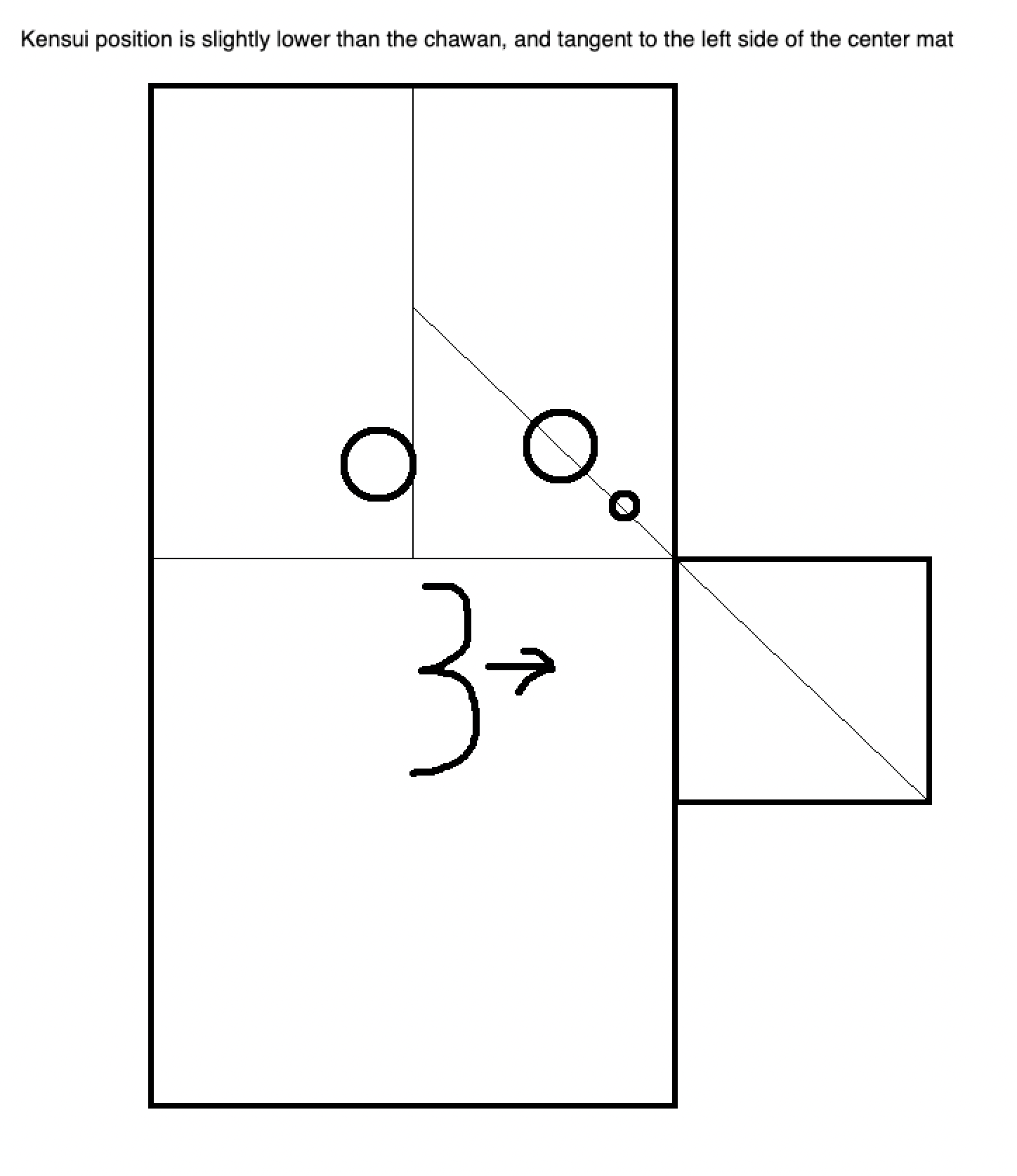
- Kensui position is
- First, directly against body as usual
- Then, left of the half part of tatami (put it low), then below the chawan (can’t be as high)
- Then, exactly where it usually goes for ro during temae. This lets you put the hishaku parallel to your imai when you close.
- NOTE: HE PUTS KENSUI AT 9 MEI from the wall instead of 5 mei. This leaves more space for the hishaku
- chawan and natsume position are exactly as along the diagonal created by the two square of the ro
- At the end, hishaku should be parallel to kattetsuki (versus pointing to the center of the tatami. maybe these are the same?)
- You do make sound here, but because the futaoki is so close to the mizusashi, it’s hard to make a lot of sound (there’s not much room behind the futaoki to “stage” the hishaku go).
- Bondate
- Suzuki-sensei’s position for chawan karioki is different than kanazawa sensei. He puts it in the same spot (above knee line, against wall), but he holds the chawan more gingerly instead of yoko, and tries to put the chawan as close to the wall as possible
- Chasen “kensui no kata” position is really to the right of the kensui, not above
- If you put the hishaku on the kensui, the chasen ends up below the hishaku go, not above or pointed toward it
- In karamono, you take karamono from mizusashi shomen then turn. In bondate, you turn, then take karamono from imai. This is because it is more precious - you can’t move with the chaire in bondate.
- This is the highest temae you can use raku, so go hard and use a chojiro piece etc (repeat from seminar)
- yes, pinky under karamono while doing doubuki is good
- also repeat of seminar: taking magemono mizusashi lid
- When you first take it off the mizusashi, you have no choice but to take it shallowly from just the lip
- but when you place it DOWN (with L here, or with R in furo), you should be holding deeply, with your fingers fully inside the rim. also for when you take it up.
- Keep the karamono completely fixed in space, above the L side of the chawan, when putting down lid / picking up chashaku / etc
- if you put the kensui at 9mei away from the wall instead of 5, you have more room to put the chawan at the end and have it be in the correct spot (tangent to the knee line)